




















Tracking The Grey Ghosts
Ladakh launches India’s first high-altitude snow leopard safari, opening a new frontier for wildlife and adventure tourism.

By Deepali Nandwani
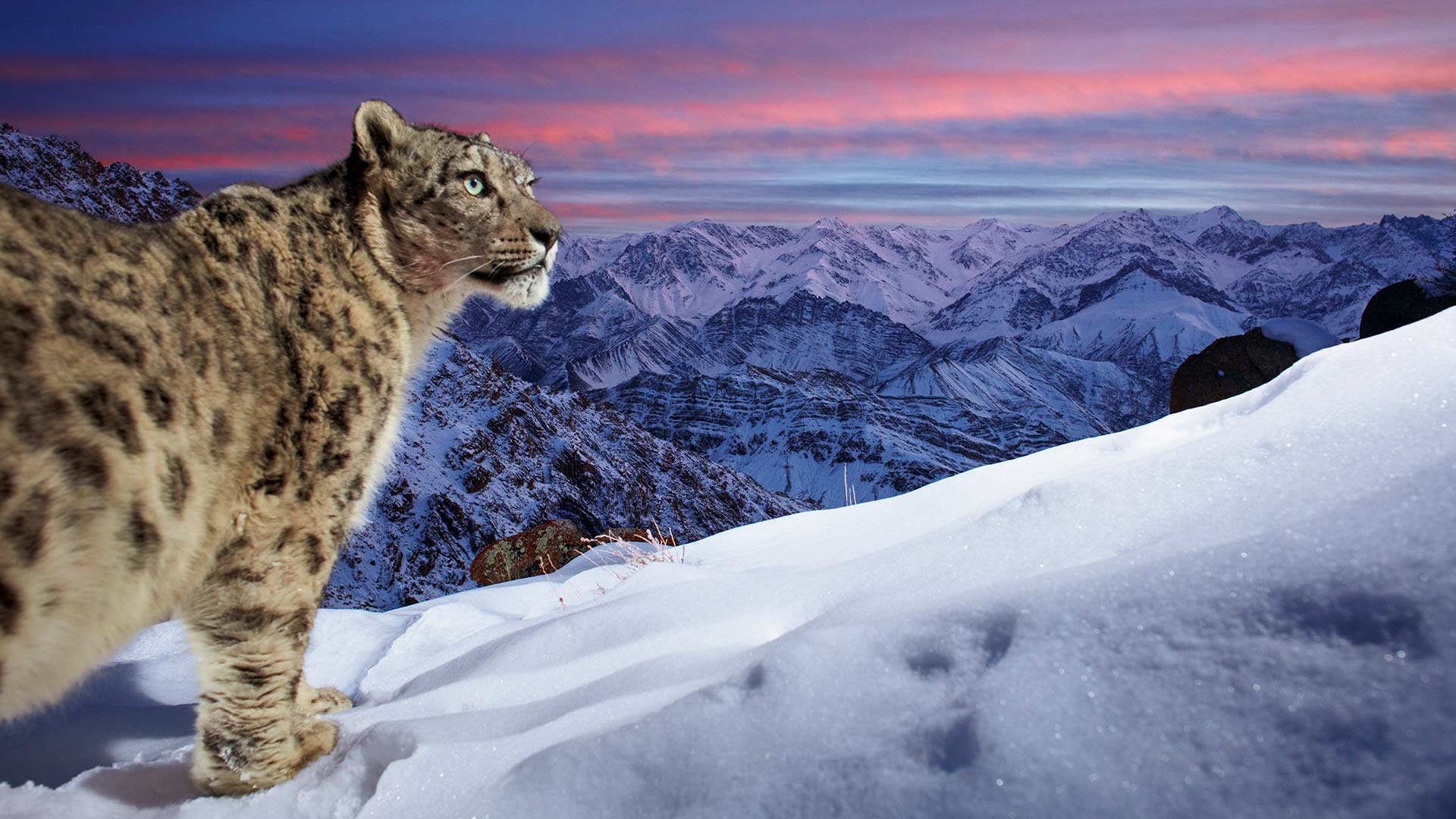
In Ladakh’s high-altitude cold desert, in the rain shadow of the Great Himalaya and wedged between the Zanskar Range to the south and the Ladakh and Karakoram ranges to the north, the snow leopard reigns as the apex predator.
And it is holding its own, a conservation story rarely told in Indian wildlife circles, where the tiger still dominates. That is slowly changing, as Ladakh puts the elusive cat, and the region’s other equally beautiful wildlife, at the core of not just its conservation policy but also its tourism.
Ladakh’s Lieutenant Governor, Vinai Kumar Saxena, has now launched India’s first high-altitude snow leopard wildlife safari. Conducted by the Snow Leopard and High-Altitude Nature Conservation (SHAN) Society in collaboration with the Department of Forest, Ecology and Environment, UT Ladakh, the safari will take travellers into areas where snow leopards are frequently sighted. Local youth are being trained to lead safaris and track the cats, often called the ‘ghosts of the mountains’. Leading safaris through Ladakh’s valleys is no easy task.
What it means for Ladakh’s tourism
Ladakh received over 4,60,000 tourists till September 2026, over 35% higher than the total tourist footfall in 2025. In September alone, domestic arrivals rose from 29,888 to 49,188 year on year, while foreign arrivals increased from 4,722 to 6,394. Saxena attributes the growth to improved connectivity, events such as Ladakh Bike Week and the Ladakh Marathon, and recent initiatives including the high-altitude Lilium flower fields and the newly launched wildlife safari.
The ghosts of the mountains
Snow leopards favour broken, steep and rocky terrain, typically between 3,200 and 5,000mts., cliff faces, ridgelines, narrow side gorges (locally called nullahs) and long scree slopes of loose, fan-shaped rubble beneath the cliffs. This terrain offers them cover to stalk and ledges to rest and watch from. They move along ridgetops and valley bottoms like corridors, leaving scrapes and scent-sprays on overhanging boulders.
Looking for a snow leopard is among the most forlorn of all quests. The chances of actually catching even the slightest glimpse of the grey-coated cat, especially in a short period, are slim. Its reclusive nature, vertical habitat, and the speed and dexterity with which it disappears stack the odds against a sighting. Yet, tracking this strikingly beautiful cat through its high-altitude terrain is perhaps one of the biggest adventures for any traveller, bringing together the thrill of the chase and wildlife in one package.
The snow leopard inhabits the high mountains of Central Asia, in fragmented populations scattered across 12 countries. So elusive is the species that it is rarely sighted even by local communities, scientists and wildlife conservationists who actively track it. Accurate numbers are therefore hard to come by, with global population estimates varying widely, from 4,500 to 7,000 cats.
India’s official estimate is 718. The Snow Leopard Population Assessment in India (SPAI), conducted between 2019 and 2023 by the Wildlife Institute of India with the Nature Conservation Foundation, Mysuru, and WWF-India, estimates 477 in Ladakh, followed by Uttarakhand (124), Himachal Pradesh (51), Arunachal Pradesh (36), Sikkim (21) and J&K (9).
Tar village offers some of Ladakh’s closest snow leopard sightings, thanks to its bowl-like shape. When a snow leopard chases its prey downhill, the pursuit can bring the cat right to the village edge.
Beyond the snow leopard, Ladakh's high-altitude wildlife includes bharal, Asiatic ibex and Ladakh urial, as well as the Tibetan wolf, Eurasian lynx and Pallas's cat.
For now, though, the safari will follow trails through Rumbak, Shang and Uley, where sightings are good, while routes have also been identified through Hemis National Park, Changthang and Karakoram Wildlife Sanctuary. It envisages a conservation model that puts local communities at the core of protecting Ladakh’s fragile ecosystem and wildlife.