












The Great Venue Hunt
As HICSA’s scale accelerates, the search for a venue reveals a larger truth: India’s hospitality ambition is outpacing the infrastructure built to host it.

By Manav Thadani
Twenty-one editions in, HICSA is no longer simply growing; it is surging.
The conference has welcomed over 600 participants annually for the past three to four years, with the last two editions each crossing the 750 mark. Sponsor participation has followed the same upward arc. Growth like this is something to celebrate for sure, but finding a room to put everyone in? That's a different story entirely.
Hosting a large-scale MICE event of global standards is not simply a matter of finding a big ballroom. The perfect venue requires a rare and uncompromising trifecta: a grand, expansive ballroom that doesn't make 750 hospitality professionals feel like they're attending a school assembly; a generous pre-function area that gives sponsors and exhibitors the space to shine rather than compete for elbow room; and a strong suite of breakout rooms which are large enough, numerous enough, and ideally not doubling as networking break venues. Conveniently located hotels would have to be there too, because no one wants a 45-minute commute between sessions and their morning coffee.
Now, convention centres that tick some of these boxes with magnificent, sprawling spaces built for exactly this kind of scale do exist. The catch? Most of them sit entirely on their own, with rarely a hotel in sight. And so, as much as we'd love to think outside the box, we remain firmly, inescapably inside the hotel.
India has seen an impressive wave of large convention centre development in recent years, yet a persistent gap remains. When developers build, the instinct is often to auction adjacent land to the highest bidder without fully accounting for the long-term value that an attached hotel would bring, in terms of the venue's usability and the economics of hospitality at scale. The cost of development has to make sense for hotel developers too. The result is a constellation of world-class spaces—Yashobhoomi (India International Convention & Expo Centre), Bharat Mandapam, Jio World Centre, Bengaluru International Exhibition Centre—that are spectacular in scale but arrive without a room to sleep in.
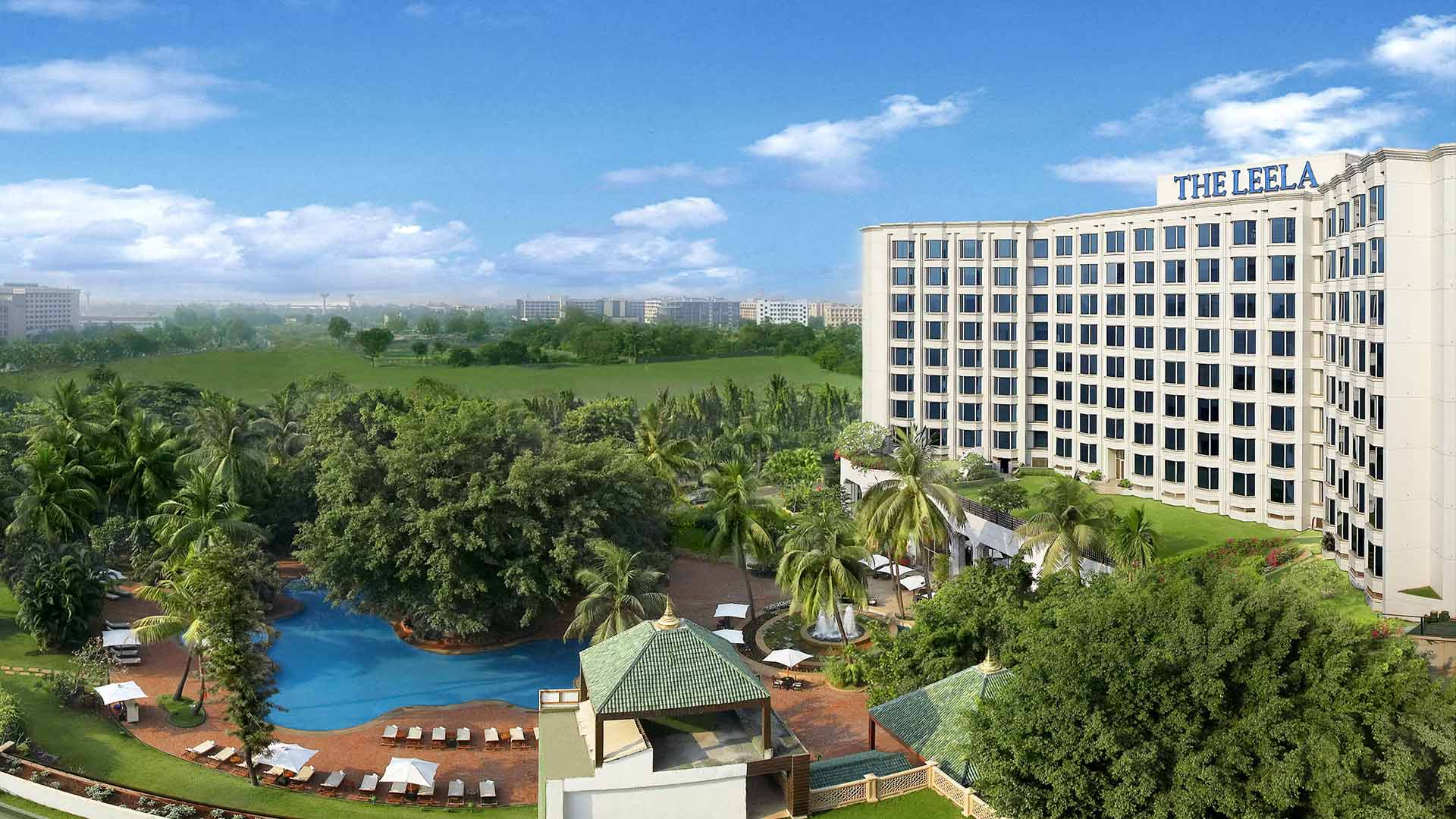
Which brings us to the uncomfortable truth: when you stack up every criterion, the capacity, the pre-function space, the breakout rooms, and the connected accommodation, the list of venues in India that genuinely qualify becomes startlingly short. We're talking about Grand Hyatt Mumbai Hotel & Residences, Taj Palace, New Delhi, ITC Grand Chola, Chennai, Grand Hyatt Kochi Bolgatty, JW Marriott Bengaluru Prestige Golfshire Resort & Spa, and The Leela Ambience Gurugram Hotel & Residences—properties you can count on one hand. For a conference that has grown as boldly as HICSA, the venue shortlist has some serious catching up to do.
The irony is not lost on us. An industry that prides itself on building world-class experiences, on crafting spaces that inspire, impress, and endure, finds itself constrained by the very infrastructure it champions. HICSA will continue to grow; of that, there is little doubt. The question that now sits squarely on the table, perhaps most fittingly, at a conference attended by the very people who have the vision and the means to answer it: will India's hospitality landscape rise to meet that ambition?
The next great HICSA venue is waiting to be built. The industry need only decide to build it.
—Manav Thadani is the Founder-Chairman of Hotelivate, which also conceptualises, curates and manages HICSA