










Drawn to Stay
A Jaipur home becomes a living, immersive homestay, where heritage is redrawn around the guest experience.

By Rupali Sebastian
In a city where heritage is often framed at a distance—admired in façades, photographed in fragments—Lalluji Luxe turns that relationship inside out. Here, the haveli is not something you look at; it is something you inhabit.
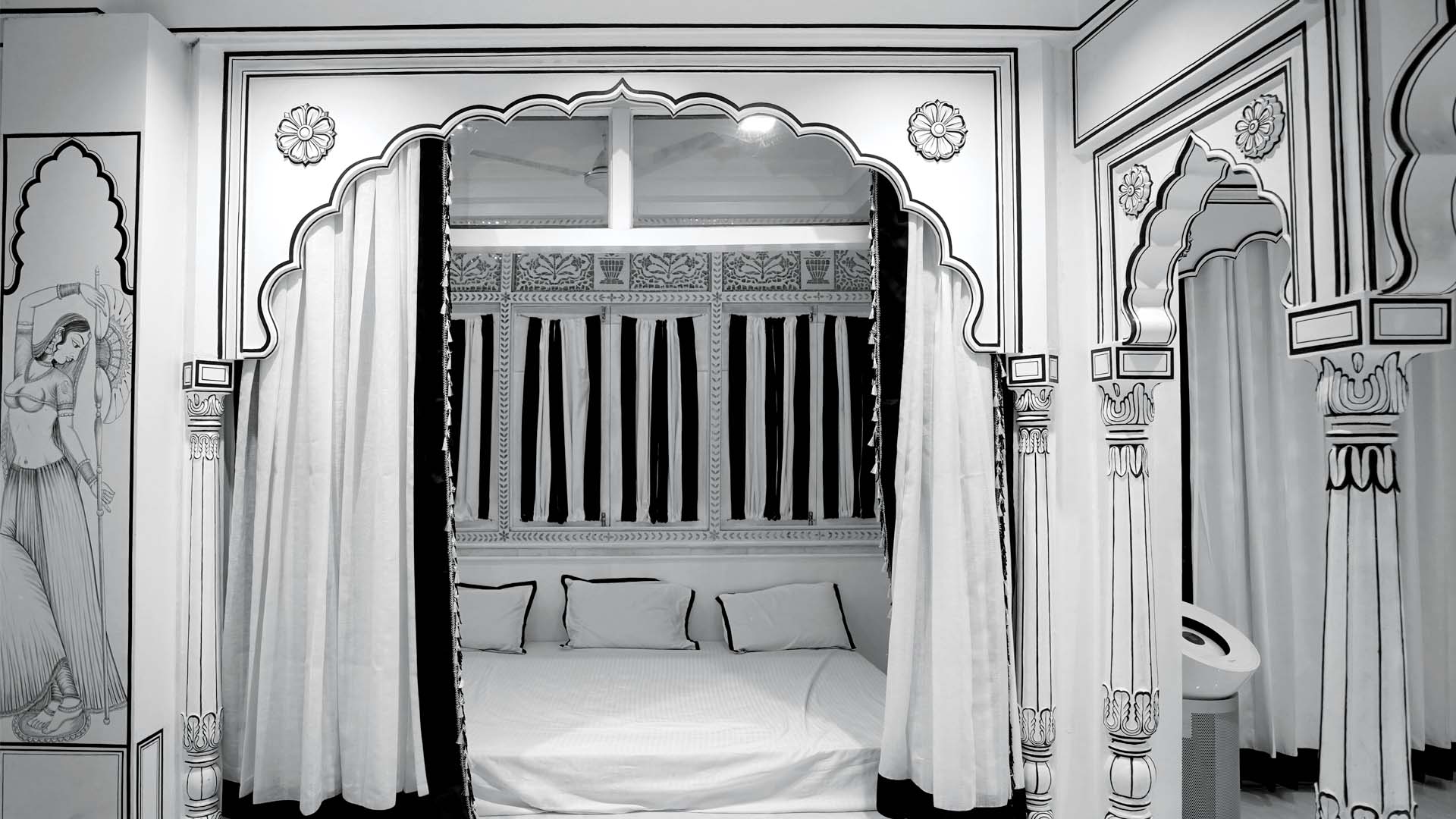
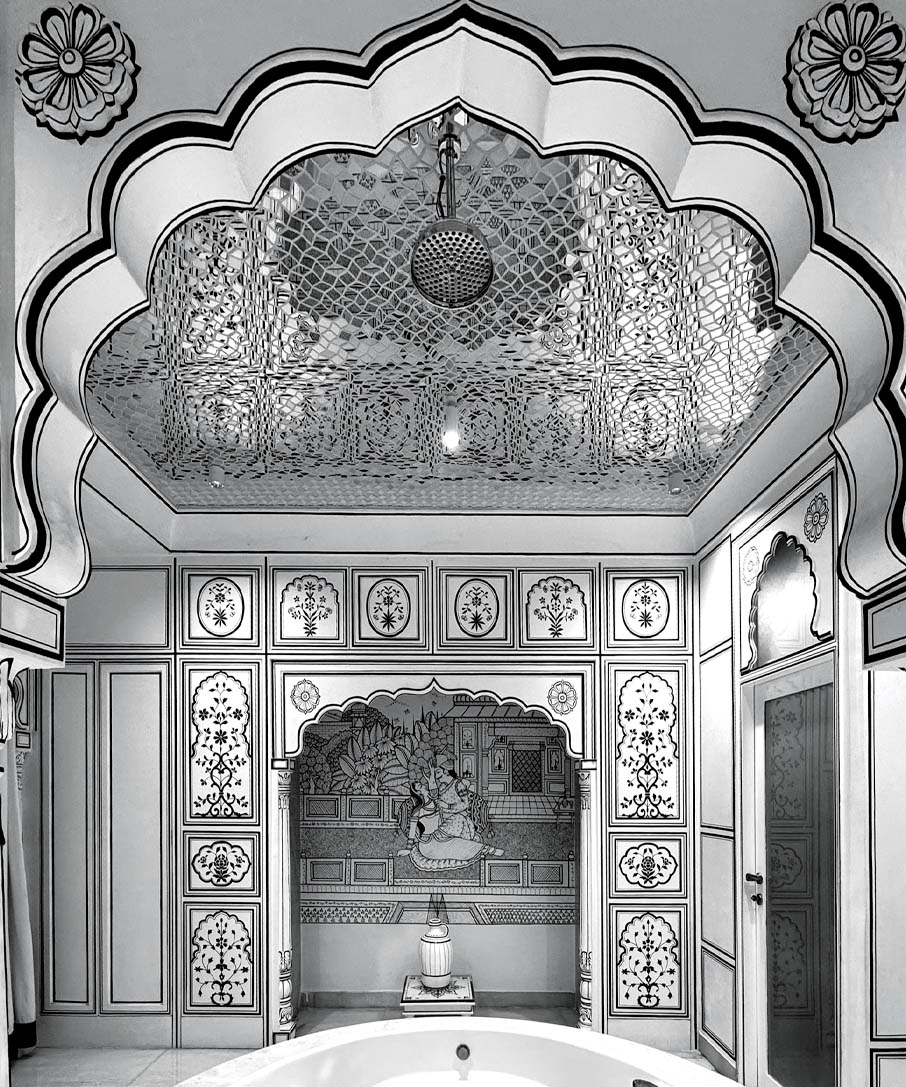
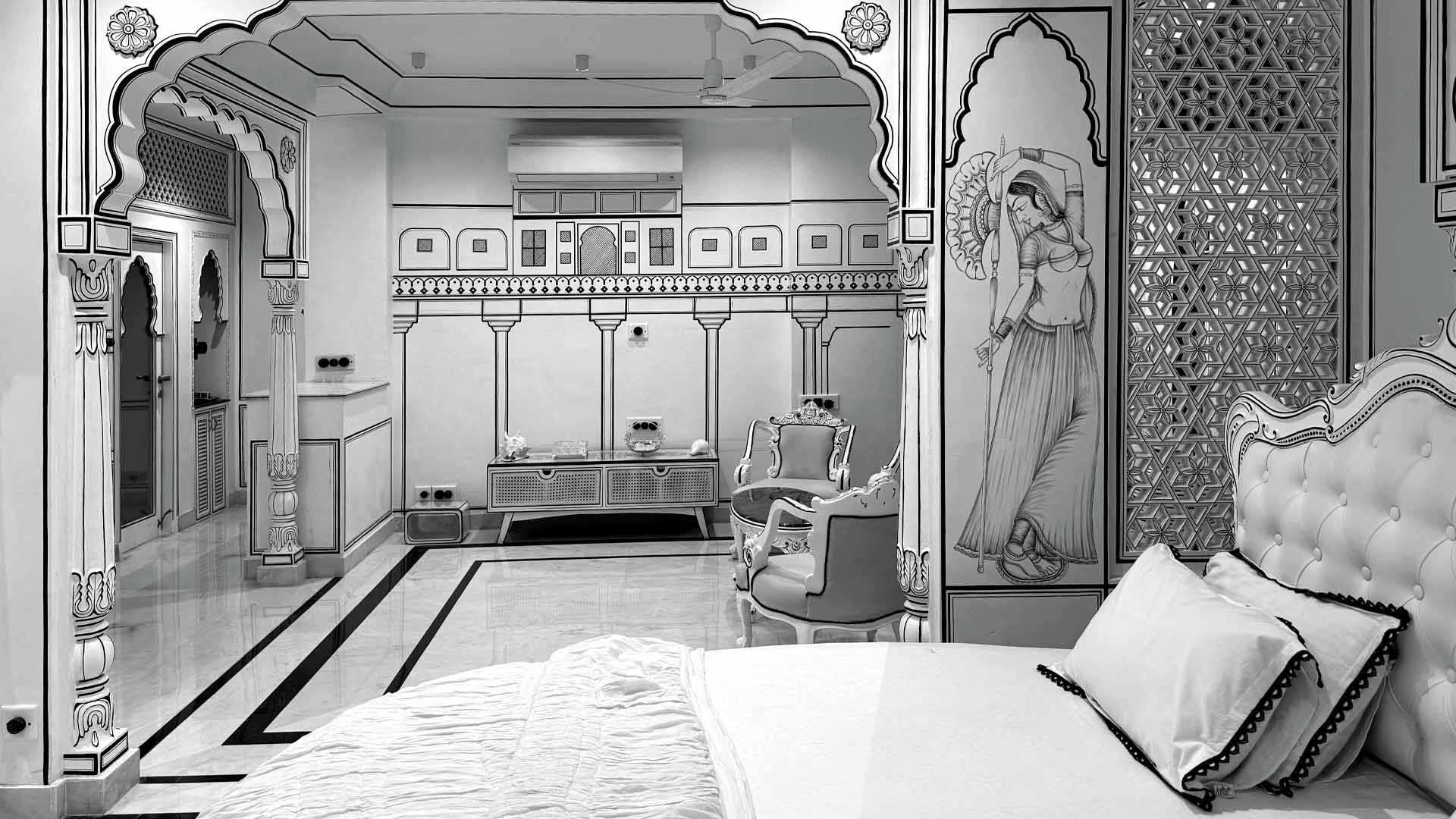
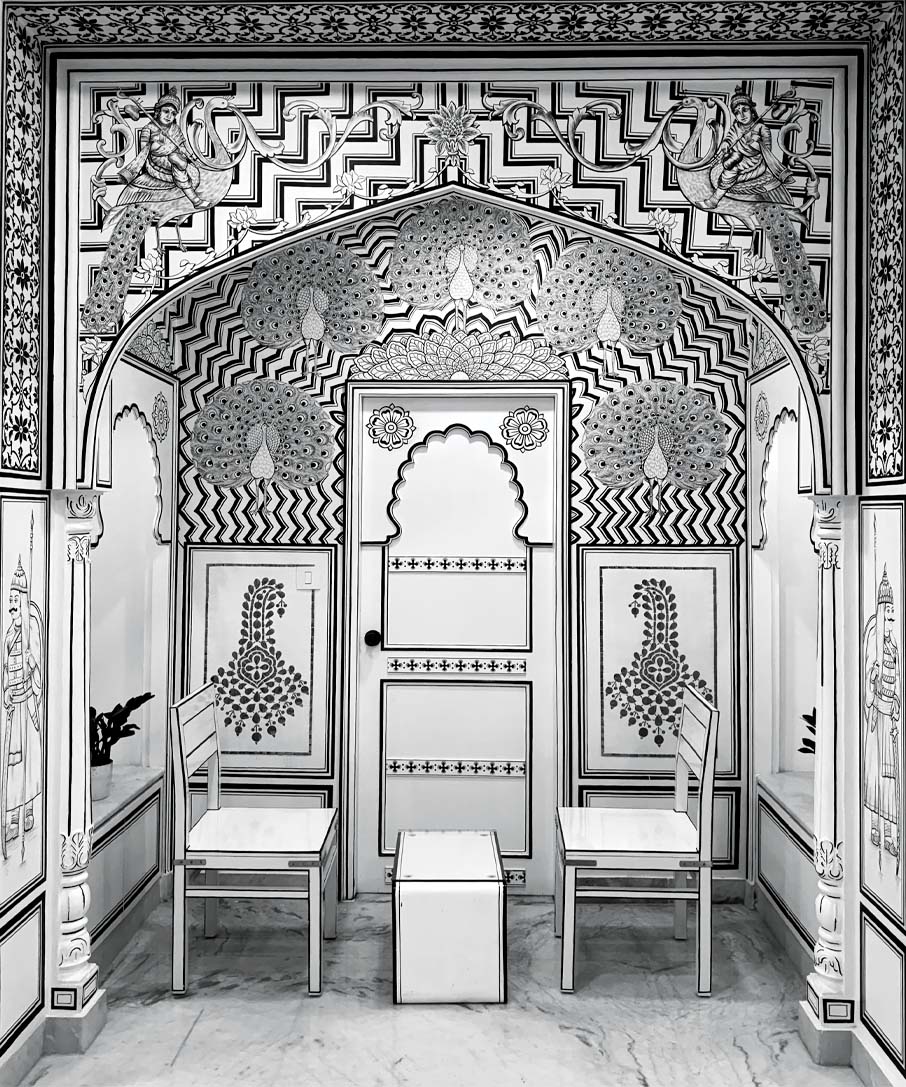
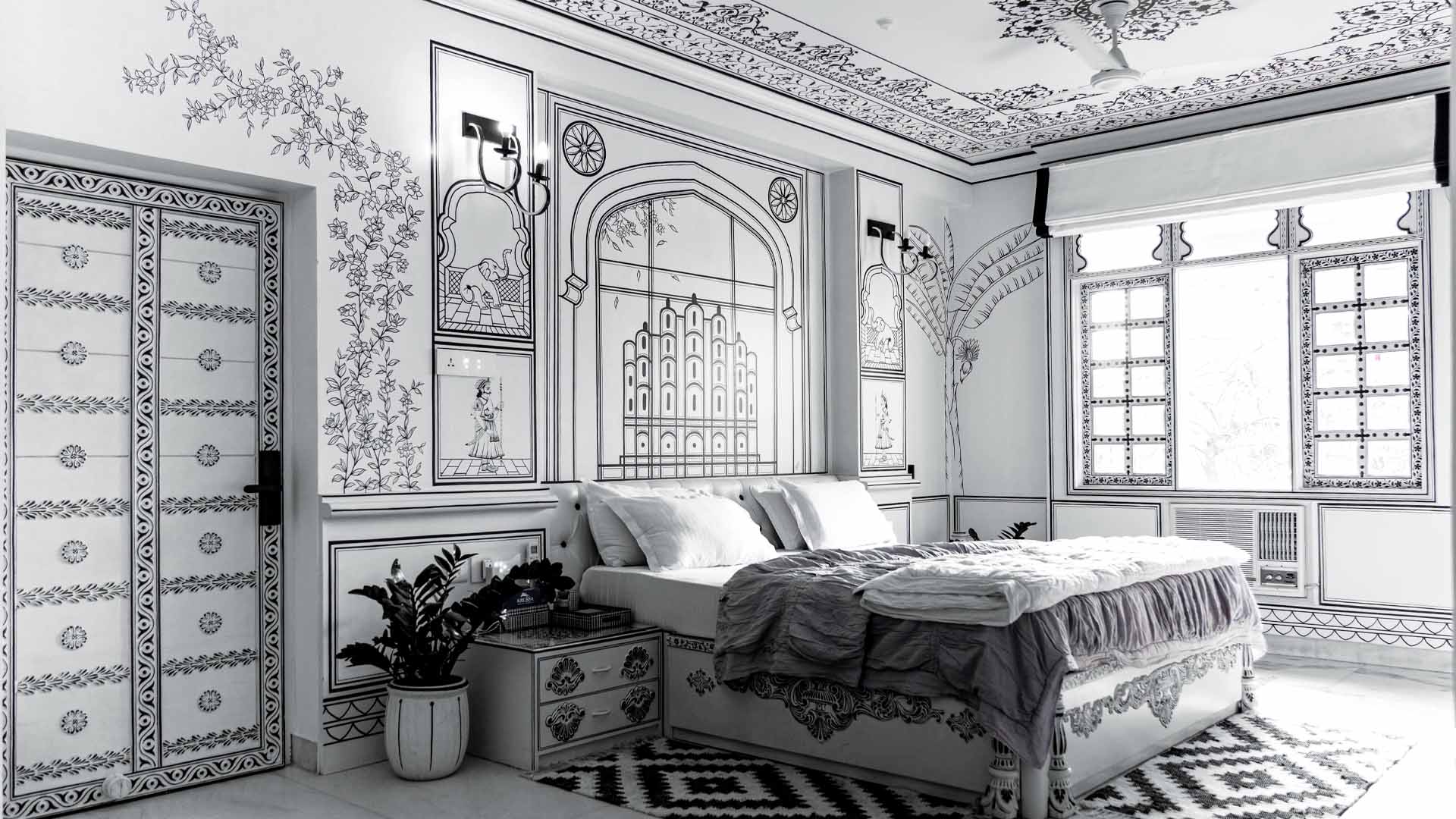
Set within Kapil Purohit’s own family home in Jaipur’s C-Scheme, the luxury homestay does not announce itself through scale or spectacle. Its provocation is quieter, more immersive. Every surface—walls, furniture, even objects—has been hand-painted in monochrome linework, collapsing depth into drawing. The result is a space that feels less built than sketched, as though architecture has momentarily stepped aside to let illustration take over.
But to read Lalluji Luxe purely as a visual experiment would be to miss its more personal beginnings. Conceived in part as a tribute to his father, the project emerged from a deeper discomfort around how Jaipur was being experienced. “People were only talking about the havelis, the palaces,” Purohit reflects. “But the guest—the person actually coming in, spending time, looking for a break—was missing from that conversation.”
The response was not to recreate heritage, but to reframe it around the guest. The idea of a two-dimensional haveli—drawn rather than built—emerged less as a stylistic flourish and more as a device. If visitors were to be central to the experience, the setting had to respond to them, not overshadow them. In photographs, in memory, even in movement, the guest becomes part of the composition, almost as though stepping into a sketch.
This conceptual pivot found its spatial language through Monika Sharma Design Studio, which translated the idea into a system rather than a motif. What appears effortless is tightly controlled—every line calibrated, every surface considered in relation to the next.
That shift—from object to experience—also meant confronting a pragmatic question early on: could such a concept sustain itself as hospitality?
“The biggest risk was that it might work visually, but fail as a living experience,” Purohit admits. A monochrome, hand-painted interior carries the danger of becoming overwhelming, even impractical over time. The instinct, especially for something rooted in personal memory, is to preserve. Hospitality, however, demands the opposite; it requires spaces to be used, inhabited, and altered.
“I had to shift my mindset from protecting a home to hosting experiences,” he says. “Now I see wear and tear as proof that the space is being experienced.”
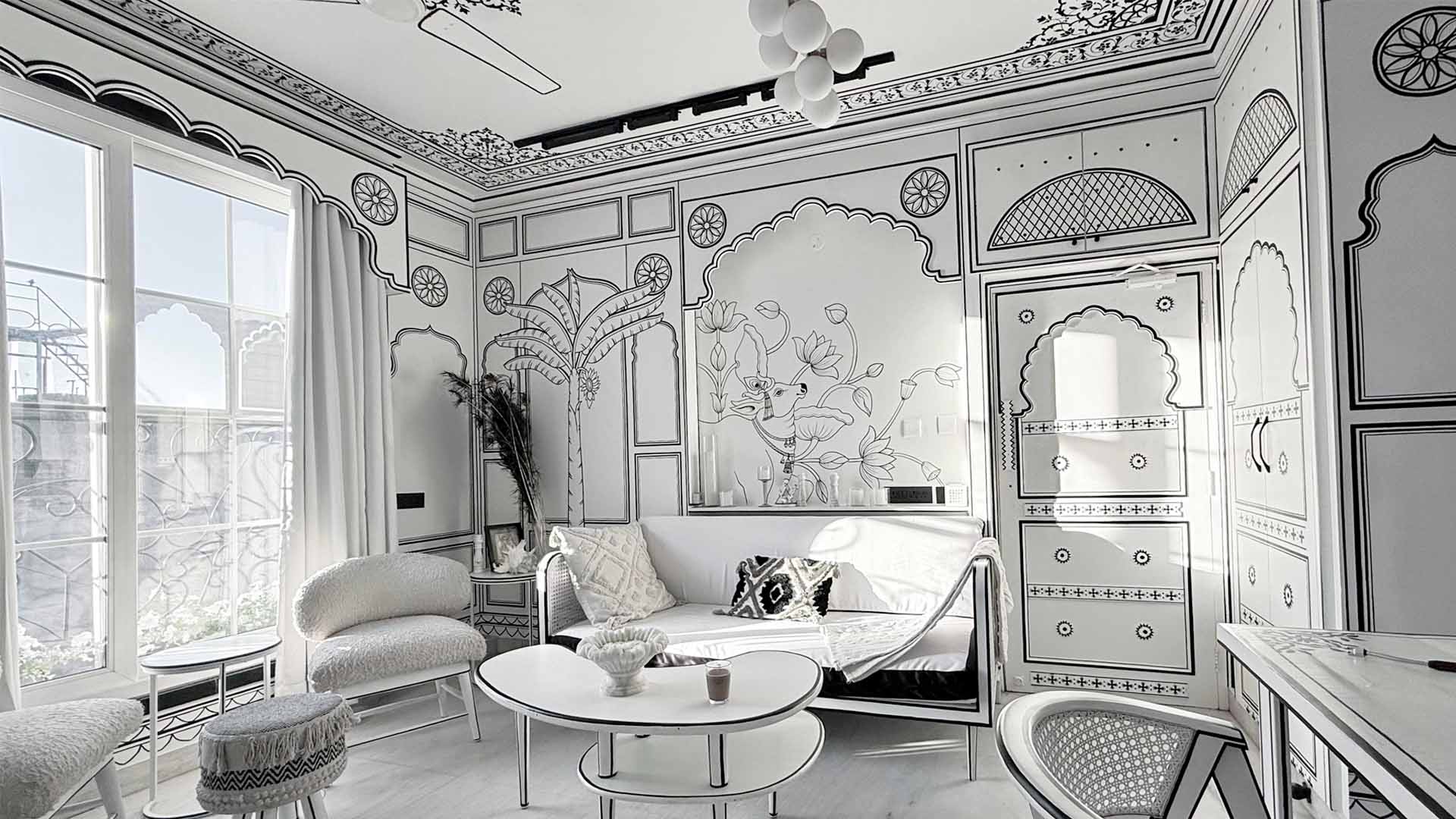
Lalluji Luxe, a luxury homestay where architecture dissolves into line.
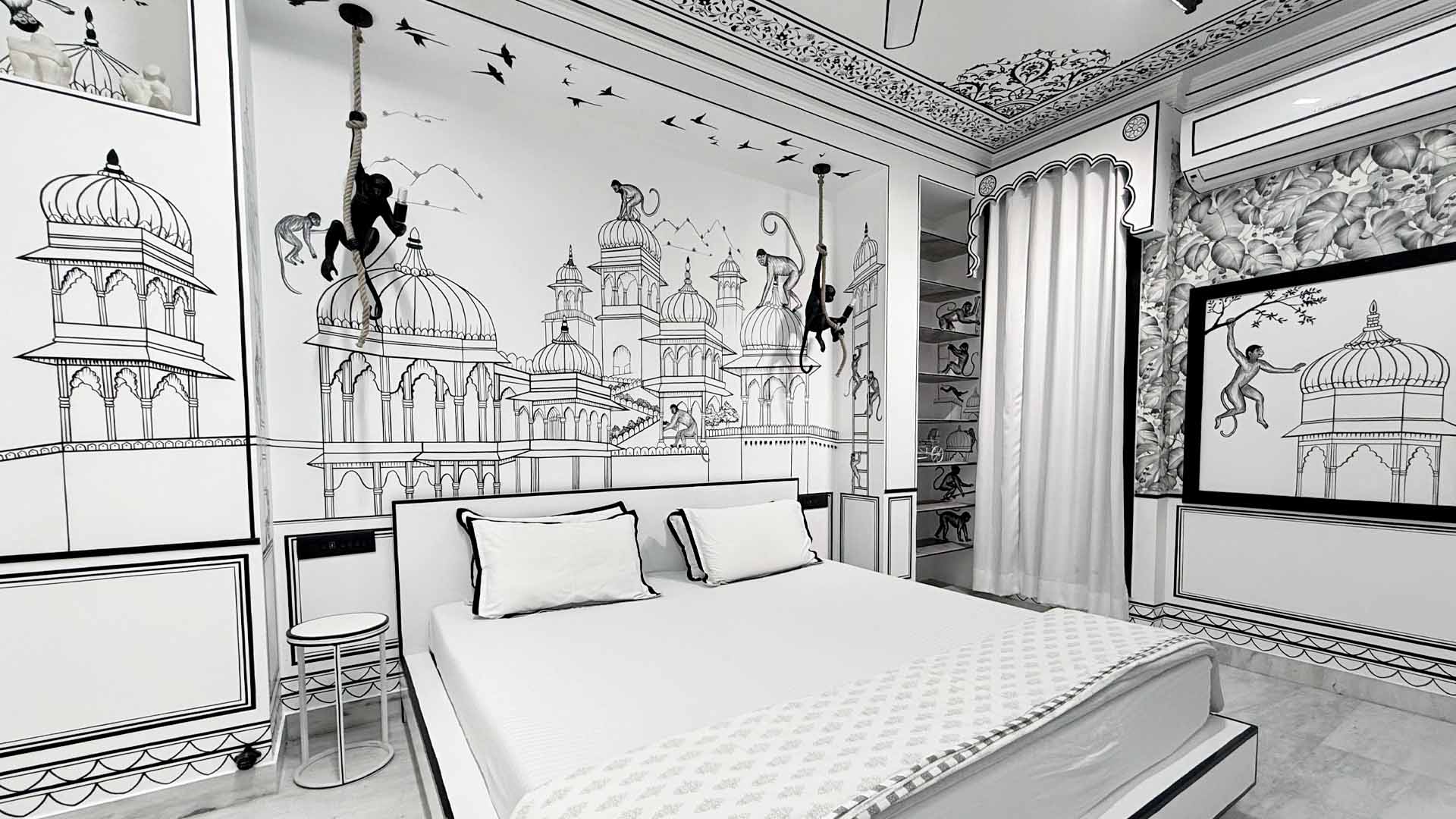
Lalluji Luxe, a luxury homestay where architecture dissolves into line.
That recalibration between emotion and operation runs through the project. The house, once private, now exists in a state of constant reinterpretation. Guests arrive, decode the illusion in their own way, interact with it sometimes playfully, sometimes tentatively. “Some treat it like an art installation rather than a home,” he notes, an early lesson that immersive design does not end at the visual. It must also guide behaviour.
For Sharma, the challenge was to ensure that the space never tipped into spectacle at the cost of comfort. “The intention was never to create an installation: it had to function as a home first,” she explains. High-use zones—beds, seating, circulation paths—were deliberately moderated, allowing ergonomics to ground the experience even as the visual language remained intact.
That language is built almost entirely through line. In the absence of colour, depth is suggested rather than stated. “Line weight and negative space became the most powerful tools,” Sharma says. “Even a slight variation can change how the eye reads the space.”
This becomes most evident in transitional moments—corners, junctions, thresholds—where the illusion is most vulnerable. Here, the project demanded an almost cartographic precision, mapping how lines travel across surfaces without breaking the visual field. The discipline is graphic, but the execution remains resolutely hand-done.
Lighting, too, is not incidental. It operates as a collaborator, shaping how the illusion holds across time. “Light can either enhance the depth or completely flatten it,” Sharma says. The choreography of intensity, direction and shadow ensures that the space retains its character through the day.
And yet, for all its control, the project resists becoming overly rigid. The hand remains visible—small variations, subtle irregularities—moments where craft surfaces through precision. It is a balance the studio chose consciously: not to eliminate imperfection, but to contain it.
The experience unfolds in two stages. The first is visual—immediate, almost theatrical. But it is the second that interests Sharma more. “A few minutes in, people stop looking at the design and start being in the space,” she says. It is in that transition that the project finds its footing.
If the design draws people in, it is something else that brings them back. Purohit is clear on this distinction. “Design creates the first impression. But hospitality builds the memory.”
That memory is constructed through details that sit in quiet contrast to the starkness of the visual language. The homestay layers in contemporary comforts—Kimerica toiletries, Maeka bio-dynamised water, Dyson air purification, and Alexa-enabled controls—ensuring the experience remains intuitive.
Equally, the hospitality remains deeply personal. Meals are home-curated, interactions are conversational, and the scale allows for a certain attentiveness that larger properties often struggle to maintain. It is here that the project quietly repositions itself—not as a novelty stay, but as a considered model of luxury homestay living.
Interestingly, Purohit does not see the concept itself as something to be replicated. The philosophy of experience-led, design-forward hospitality can travel. The form, he insists, should not. “Each space should have its own story,” he says. “The idea is not to copy Lalluji Luxe, but to evolve from it.”
Beyond the photographs, beyond the immediate cleverness of the illusion, it proposes a different way of thinking about heritage, not as something fixed in time, but as something that can be redrawn, quite literally, around the person experiencing it.
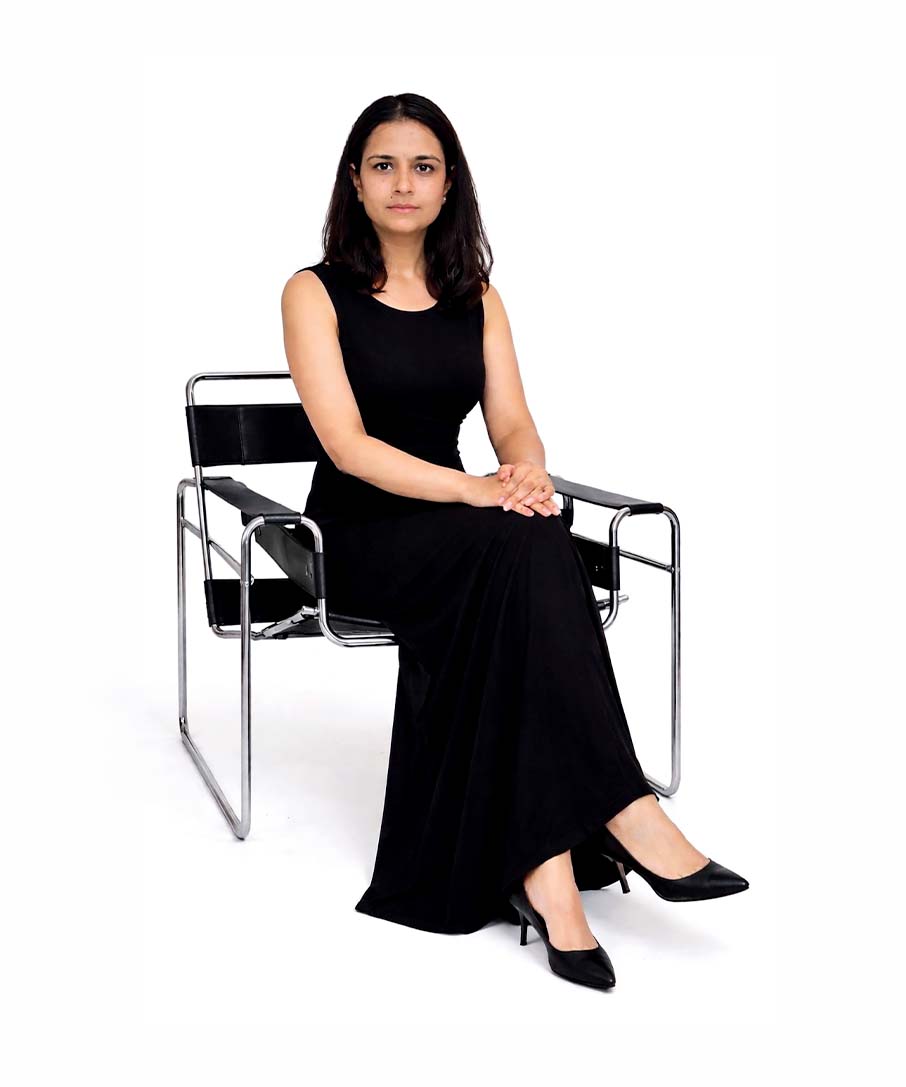
Monika Sharma, Founder, Monika Sharma Design Studio.
The Making of a 2D World
At Lalluji Luxe, the illusion of two dimensions is not a surface treatment—it is a carefully constructed visual language.
The idea began with a simple provocation: what if a haveli could be experienced as a sketch rather than a structure? From there, the process unfolded through trial, error, and iteration. Walls were painted, reassessed, repainted, and refined until the visual read felt precise.
Depth, paradoxically, is what makes the flatness convincing. Instead of a single line, the team developed a system of three—thin, medium, and bold—to create hierarchy and visual layering. Furniture, artefacts, even everyday objects were treated similarly, outlined so they appear embedded within the drawing.
Execution relied heavily on traditional craft. Local artisans, trained in miniature painting and Pichwai traditions, were brought in—each contributing according to their strengths.
Materials played a critical role. Lime plaster formed the base, while the black linework drew from a traditional preparation similar to kajal—natural carbon soot blended with castor oil and plant-based binders such as babul gum. In select areas, natural watercolours were also introduced, allowing for softer tonal variation while maintaining the overall monochrome discipline. This gave the lines their depth while anchoring the work in vernacular technique.
Crucially, restraint was key. “If the walls became too busy, the experience could feel overwhelming,” says Kapil Purohit, owner of Lalluji Luxe. Each surface was calibrated to hold detail without tipping into excess.
The result is not just an aesthetic, but a method—one that turns drawing into space, and space into experience.
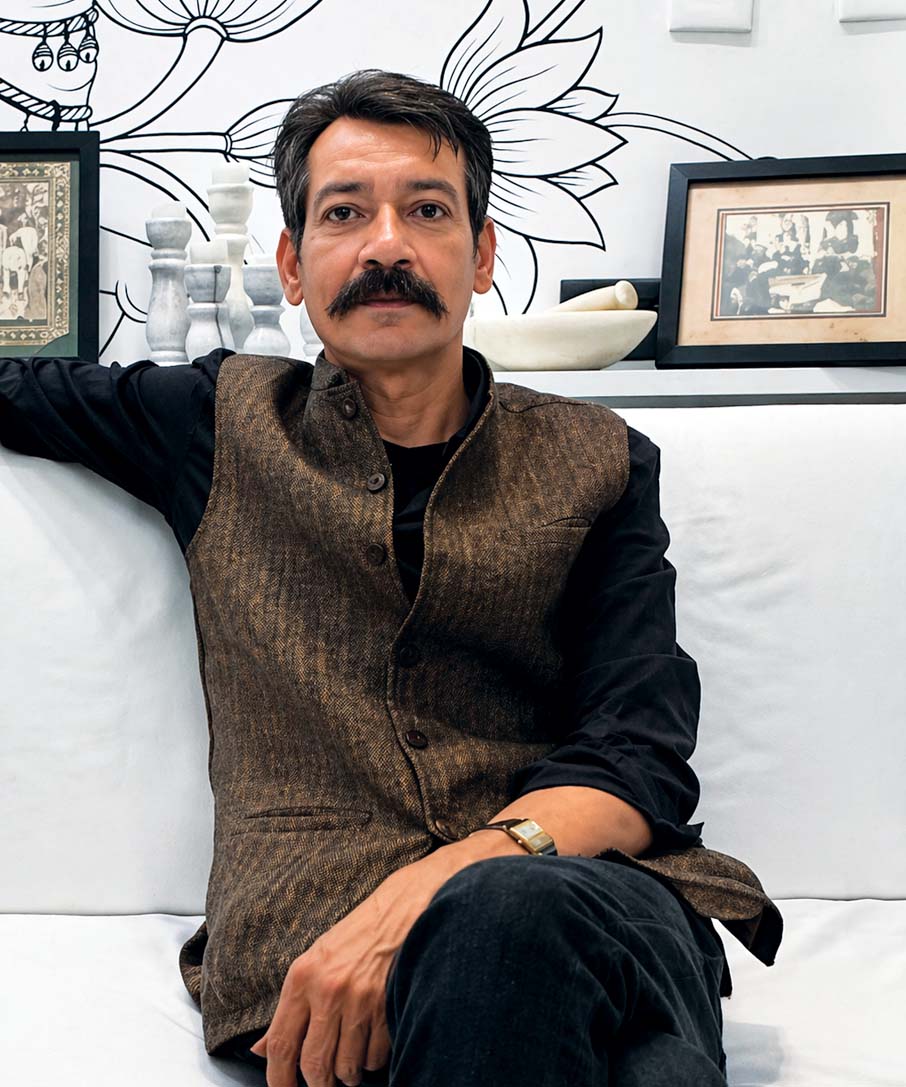
Kapil Purohit, Owner of Lalluji Luxe.