










The Leela At 40
Forty years after Captain C.P.K. Nair opened the first Leela in Mumbai, The Leela Palaces, Hotels and Resorts has a fragrance, a celebratory album with sarod maestros Amaan and Ayaan Ali Bangash, award-winning restaurants, a wellness philosophy, a private members’ club, and a speakeasy on Asia's 50 Best Bars list. Inside a luxury hospitality brand’s reinvention as a lifestyle house under Brookfield Asset Management.

By Deepali Nandwani
Think of a luxury hotel that represents the best of Indian artisanal craftsmanship. Not a contemporary one, where an embellished wall or a hand-painted fresco is a design flourish added as an afterthought, but one in which handmade craft and Indian design is a philosophy tied to the land it belongs to.
Think of one steeped in India’s past and its present: where antiques rest nonchalantly against Thikri walls, modern Indian art shares wall space with hand-painted frescoes, and experimental cocktail bars stand cheek-by-jowl with restaurants serving classic Indian food. A bit like India itself, with a soul that is quintessentially desi, in an avatar that is global.
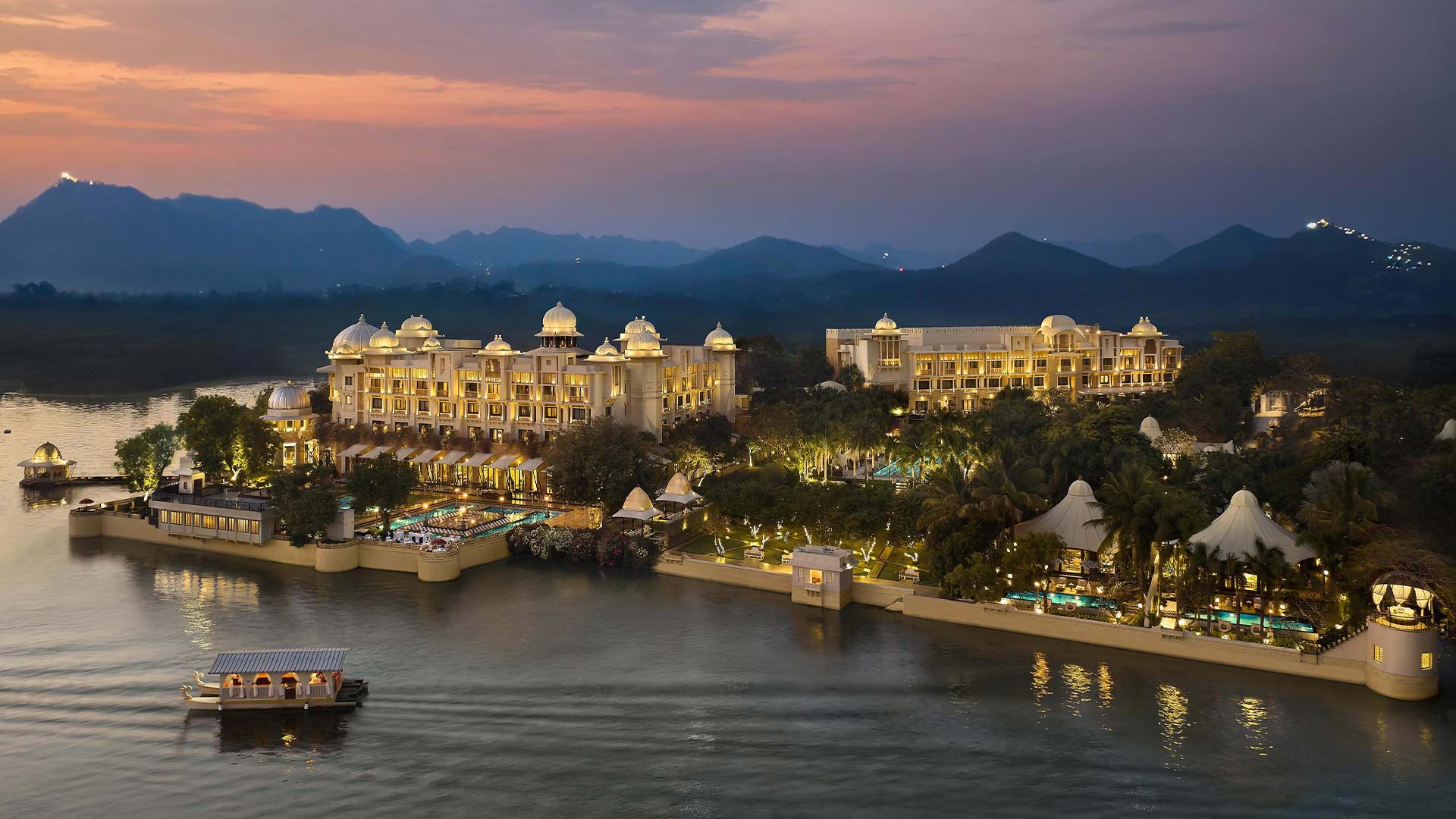
Some evenings stay with you long after the meal is forgotten. Mine was at Sheesh Mahal, The Leela Palace Udaipur’s signature restaurant, at a table separated from Lake Pichola by a low latticed wall. Before dinner, a liveried server poured rose-scented water from a long-necked jug over my hands into a silver bowl of petals. At the end, he tied a red thread around my wrist for luck. None of it was on the menu.
The Leela Palaces, Hotels and Resorts is building a lifestyle brand rooted in design, ideas and gestures like these. Its lobbies now play A Living Raga, fourteen compositions written for its 40th year by sarod maestros Amaan and Ayaan Ali Bangash. Tishya, its signature fragrance, draws on the lotus and the Neelakurinji, a flower that blooms once in 12 years. At dusk, mashaals are lit to Carnatic music at The Leela Palace Chennai, and diyas to Kalbelia dancers at The Leela Palace Udaipur. The picture is of a hospitality brand reinventing itself as a lifestyle house under Brookfield, which acquired it in 2019.
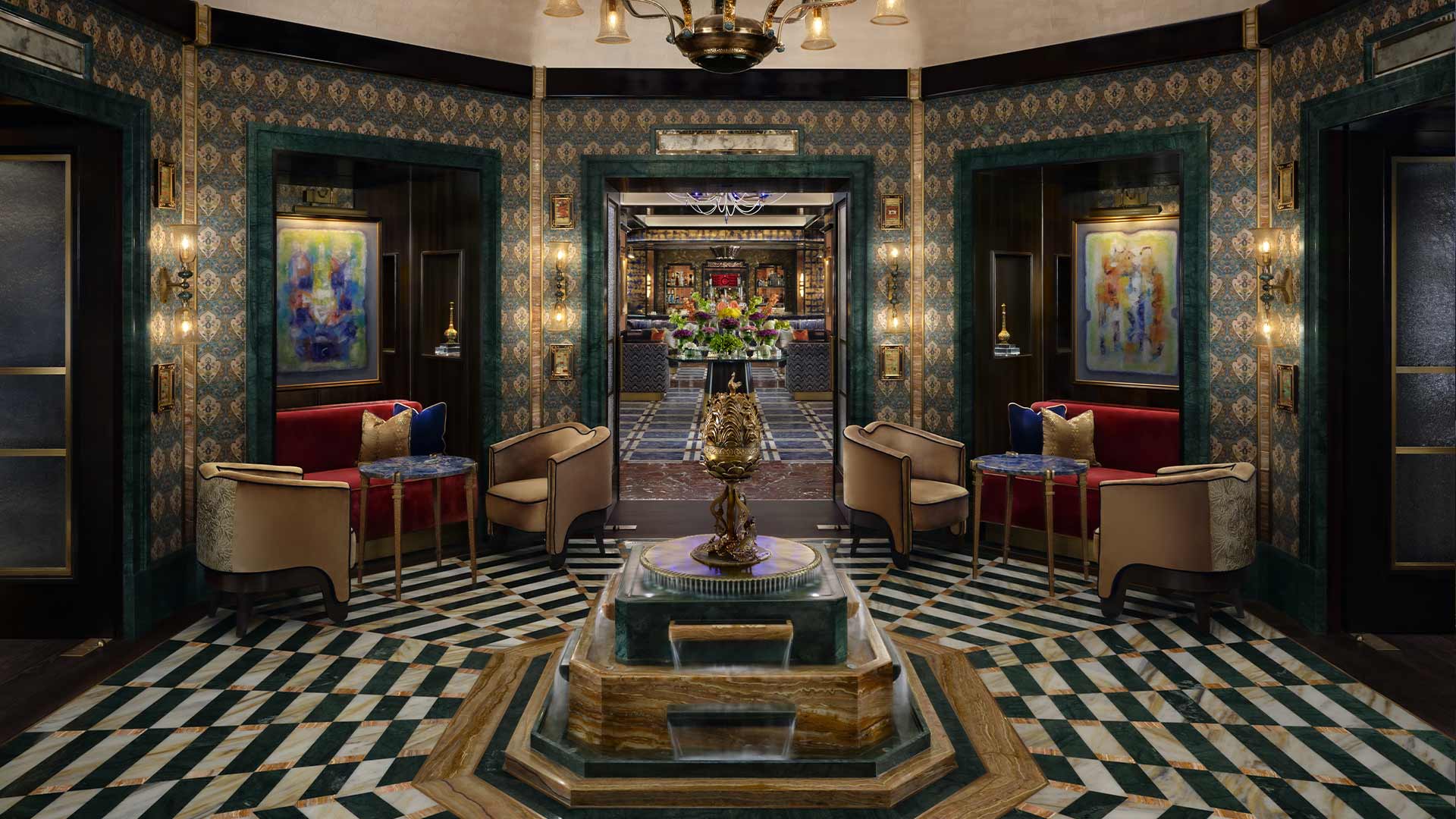
Arq By The Leela’s vestibule sets a richly Indian tone.
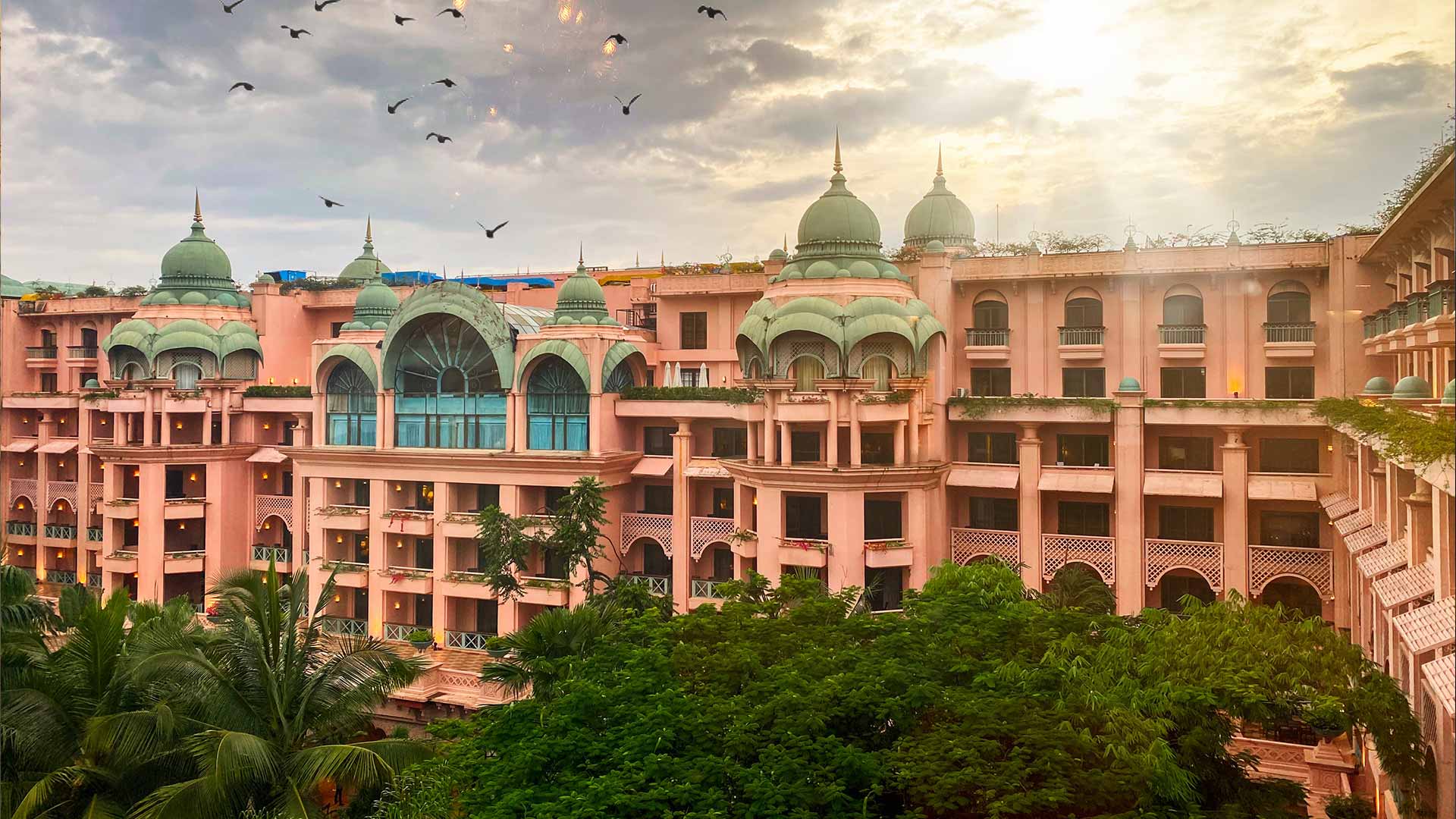
The Leela Palace Bengaluru reflects Mysore’s royal grandeur.
The soul of The Leela
How do you define the soul of a hospitality group that spans so many lifestyle products, each drawing on the best of India? Its dining destinations, some built on global collaborations, are patronised as much by non-residents as by guests. Its wellness philosophy goes beyond the spa, extending to spaces, cuisine and the very approach to healing. Its private members’ clubs are more than networking spaces; they are cultural centres with luxury flourishes: rare whiskies, a great coffee programme, chefs who offer bespoke meals with provenance, and literary and cultural evenings. And its resplendent leisure hotels are design hotbeds, resonant with centuries of Indian luxury markers, from service to identity.
For The Leela, luxury begins with how a guest feels, a point its leadership returns to often. “For us, luxury is not simply a question of scale or splendour. It is about creating a feeling, of being welcomed, understood and connected to a place in a way that feels meaningful and memorable,” says Anjali Mehra, Executive Vice President, Brand and Communications, The Leela Palaces, Hotels and Resorts.
Ask her how she introduces The Leela to someone who has never stayed there, and she begins with the founder. “When Captain C. P. Krishnan Nair founded The Leela in 1986, his ambition was not simply to build a luxury hotel, but to present the finest expression of Indian luxury to the world. Forty years later, that ambition remains our compass.”
The brand calls its philosophy ʻTrue Indian Luxuryʼ, and Mehra wants the phrase read as more than a slogan. “I often think of ʻTrue Indian Luxuryʼ as a point of view rather than a tagline.” Indian heritage, in her view, can define a distinct expression of luxury, holding its own against the highest global standards.
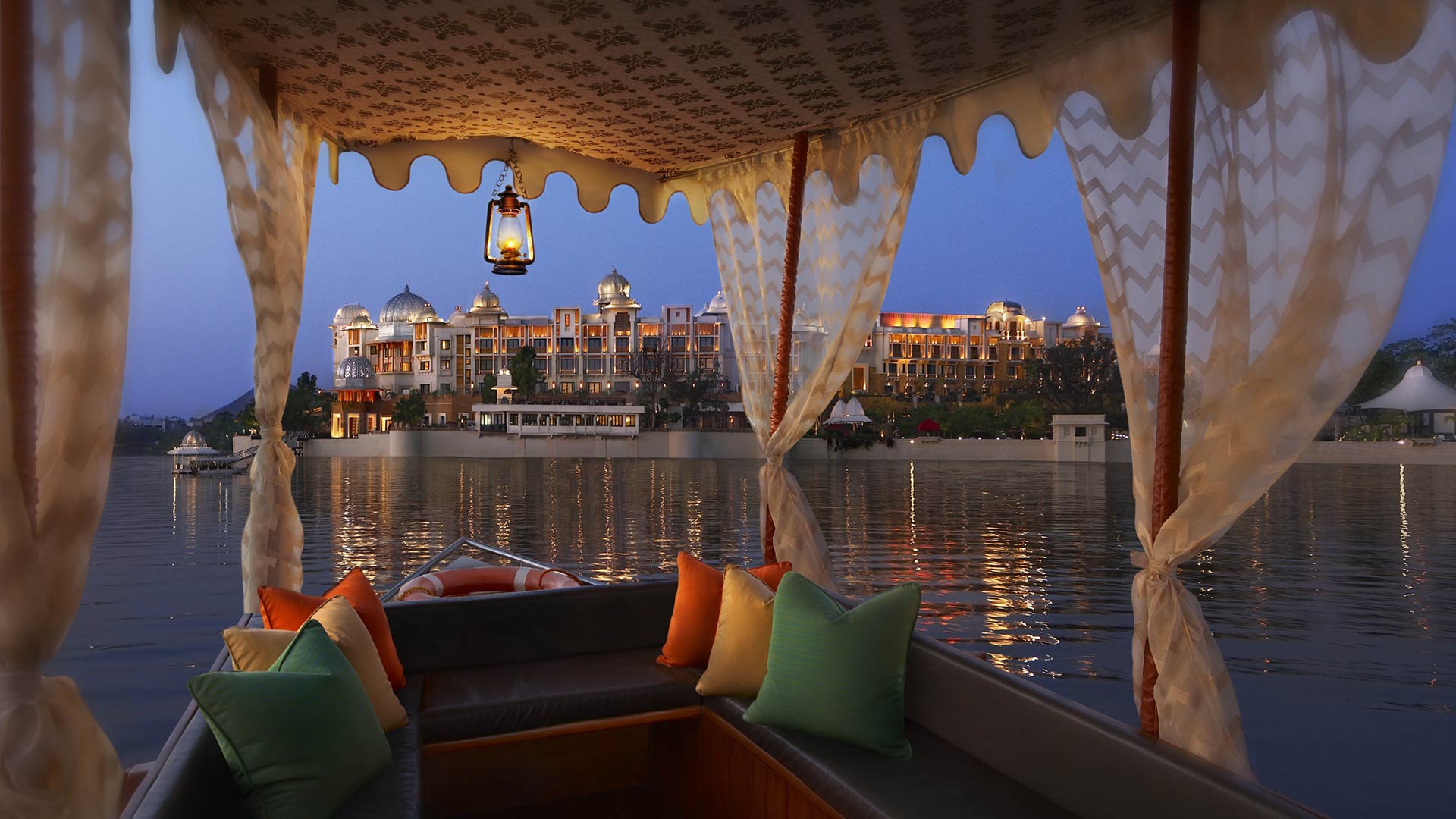
Boat rides on Lake Pichola offer another perspective on The Leela Palace Udaipur.
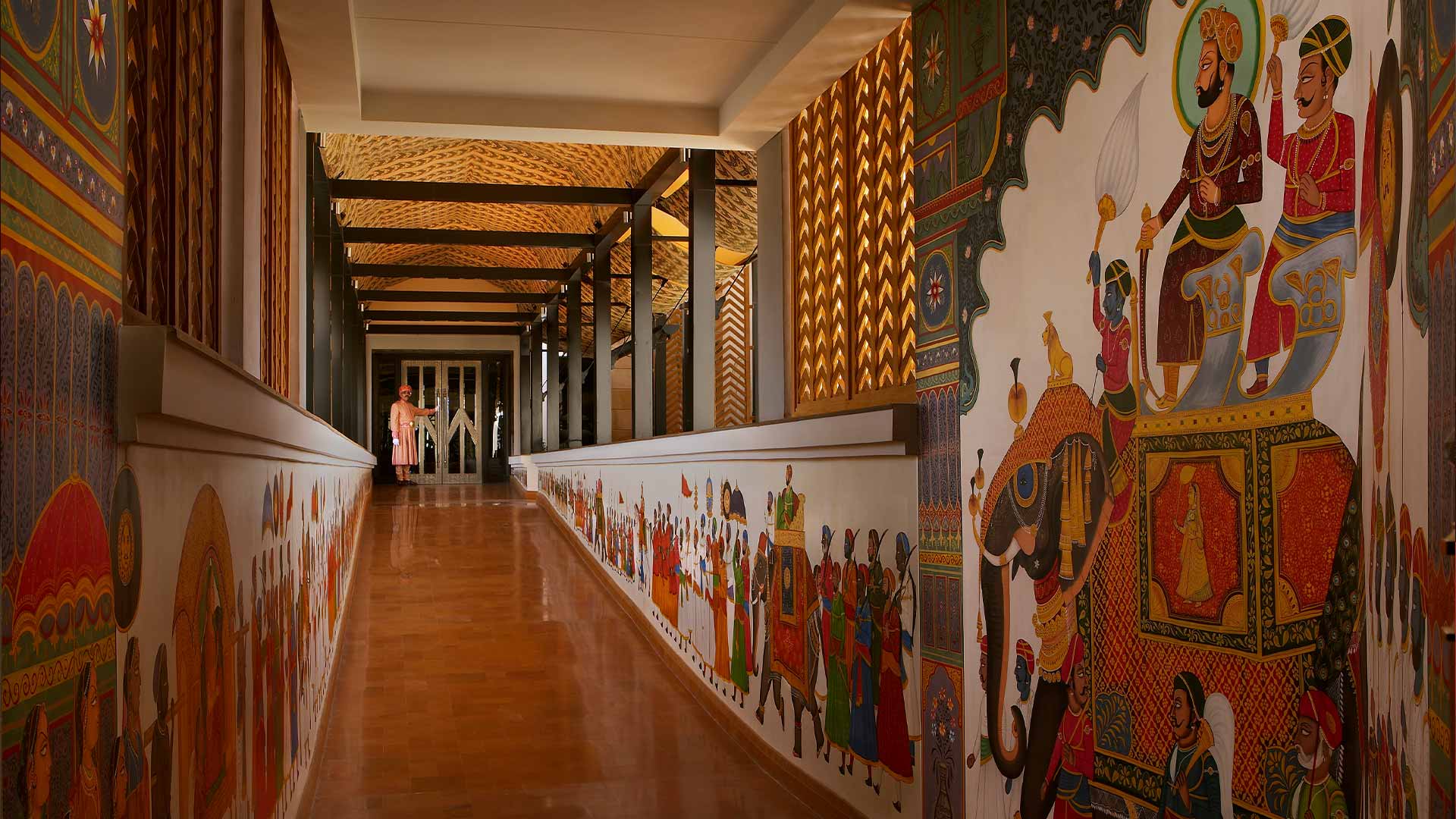
The connecting bridge at The Leela Palace Udaipur celebrates Mewar’s architectural heritage.
“Our ambition is to build a portfolio of exceptional properties, not simply to maximise the number of destinations in which we operate. We will measure the success of our expansion not just by where The Leela Palaces, Hotels and Resorts is present, but by the strength of the position we build in each market and the long-term value those properties create.”
Anuraag Bhatnagar
Whole-Time Director and Chief Executive Officer, The Leela Palaces, Hotels and Resorts

In practice, India shows up across The Leela hotels and resorts in architecture and craftsmanship, art and cuisine, and rituals of welcome. “Each property has its own character, shaped by its destination, yet there is a common sensibility that connects them all.”
At The Leela Palace New Delhi, that connecting thread hangs on the walls. The art collection includes works by Satish Gujral, Paresh Maity, Jayasri Burman and Seema Kohli, alongside revived crafts such as Bidri metalwork from Bidar, and inlay and miniature painting. Sculptor Satish Gupta’s lotus works, including The Golden Lotus and Let a Thousand Lotuses Bloom, recur through the palace, and the flower has become part of the property’s visual identity.
The hotel, of course, stays at the centre of the brand. What has changed is how far The Leela reaches beyond the room. “For me, the distinction is between being a place where people stay and being a brand they choose to interact with, return to and build a relationship with,” says Mehra. “Hospitality remains at the heart of The Leela, but the world of luxury today extends well beyond the hotel stay. People seek distinctive dining experiences, meaningful cultural encounters, wellbeing, design and destination discoveries that reflect their interests and aspirations.”
Numbers support the claim. In FY’26, non-resident guests accounted for 54% of covers at The Leela’s city hotels, up from 51% a year earlier. Anyone booking a table at ZLB23 or The Azulian House in Bengaluru, or at Megu in New Delhi, engages with The Leela without checking in.
Other extensions take that Indian approach to luxury further. Arq By The Leela, a members-only club with a contemporary Indian design palette and a cultural programme that puts art and books at the forefront, opened in Bengaluru, followed by New Delhi, with Chennai due in November. Aujasya by The Leela takes the brand’s wellness philosophy beyond the space and into the wider stay.
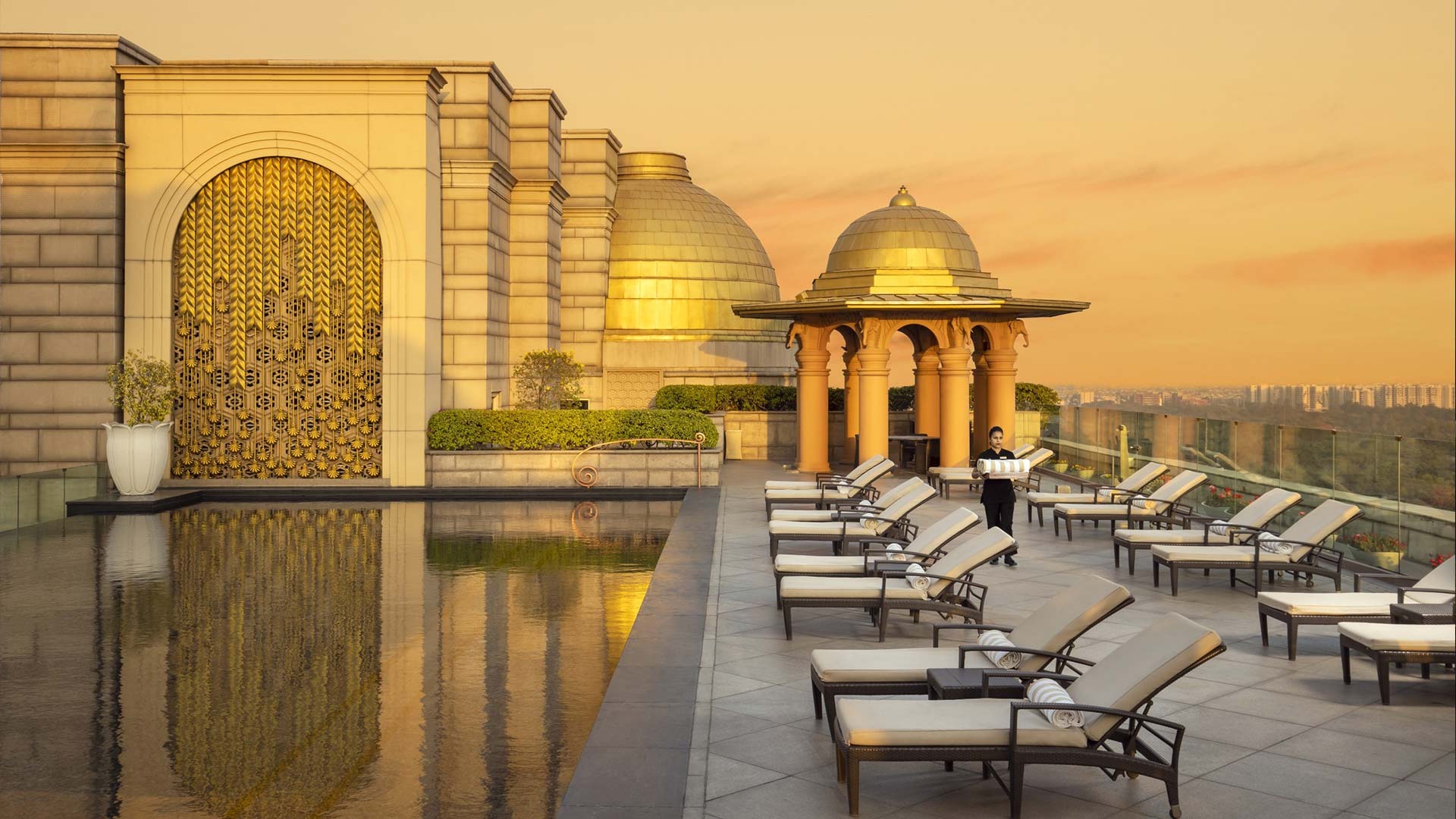
The domes of The Leela Palace New Delhi evoke India’s royal architectural traditions.
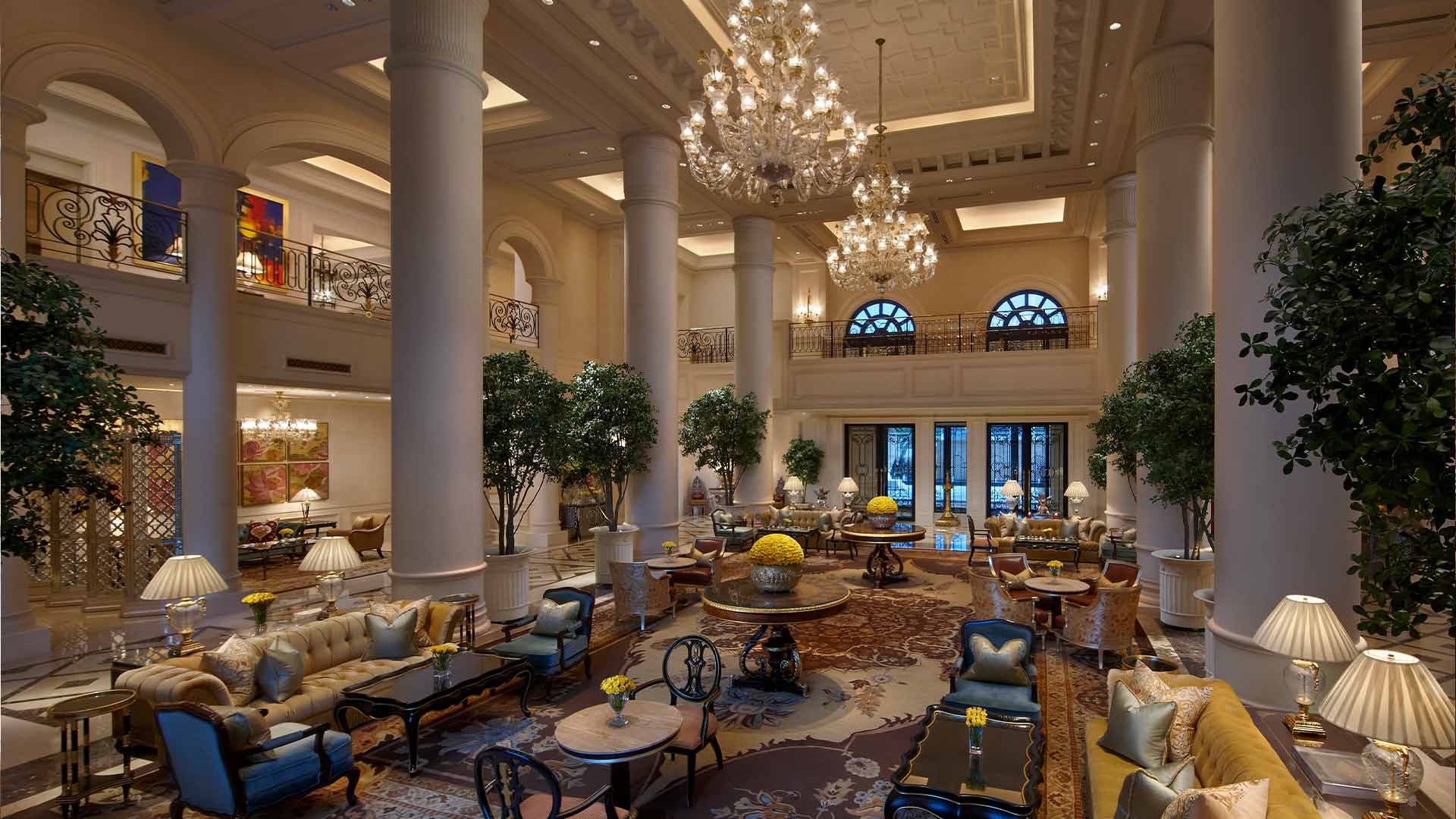
The Lobby Lounge at The Leela Palace New Delhi draws on Edwardian elegance for its refined setting.
Anuraag Bhatnagar, Whole-time Director and Chief Executive Officer, The Leela Palaces, Hotels and Resorts, believes this sensibility should never harden into a formula. “We do not believe every property should conform to a standardised The Leela template. In fact, that would diminish what makes our portfolio special,” he says. “Consistency must never mean uniformity.” A palace in Udaipur, a city hotel in Mumbai and a forest sanctuary in Coorg should each reflect its surroundings. “What connects them is the quality of hospitality, the attention to detail, and the underlying commitment to making every guest feel genuinely cared for.”
The Leela Coorg Forest Sanctuary, the group’s newest property, is a sanctuary where the forest, coffee estates and Kodava culture shape the stay, and luxury takes its cue from the Western Ghats. It is a first for The Leela: palace grandeur traded for forest quiet. “At The Leela Coorg Forest Sanctuary, the landscape, coffee heritage, nature and wellness become integral to the experience rather than simply a backdrop to a stay,” says Mehra.
Coorg was a rebrand, launched in July 2026, and Bhatnagar says the brief was to work with what the estate already had. “The property already had extraordinary natural assets: 76 acres of forest and coffee plantations, the biodiversity of the Western Ghats and a strong connection to Kodava heritage. The opportunity was not to impose an identity on the destination, but to reveal and elevate what was already distinctive about it.”
Sensory experiences are as much a part of the story The Leela is telling as its hotels. “Even our sensory expressions, from Tishya, our signature fragrance, to Melodies by The Leela, our sonic identity, allow the brand to be experienced beyond a physical property and a stay,” says Mehra.
Every luxury brand that stretches its name faces the same risk: spread too thin, it loses meaning. So The Leela, Mehra says, has set itself a filter. “The important distinction is that we are not extending the brand simply to occupy more categories. Every new expression must have a reason to exist and a clear connection to our identity. A lifestyle brand is not defined by how many things it offers, but by how consistently its point of view comes alive across them. For The Leela, that point of view is rooted in Indian culture, thoughtful curation, personal service, and an understanding of what makes an experience truly memorable.”
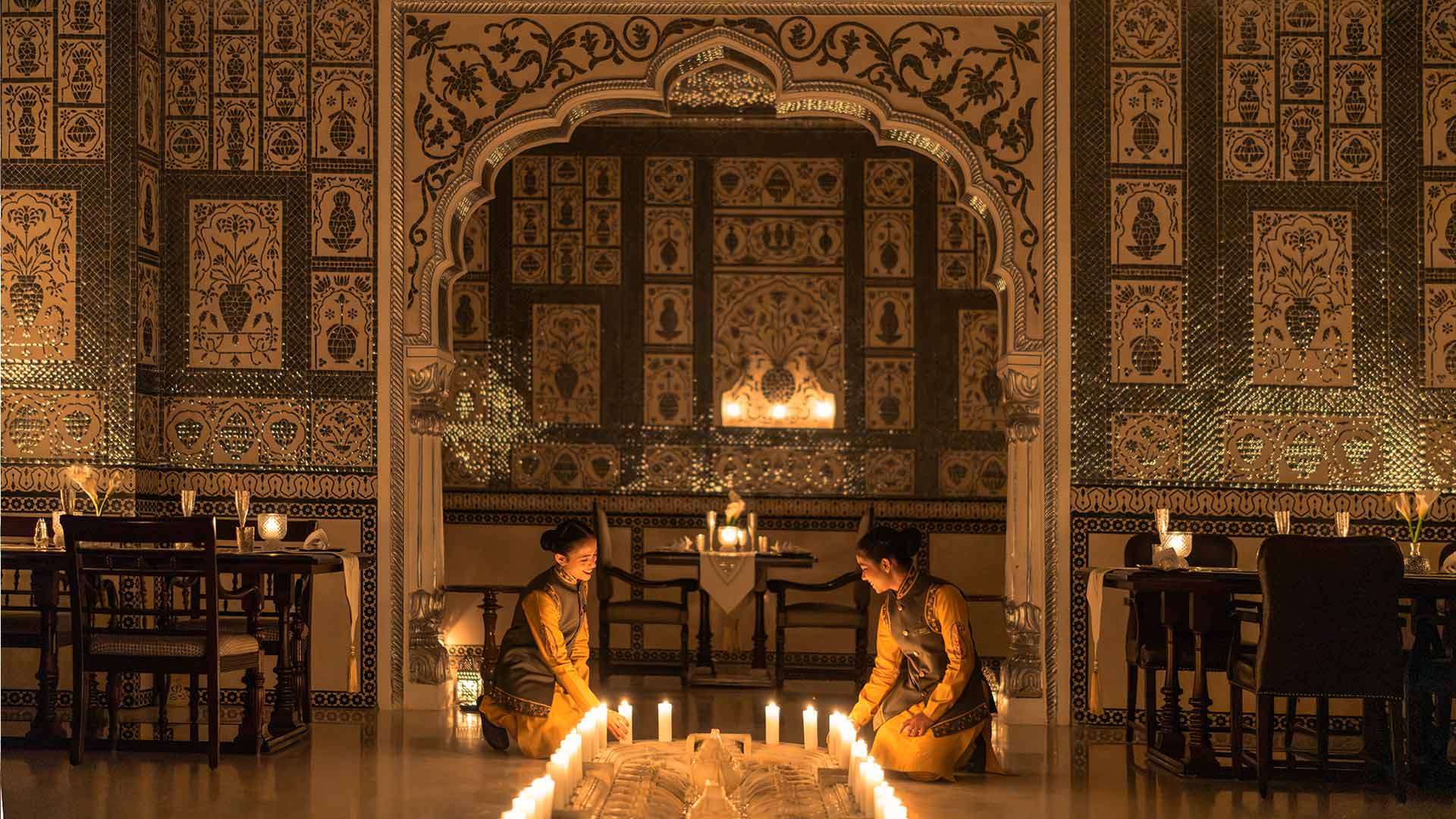
Jamavar at The Leela Palace Jaipur brings culinary heritage into focus.
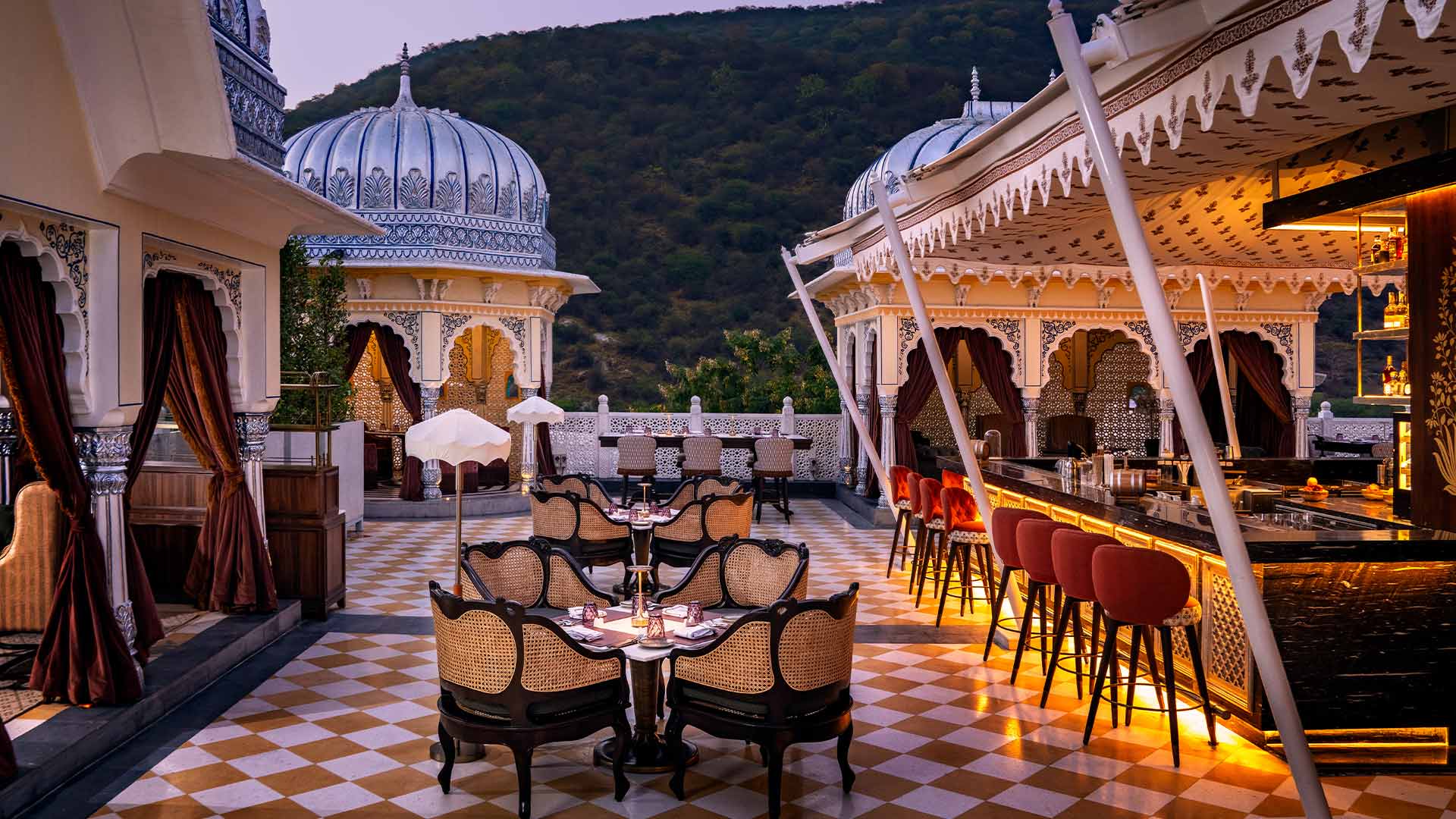
The Amber Terrace at The Leela Palace Jaipur offers dining amid Rajput-inspired architecture.
When dining becomes the destination
Consistency is easiest to judge at the table, where The Leela has placed some of its most visible bets. Restaurants have always been central to the brand, and none more so than Jamavar, with its flagship at The Leela Palace Bengaluru. So popular is it that The Leela reimagined Mohan Mahal at The Leela Palace Jaipur as Jamavar, a restaurant the brand considers its culinary legacy. Named after the 16th-century Jamavar shawls of Kashmir, fabled for their intricate weaves, it carries the same philosophy of craftsmanship into its interiors and cuisine.
Over the years, The Leela has brought celebrated New York names such as Megu and Le Cirque to India. The group has single-handedly preserved the ultra-luxury, white-glove era of these brands while their US counterparts have faded away. The group has also created successful brands of its own.
In FY’26, The Leela's F&B revenue grew 15% year on year. Anupam Dasgupta, Senior Vice President — Operations (North) and Head of Wellness, The Leela Palaces, Hotels and Resorts, traces the shift over several years. “I would see this as an evolution rather than a single turning point. As dining out becomes increasingly about discovery, social occasions and experiences, the opportunity for a luxury hotel is to create restaurants and bars that people choose, not simply because they are staying with us.”
He watches one figure closely: the rise in non-resident covers at city hotels, from 51% to 54%. “These are important indicators of how our restaurants are building relevance beyond the resident guest. Ultimately, F&B has become a business pillar because it can generate demand independently, deepen our relationship with the city and strengthen the overall appeal of the property.”
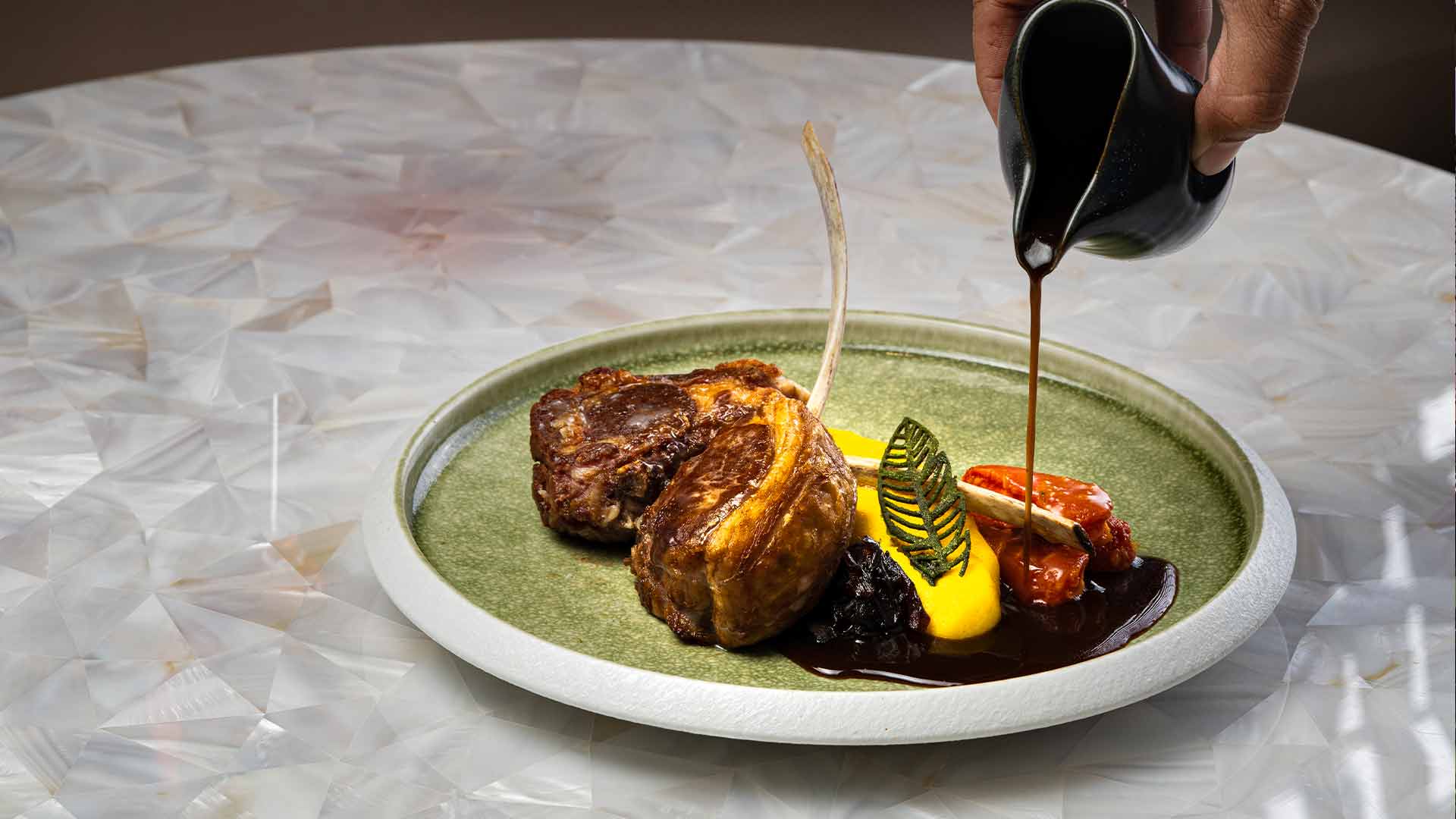
The Charred Lamb Rack at The Peacock Lounge, The Leela Palace Jaipur, reflects the brand’s contemporary culinary ambitions.
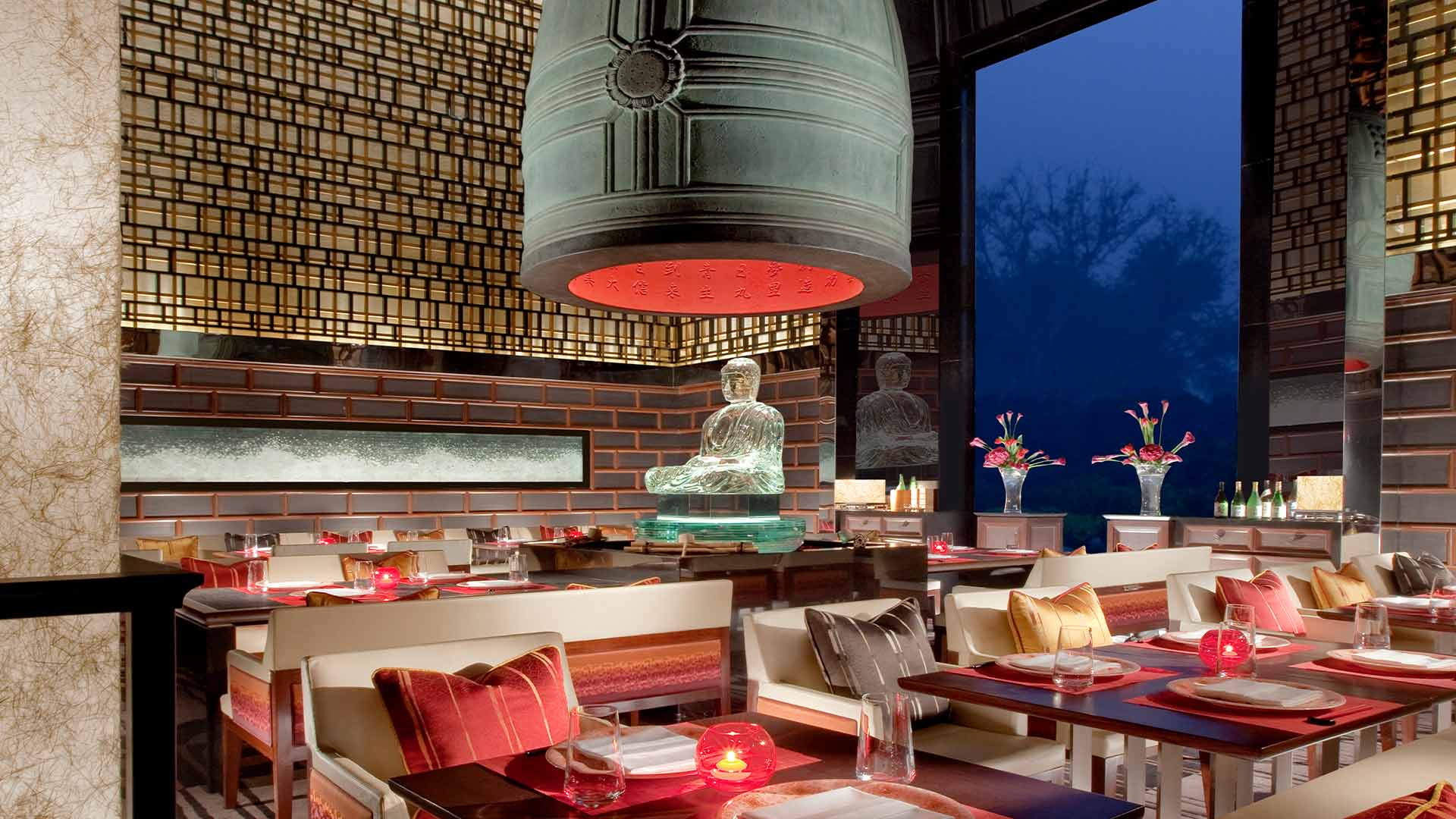
Megu at The Leela Palace New Delhi brings Japanese fine dining into The Leela’s international culinary portfolio.
"A melody heard in a particular setting, a fragrance that becomes familiar, or a ceremonial welcome that connects you to the spirit of a destination can become part of how you remember a place. These seemingly small details can create an emotional connection far more enduring than the moment itself. Ultimately, the most meaningful luxury is what stays with you after you leave."
Anjali Mehra
Executive Vice President, Brand and Communications, The Leela Palaces, Hotels and Resorts
Building standalone culinary destinations has been the group’s stated goal for some years. In FY’26 alone, it introduced or upgraded seven F&B venues. “Le Cirque returned at The Leela Palace New Delhi with a refreshed Franco-Italian dining experience, while at The Leela Palace Jaipur, the transformation included the arrival of Jamavar, the new The Aravalli Dining Room, The Peacock Lounge and The Amber Terrace. At The Leela Palace New Delhi, The Qube was also re-envisioned as an all-day dining destination,” says Dasgupta. “Each intervention has a distinct purpose, whether it is strengthening a signature restaurant, creating a new social setting or making better use of a space.”
The Qube’s makeover shows how far that thinking goes. Its evenings now run on an à la carte menu by Chef Ashmeet Singh Jolly, alongside a Thai dining studio led by Chef Krung Thong from Kalasin in northeastern Thailand. An LED art wall, curated with Masha Art, rotates digital works by Indian artists including Seema Kohli and Shrikant Kadam.
Behind the investment in F&B is a changed diner. “Today’s diners, particularly younger consumers, are engaging with food through a wider lens. The cuisine remains fundamental, but so are the story behind it, the atmosphere, the quality of service and the sense of discovery,” Dasgupta says. “For us, the answer is not novelty for its own sake, but concepts with a clear identity and the quality to encourage repeat visits.”
That thinking plays out most clearly at The Leela Palace New Delhi, home to Jamavar and Megu. “A restaurant earns its reputation over time through consistency, culinary integrity and the trust it builds with its guests. The responsibility is to protect those foundations while continuing to give people reasons to discover it, return to it and experience it differently,” he says. At Megu, that has meant new formats: an omakase for a chef-curated meal and an izakaya for shared plates and conversation. “A restaurant with a strong identity does not need to reinvent itself constantly. It needs to keep refining the experience, remain attentive to its guests and ensure that its food, service and setting continue to justify the choice.”
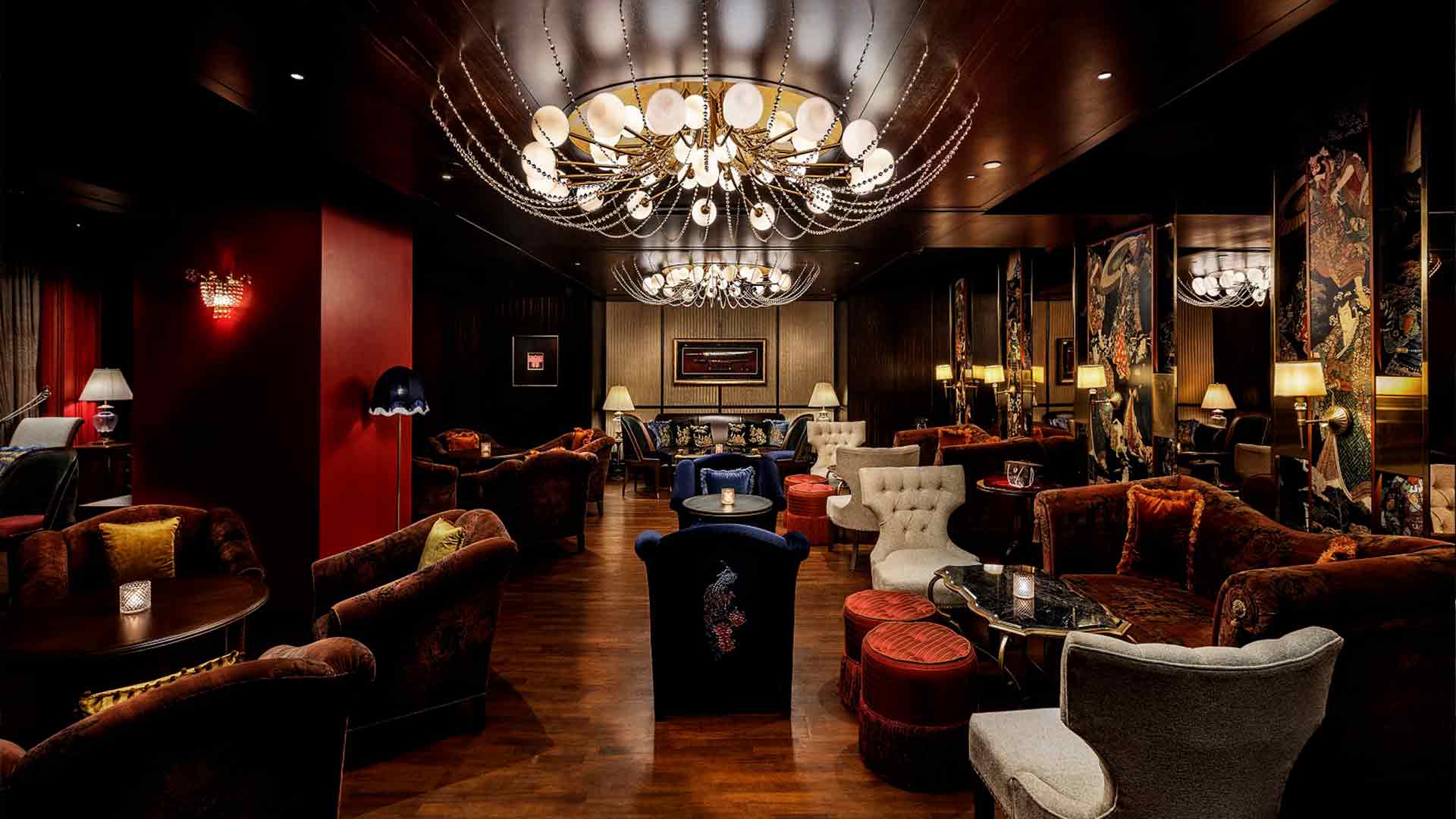
ZLB23, the Kyoto-inspired speakeasy at The Leela Palace Bengaluru, ranked No. 31 on Asia’s 50 Best Bars in 2025.
Bars have become the sharpest expression of The Leela’s inventive approach. At The Library Bar in New Delhi, the Literary Mixology menu casts each cocktail as a character or theme from a novel. “We have always believed that storytelling is one of the most powerful tools in the industry, as it transforms a mere cocktail into a wholesome experience for each guest,” says Manish Kumar, Beverage Manager. Its Pablo Picasso, built on tequila with a house brine of vinegar, red chilli, cardamom, star anise and cinnamon, translates Indian pickling traditions into a glass. At The Leela Palace Jaipur, Beverage Manager Aditya Sharma’s Regal Rajasthan menu draws on royal traditions and local ingredients. “Without a story, a cocktail’s just a mix of liquids. But add a narrative, and suddenly you’ve got a memory in a glass.”
Bengaluru, however, is where The Leela has been boldest. “It has a sophisticated, cosmopolitan audience, a strong dining-out culture and consumers who are open to discovering concepts with a distinctive point of view,” says Dasgupta. “That creates an opportunity to be ambitious, while remaining rigorous about the quality of the experience.”
ZLB23, a Kyoto-inspired speakeasy reached through a kitchen, climbed to No. 31 on Asia’s 50 Best Bars in 2025, up from No. 40 a year earlier. “ZLB23 has reinforced our belief that a hotel can be home to a destination that competes on the strength of its own identity, craft and following,” he says. “Its discreet entrance is part of the discovery, but the experience has to deliver long after that first impression.” Domestic and international bar takeovers keep it connected to the wider bartending community. “A destination bar needs a compelling concept, category-level credibility and the consistency to build a loyal audience.”

Intricate floor detailing at Arq By The Leela carries the brand’s commitment to Indian craftsmanship into its private members’ club.
Its newest layer, The Theatre, takes the idea further: an intimate cocktail room behind velvet curtains, where Head Mixologist Rajib Mukherjee performs against a screen telling each drink’s story. “This isn’t just another drink menu refresh; it’s a fully immersive sensory experience where mixology meets performance,” says Mukherjee. Bhatnagar describes it as “a laboratory, a place for the best mixologists to come and display and perform artistry through mixology”.
Also at The Leela Palace Bengaluru, The Azulian House is built around the idea of a botanist’s home. “It brings together three complementary influences: Peru’s rich culinary heritage, Bengaluru’s identity as India’s Garden City, and an agave-led beverage programme that gives the concept a distinctive point of view,” says Dasgupta. Its four spaces, The Living Room, The Glasshouse, The Lab and The Orchard, are set among herbs and fruit trees. “Storytelling is therefore not limited to the menu or the design; it runs through the entire experience, from the landscape to the glass.”
Significantly, The Azulian House was created without a celebrity chef. “Building a concept in-house gives us the opportunity to develop the entire experience from the ground up, bringing together the culinary proposition, design, beverage programme and service philosophy under one cohesive identity,” Dasgupta says. “In that sense, The Azulian House is a brand in its own right, and intellectual property of The Leela.” Celebrated chefs still have a place. “But the partnership must go beyond a name.”
Will these brands leave the hotel? Possibly, though not as a goal in itself. “Not every restaurant needs to become a multi-city brand. Some concepts derive their appeal from their relationship with a particular property, its architecture or its destination. Others may have a more transferable proposition. The discipline is to recognise the difference,” says Dasgupta.
What holds the portfolio together, in his view, is principle rather than format. “Our philosophy is not to make every restaurant look or feel the same. It is to ensure that each has a distinct culinary purpose, is authentic to the experience it promises and is delivered with the care and attention associated with The Leela. The menu may change from one city to another, but the principles of integrity, craftsmanship and thoughtful hospitality remain constant.”
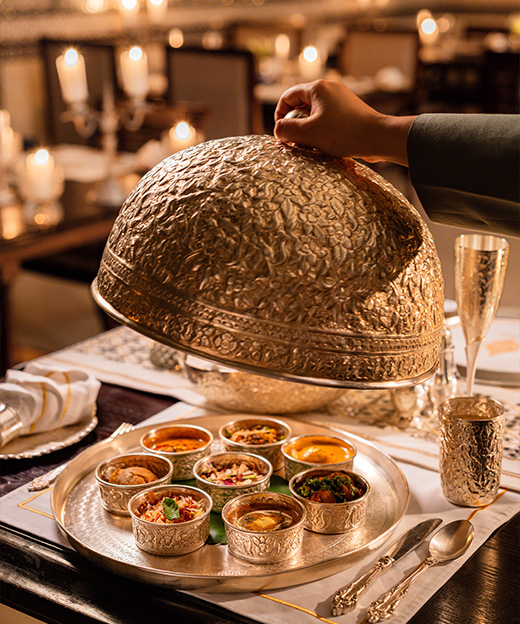
The vegetarian thali at Jamavar, The Leela Palace Jaipur, reflects the brand’s philosophy of preserving India’s culinary heritage through contemporary luxury hospitality.
“Our food philosophy combines culinary integrity with a strong sense of place. Food is one of the most meaningful ways in which a guest experiences a destination, its culture and its traditions. Our responsibility is to honour that connection while bringing the precision, creativity and thoughtful hospitality that define The Leela.”
Anupam Dasgupta
Senior Vice President – Operations (North) and Head of Wellness, The Leela Palaces, Hotels and Resorts
Luxury that lives beyond the stay
Tucked away in The Leela Palace Bengaluru, far from the lobby and above a row of luxury stores, among them an art-filled Sabyasachi, is Arq By The Leela, a private members’ club. It is decidedly opulent and a treat for the senses: patterned, textured and art-inspired, with an inventive coffee bar where the barista experiments with beans and roasts, dining spaces where the chef sends out dishes not always on the menu, a bar stocked with rare spirits, a cultural calendar, and spaces to read, lounge and network.
Arq has since opened in New Delhi, and Chennai follows in November. Bhatnagar calls it “an important evolution in how we think about luxury hospitality. It allows us to build a relationship with our guests that extends beyond the traditional hotel stay, through culture, community, discovery and meaningful connection”.
Conceived as a Living Library of Wonders, Arq takes its identity from each city. Bengaluru draws on the Palace of Imagination and avant-garde Indian arts, New Delhi reinterprets the Dance of the Peacock, and Chennai looks to the Coromandel Coast and the Cadence of Madras. “This balance between a shared philosophy and a strong local identity is important. We see Arq By The Leela as a platform that evolves meaningfully in different cultural contexts,” says Bhatnagar.
The response, he adds, “has been encouraging”, and more chapters may follow, though not in a hurry. “Our priority is to deepen the experience in our existing and upcoming locations, build engaged communities, and ensure that each club has a compelling reason to exist.”
Branded residences take the idea home, allowing The Leela to build enduring relationships with guests. “We see luxury increasingly moving towards continuity, personalisation and a sense of belonging, rather than being confined to a particular visit,” says Bhatnagar. The Leela already has The Leela Ambience Gurugram Hotel & Residences and The Leela Residences in Bengaluru. The Leela Luxury Residences Mumbai is slated for FY’27. “Branded residences bring together the privacy of a home with the service, discretion and attention to detail. They also create an opportunity to leverage our brand and hospitality expertise in an adjacent segment, with a different capital and revenue model.”
Bhatnagar sees the club, residences and hotels feeding one another. The wider idea is a connected ecosystem. “A hotel guest may become a club member; a club member may choose a Leela property for a celebration; and a resident may continue to engage with our hospitality experiences across the portfolio,” believes Bhatnagar. He is careful not to overstate it, though. “These are potential pathways for deeper engagement, rather than outcomes we take for granted.”
Each new luxury extension still has to pay its way. “Each proposition must stand on its own commercial merits. But together, they can broaden our addressable market, create additional revenue opportunities and strengthen the lifetime value of our guest relationships.”
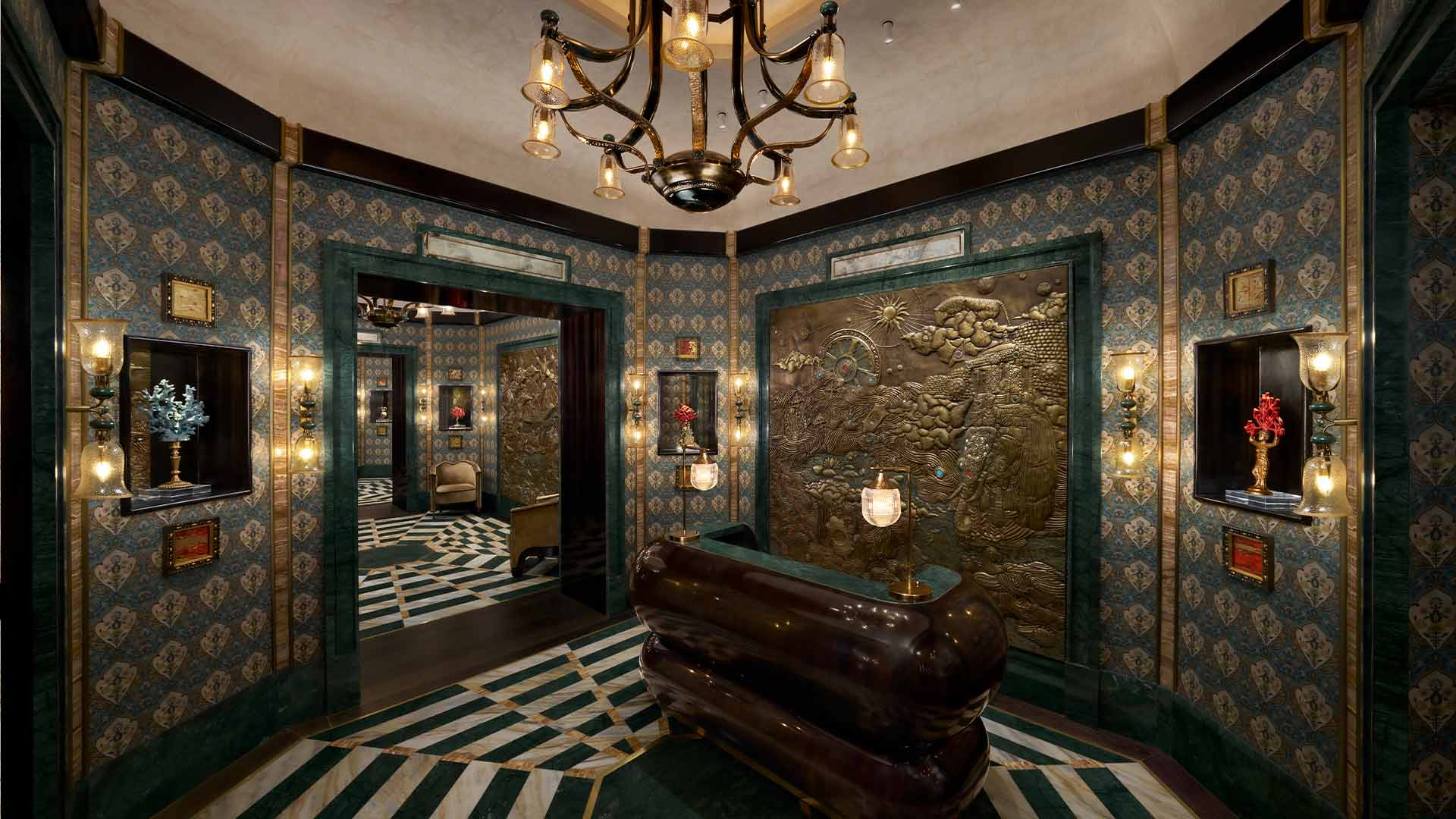
Arq By The Leela, a private members’ club, is decidedly opulent and a treat for the senses: patterned, textured and art-inspired.
A sense of place
At The Leela Palace Udaipur, Amrut Mahal sits in the Guava Garden, a 120-year-old structure where fishermen on Lake Pichola once stopped to rest. Today it is a dining room with low seating and windows that frame lit-up monuments across the water. Here, as across The Leela, destination writes the design narrative.
“Our design language is fundamentally shaped by place,” says Vikram Choubal, Senior Vice President — Technical Services. “Each property draws its character from the architecture, artistic traditions, craftsmanship and cultural identity of its destination, interpreted for the expectations of the contemporary luxury traveller.”
No single designer or architect is credited with that language. “It is a considered collaboration between our brand and hospitality teams, architects, interior designers, conservation specialists and skilled artisans, guided by a common philosophy: to preserve the individuality of each destination while ensuring that every property delivers the quality and sensibility associated with The Leela.”
Walk through the palaces and the differences are obvious to the eye. “Udaipur draws on the grandeur and craftsmanship of Mewar’s royal residences; Jaipur reflects Rajasthan’s architectural traditions through frescoes, jaalis and ceremonial details; Bengaluru takes inspiration from the palaces of Mysore, with intricate woodwork, ornate ceilings and landscaped gardens; while New Delhi brings together the symmetry of Lutyens’ Delhi and Indian detailing,” says Choubal. “Each is different, but all express a strong sense of place.”
This design instinct dates to the first Leela, opened in Mumbai in 1986 as a resort within the city, set in 11 acres of landscaped gardens with waterfalls and a lotus pond. Grandeur, gardens and Indian craft became signatures long before the brand reached Udaipur or Delhi.
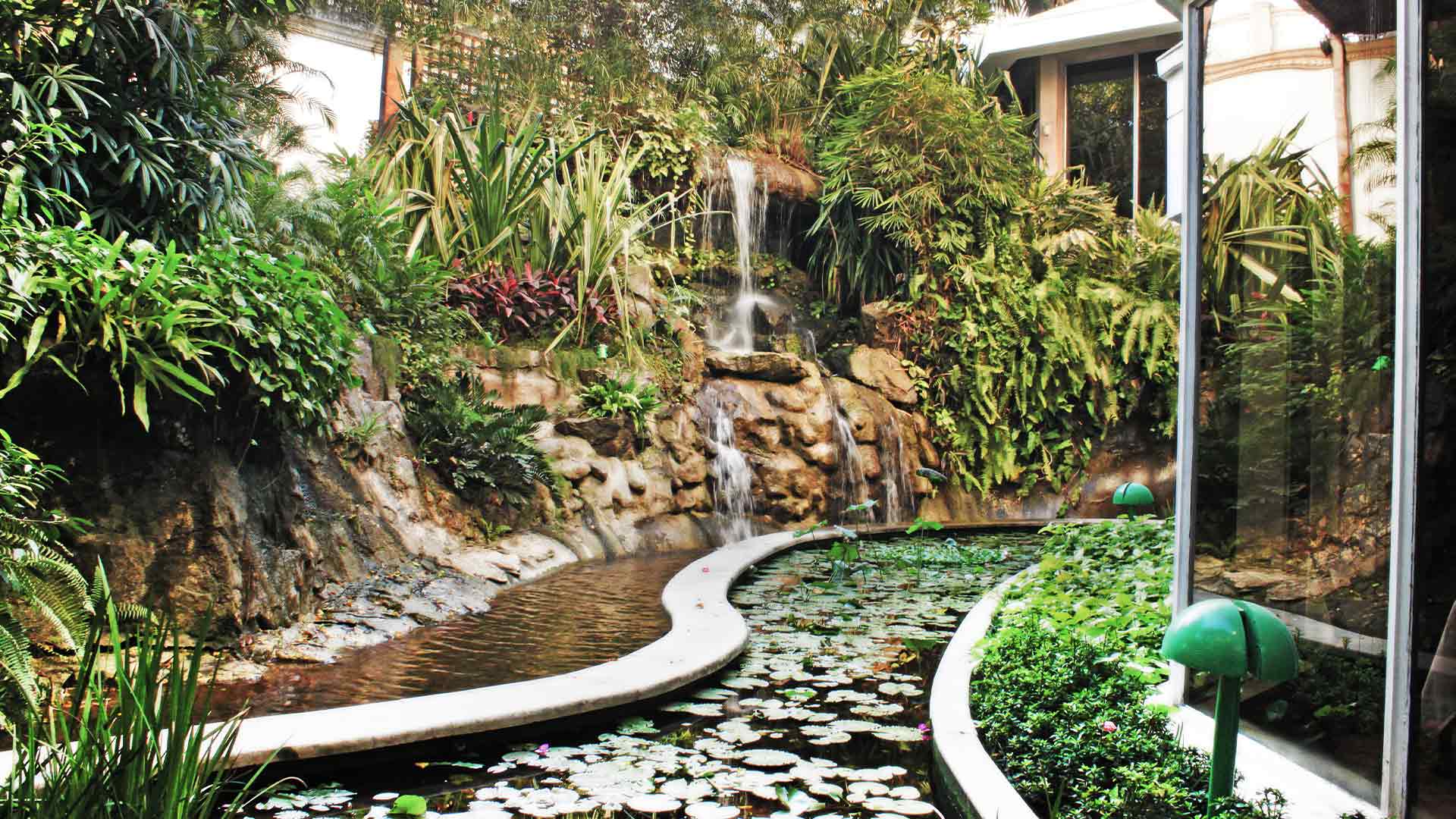
The waterfall at The Leela Mumbai recalls its original vision of a resort within the city, with landscaped gardens central to its design.
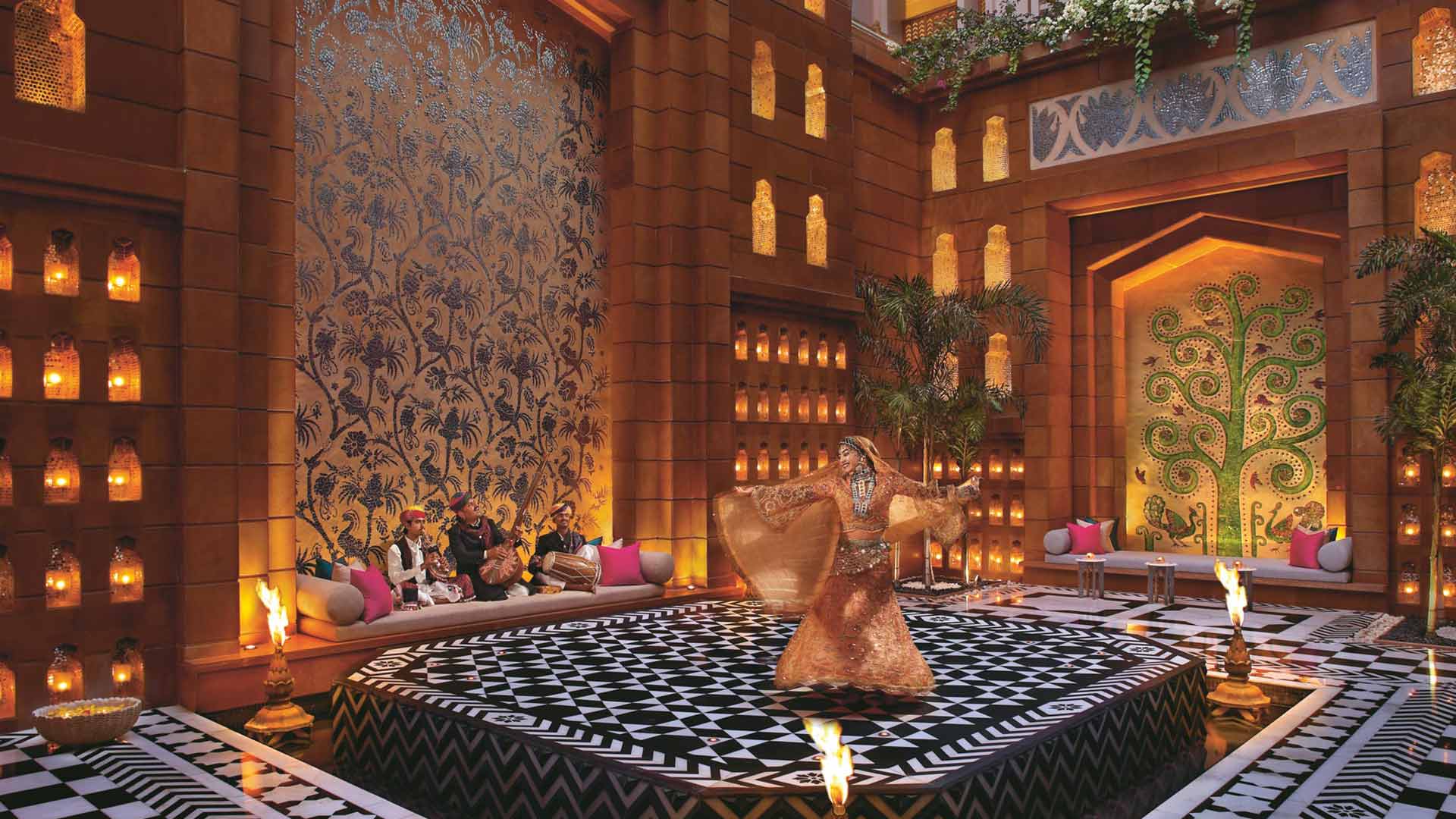
The ceremonial ritual at The Leela Palace Udaipur brings Rajasthan’s living traditions into the guest experience.
"There is a strong cultural case for the palace hotel format. Yet, destinations such as Coorg demonstrate that luxury need not be defined by scale or grandeur. For The Leela, the opportunity lies in having the breadth to express Indian luxury in different ways: through the grandeur of a palace, the intimacy of a forest sanctuary or the character of a desert retreat."
Vikram Choubal
Senior Vice President – Technical Services, The Leela Palaces, Hotels and Resorts
Which raises the question every luxury group in India now faces: can anyone still build a palace? Choubal refuses the either-or. “I do not see this as a choice between palaces and smaller, destination-led resorts. The question is not which format is more relevant, but which format is right for a particular destination, its demand profile and the experience we want to create.”
He is upfront about the commercial considerations. “A palace is a significant investment. Its economics depend on the strength of its location, the depth and diversity of demand, its ability to command a premium and the range of experiences it can support, from leisure and dining to weddings, celebrations and business gatherings. It must offer a compelling proposition beyond architectural grandeur alone.” Every format, he adds, requires a distinct investment case, grounded in demand, positioning, operating economics and long-term returns. “We must be disciplined about where we invest and ensure that the product is appropriate to the destination rather than pursuing a single model across the portfolio.”
The cultural argument is just as strong. “India’s architectural and artistic heritage is a remarkable source of differentiation, and travellers seek experiences that connect them meaningfully with a destination. But a palace in 2026 must be more than a magnificent building. It must bring its heritage to life through its design, art, cuisine, rituals, craftsmanship
and hospitality.”
Art walks are one way that heritage and cultural narrative connect with guests. “Our curated art walks allow guests to discover the cultural character of our properties, from modern and contemporary Indian art collection in New Delhi to regional craftsmanship in Udaipur, palace storytelling in Jaipur and the distinctive architectural and artistic traditions expressed across our other destinations. The Leela Palace Trail extends this idea further, connecting nine palaces and resorts through a curated multi-destination journey,” says Choubal.
For The Leela, destinations such as Coorg demonstrate that luxury need not be defined by scale or grandeur. At The Leela Coorg Forest Sanctuary, he says, “the setting itself becomes central to the experience.” Next is Jaisalmer, an 80-room desert resort near the fort. “A desert destination such as Jaisalmer calls for an interpretation rooted in the character of Thar and the region’s living heritage.” The responsibility to the destination also extends to how the hotels are constructed: The Leela holds South Asia's largest portfolio of EDGE Advanced green building certifications, covering five of its palace properties with a certified footprint of 2.41 million square feet.
The future of luxury hospitality, Choubal argues, “is not one architectural formula. It is the ability to create experiences that could belong nowhere else, while ensuring that each one is commercially sustainable and true to its destination.”
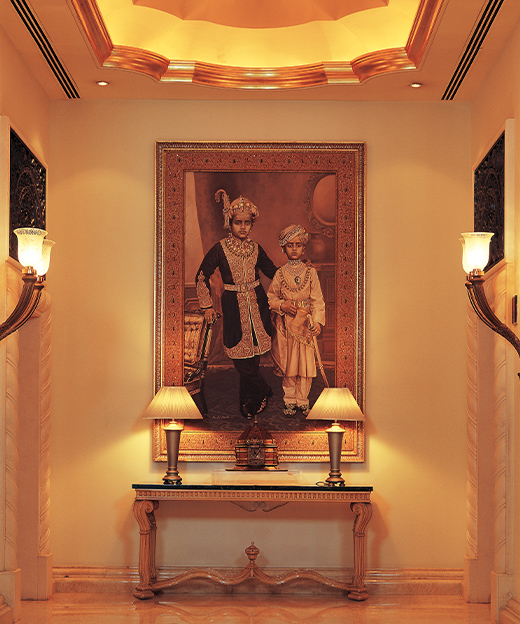
Bhim Singh Hada’s artwork at The Leela Palace Bengaluru adds another dimension to the hotel’s collection of Indian art.
Shakti, Shanti, Soumya
How Aujasya by The Leela moves wellbeing out of the spa and into the stay.
At breakfast in a Leela hotel, the paratha now has competition. A ragi idli, a millet dosa, a FAB pancake made from finger millet, amaranth and barnyard millet: this is Aujasya by The Leela, and it began, unusually for a wellness programme, at the table.
Launched in 2022 and developed with nutritionist Dr Ankita Jalori, Aujasya was built for guests who travel constantly and eat out too often. Its menus pair familiar dishes with better grains, so an Indian traveller meets an idli and an international one a pancake, each quietly reworked.
“Aujasya by The Leela was conceived around the belief that wellbeing is not a collection of treatments, but a way of life,” says Anupam Dasgupta, Senior Vice President — Operations (North) and Head of Wellness. “We wanted to move beyond standalone spa and yoga experiences to create a more holistic philosophy that reflects how people nourish themselves, move, rest and reconnect.”
That philosophy rests on the Trinity of Balance: Shakti (energy), Shanti (peace) and Soumya (inner radiance). It now runs well past breakfast. Aujasya Sampoorna offers curated meal plans, including anti-inflammatory, detox and high-protein, low-carb menus, so guests can keep their routines on the road. Zero-proof cocktails and wellness snacks sit on menus across the group. Yoga, Pilates and forest walks share the calendar with workshops in pottery, weaving and Indian toy painting.
Next comes the Aujasya Signature Ritual, rolling out across hotels: a welcome elixir, sound healing, warm herb-infused oils, an Aujasya tea experience and a keepsake to take home. Retreats are planned too.
Dasgupta sees no conflict between wellness as revenue and wellness as a reason to stay. “As travellers look for experiences that help them feel restored and reconnect with themselves, a thoughtful wellness philosophy can strengthen a hotel’s appeal and offer guests another reason to choose it,” he says. “The commercial opportunity and the guest benefit are therefore connected, rather than competing priorities.”
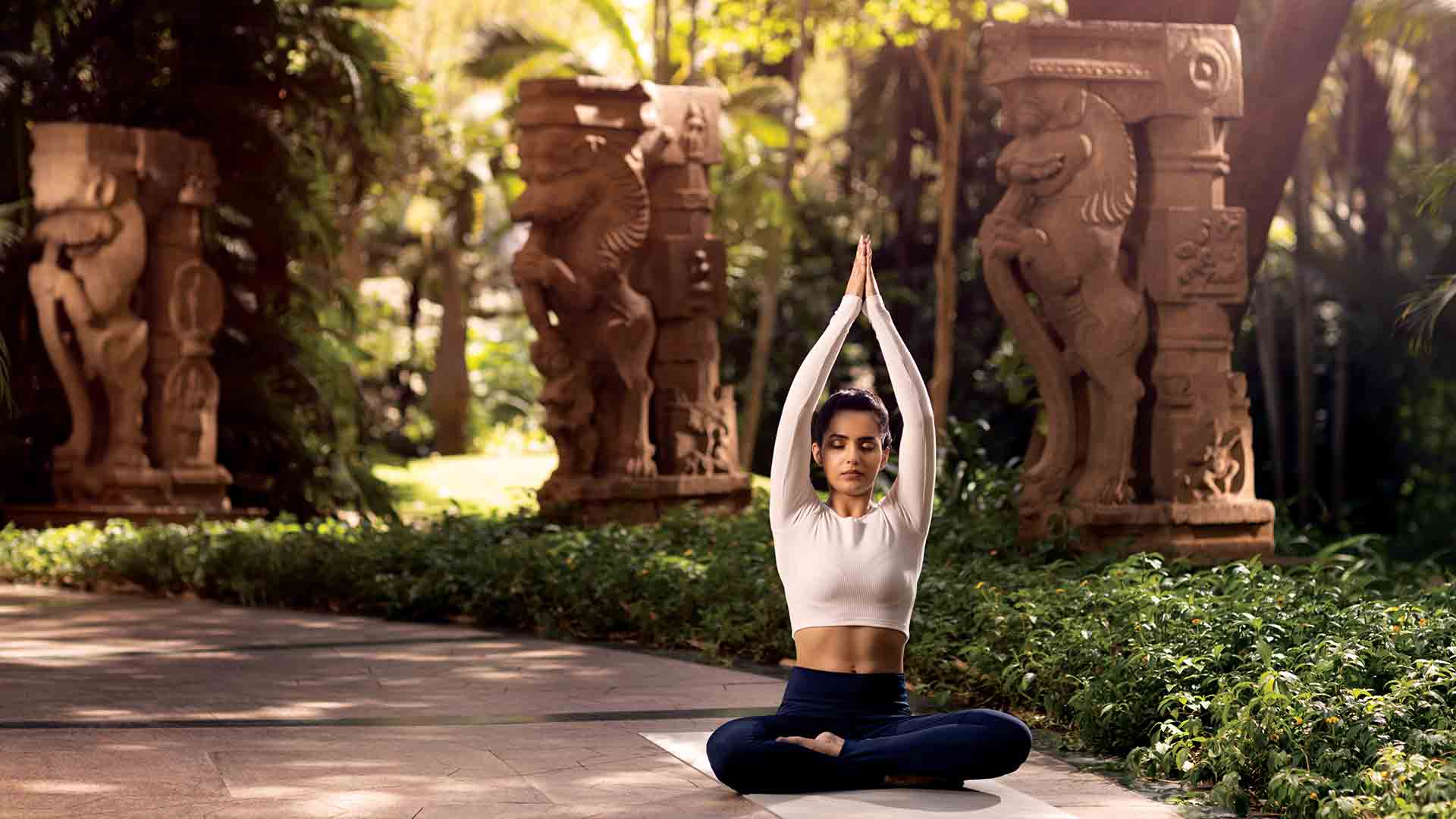
Yoga at The Leela Palace Bengaluru makes wellbeing part of the everyday stay.
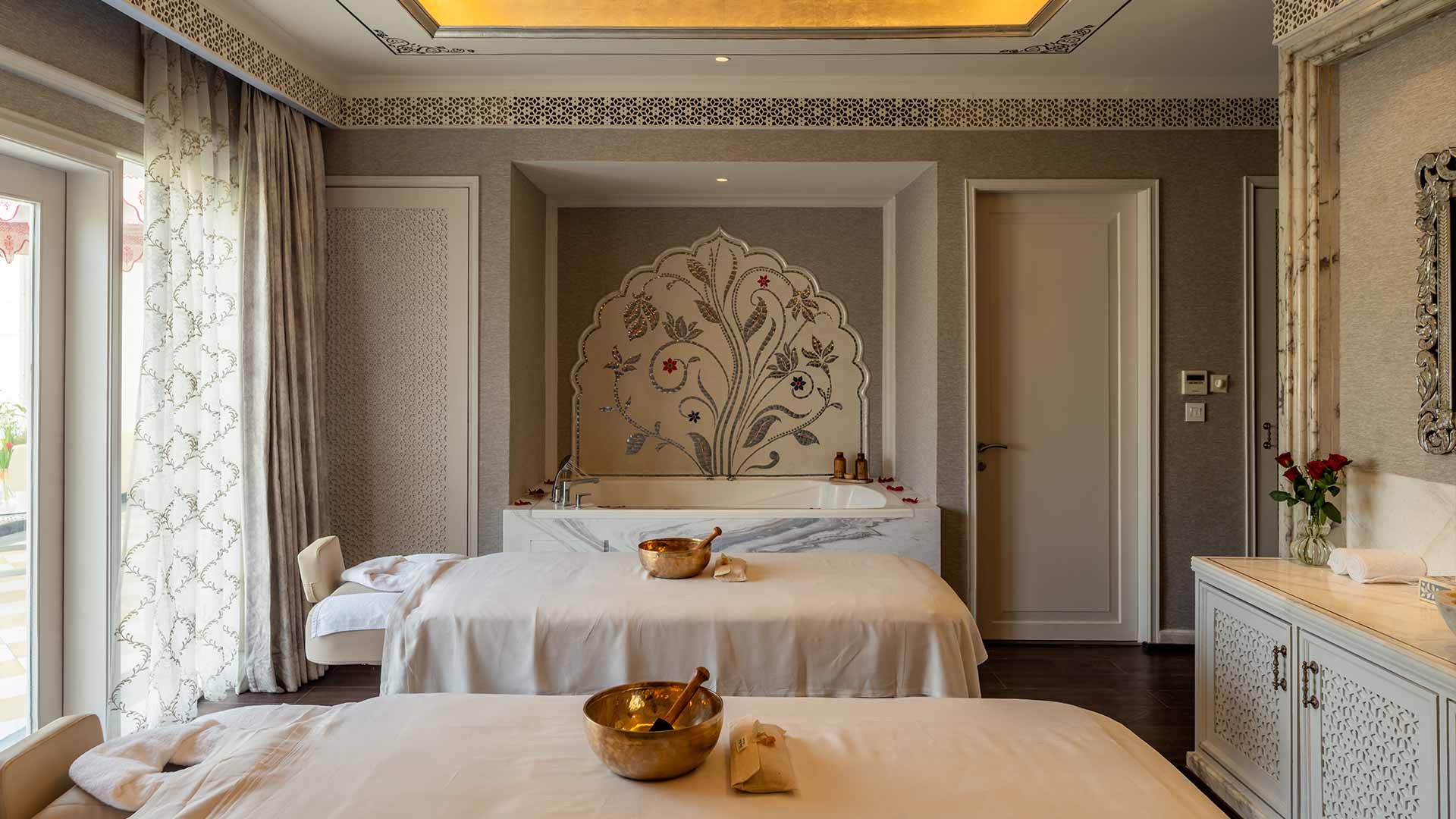
Aujasya by The Leela Spa at The Leela Palace Jaipur extends the brand’s wellness philosophy beyond treatments.
Growth without a template
When Brookfield Asset Management acquired The Leela Palaces, Hotels and Resorts, the new owners faced the question every buyer of a founder-led brand must answer: how much of the legacy do you retain? For Mehra, the answer began with intent. “What was important to preserve was the founding ambition: to create an exceptional expression of Indian luxury that could stand confidently on the world stage. Captain Nair gave The Leela a distinctive vision, one rooted in India’s cultural richness, individuality of place and a deeply personal approach to hospitality. Those remain central to our identity.”
The machinery around that vision evolved. “A contemporary luxury hospitality business requires strong financial foundations, access to capital, technology, global distribution and the organisational capabilities to develop its portfolio sustainably,” she says. “The transition, therefore, was not about choosing between heritage and modernity. It was about recognising that a legacy can only remain relevant if it continues to evolve. Preserving the founding vision did not mean preserving every aspect of the way the business had historically operated.”
Expansion now runs on a growth model that brings together selective ownership, management contracts and other capital-efficient opportunities. Bhatnagar says, “Each serves a different strategic purpose, allowing us to balance investment, control, returns and the pace at which we expand. But every opportunity must meet the same fundamental test: can we deliver an experience that genuinely merits The Leela name?” Coorg, acquired and rebranded, is owned; Jaisalmer, due to open under a management agreement, is not.
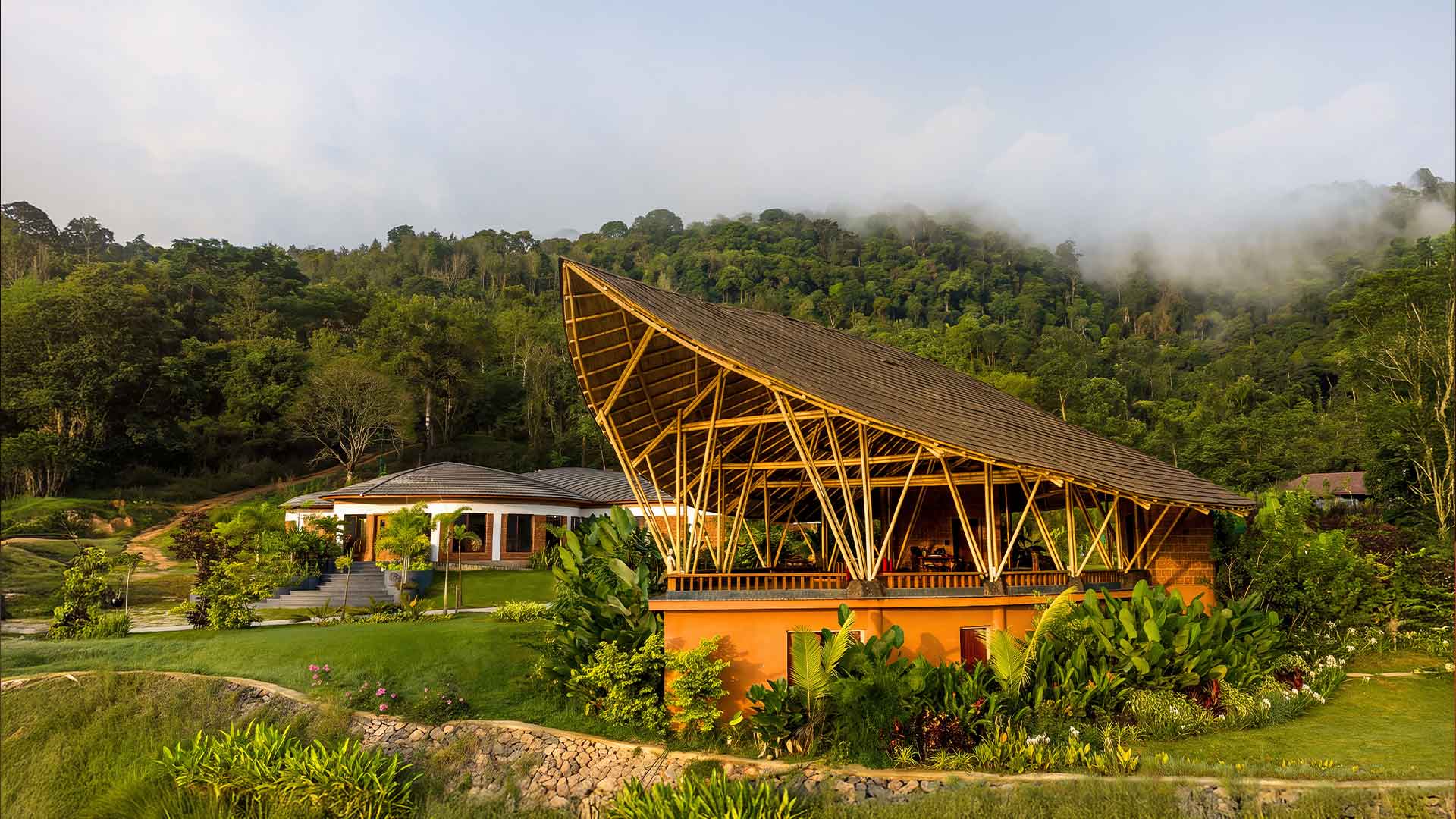
The yoga deck at The Leela Coorg Forest Sanctuary makes the surrounding landscape part of the wellness experience.
“The people who have grown with The Leela over the decades are an important part of our institutional legacy. I believe people stay when they find a combination of belonging, opportunity and pride in what they do. In hospitality, that sense of purpose is particularly meaningful because the work has a direct human impact.”
Rohit Pandey
Head of HR, The Leela Palaces, Hotels and Resorts
Before a property carries the brand name, it is examined well beyond its physical attributes to understand what makes a destination special. “It could be its landscape, architectural character, cultural heritage, craftsmanship or relationship with the local community. The fundamentals matter too: location, accessibility, asset quality, market potential and the ability to deliver exceptional hospitality sustainably. There must also be a compelling story that The Leela can bring to life,” he says.
India remains the main market, with a pipeline spanning Jaisalmer, Agra, Ayodhya, Bandhavgarh, Ranthambore, Srinagar, Sikkim and Tadoba, alongside key cities. Palm Jumeirah in Dubai is the group’s first overseas venture. “It gives us an opportunity to bring The Leela’s distinctive expression of Indian luxury to a global audience while building our international presence in a measured manner,” says Bhatnagar.
Discipline also means walking away when the economics, strategic fit or chance of a genuinely different experience fall short. “Growth also has to be financially disciplined. We must assess the investment required, the returns expected and the long-term strategic value of each opportunity rather than pursue expansion for its own sake,” he adds.
The legacy, then, is not simply what the group inherits. It is what it chooses to carry forward, what it strengthens, and what it creates for the future. The challenge is to scale the business while retaining and retaining the soul of the brand.
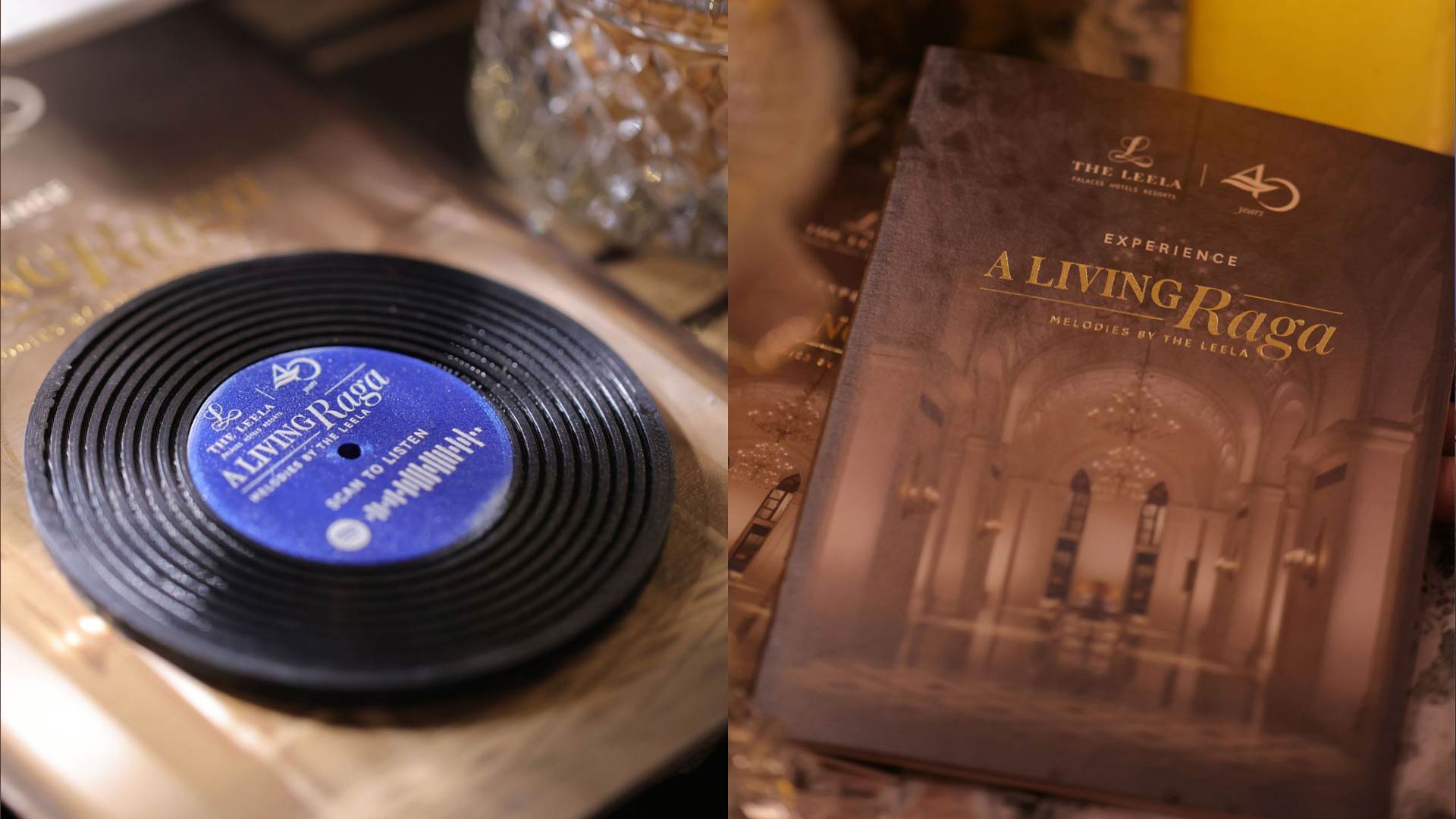
A Living Raga, composed by sarod maestros Amaan and Ayaan Ali Bangash, marks The Leela’s 40th anniversary.
The road to 50
Ten years from now, The Leela Palaces, Hotels and Resorts turns 50. Bhatnagar wants the brand to be recognised as one that has helped define what Indian luxury means on the global stage. Its operational and pipeline portfolio already spans 25 hotels and more than 5,200 keys, but size is not the target. Bhatnagar wants The Leela “not simply to be larger by 2036,” but “to be more relevant, more distinctive and more deeply connected to the guests and communities we serve. Growth must strengthen our brand, our business and our ability to deliver enduring value.”
Five pillars will guide that growth: art, culture and heritage; culinary; wellness; mindful luxury; and service ethos. “Whether through India’s living artistic traditions, exceptional culinary experiences, holistic wellbeing, thoughtfully conceived destinations or our deeply personal approach to service, the focus will remain on creating value beyond the physical stay,” he says.
For fellow hoteliers, he draws three lessons from the past five years. The brand and the business can grow together: “You can strengthen the business while elevating the brand, but doing so requires clarity of purpose, financial discipline and an uncompromising commitment to the guest experience.” Money and experience are linked: “In luxury hospitality, financial discipline is not separate from the guest experience; it enables us to invest in our properties, our people and the capabilities that sustain our competitive advantage.” And guests remain the final judge: “The guest experience remains the ultimate test of a hospitality brand.”
None of it holds without an effective team. “Systems, processes and standards are essential, particularly as an organisation grows, but they cannot substitute for a culture of genuine care. Our philosophy of Atithi Devo Bhava must be lived by our associates in the everyday decisions and interactions that shape a guest’s experience.”
In an increasingly competitive market, it is tempting to follow prevailing trends or replicate what works elsewhere. “But,” says Bhatnagar, “lasting differentiation comes from understanding your own identity and expressing it consistently, while remaining responsive to changing expectations.”
Forty years after Captain Nair set out to show the world what Indian luxury could be, The Leela team believes that growth creates opportunity, sound economics creates resilience, and a distinctive brand delivered through exceptional people creates lasting preference. The real achievement is bringing all three together without losing sight of what makes The Leela worth choosing.
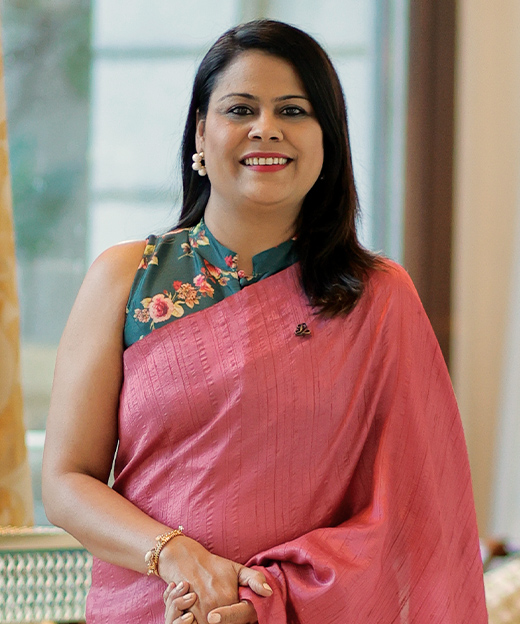
Preeti Makhija became The Leela’s first woman General Manager in 2025, taking charge of The Leela Palace New Delhi.
Preeti Makhija becomes the first woman to run a Leela hotel, and the training that ensures she won’t be the last.
In 2025, Preeti Makhija took charge of The Leela Palace New Delhi, the group’s flagship. In four decades, no woman had run a Leela hotel before her.
“Preeti is the first lady General Manager of a Leela Hotel and as such this is an important milestone for us,” says Rohit Pandey, Head of HR. The aim, he says, is to ensure women have “a clear pathway to positions of greater responsibility.”
That pathway runs through The Leela Executive Accelerated Development Programme (LEAD), leadership initiatives with IIM and #LeelaEmpowersHer, while Shefs at The Leela draws women into kitchens. “The true measure of progress is not just being the first to open a door, but ensuring that we build the capabilities, confidence and opportunities for others to follow,” says Pandey.
In an industry where loyalty is increasingly fleeting, several associates have been with The Leela for nearly 40 years. For Pandey, tenure matters less than what is handed on. “The most meaningful measure of our legacy is not simply how long people have stayed with us, but how effectively they pass on the knowledge, values and standards that make The Leela distinctive.”
The Leela Centre of Excellence (LCoE), developed with Le Cordon Bleu and GD Goenka University, does that at scale. “The idea behind setting up the Leela Centre of Excellence was to institutionalise the Leela culture and our service ethos,” says Pandey. It brings leadership, butler, Palace Services and culinary training under one roof, aiming to develop more than 3,000 associates and reach over 650 associates and managers each year.
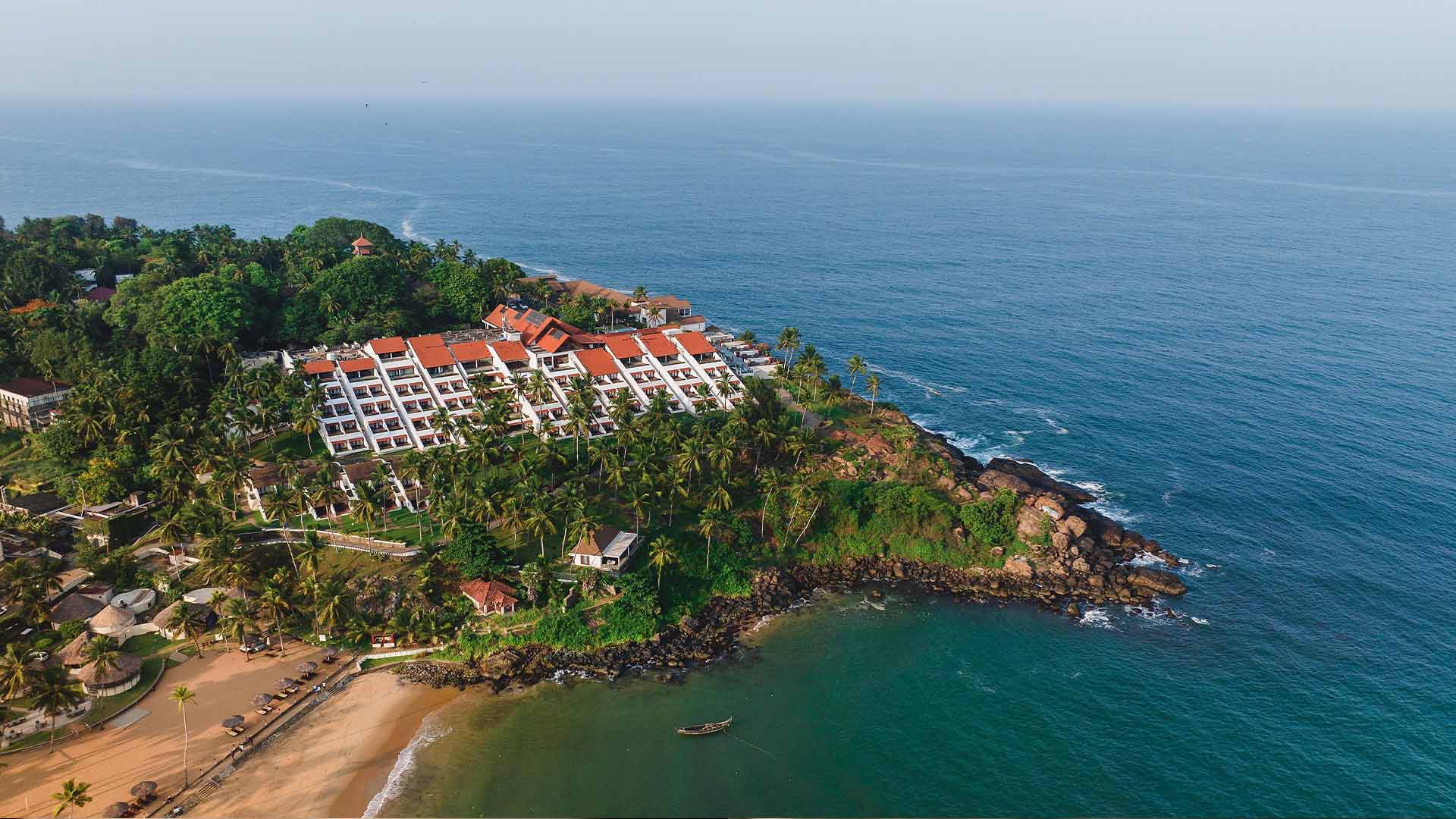
The Leela Kovalam, A Raviz Hotel, draws on Keralam’s coastal setting for its distinctive resort identity.