




















Rising Travel Costs and India's Price Edge
Jet fuel taxes, a weaker rupee, and a new GST structure are pushing up the cost of flying and staying in India, even as government data show the country still ranks highly on price against global peers. Here is what the numbers say about where India stands, and where it is losing ground.


By Sagari Gupta
The Directorate General of Civil Aviation recorded 146.8 lakh domestic air passengers in March 2026, a number that looks steady on paper. The cost behind that number is not. Average jet fuel prices, announced on 1 April 2026, rose 9.2% from the previous month and 18.2% from the previous year, driven by the conflict in West Asia, according to rating agency ICRA. Aviation turbine fuel now makes up 30 to 40% of an Indian airline's operating cost, a share well above the global norm. When fuel moves this much this fast, ticket prices follow.
What is driving up the cost of flying
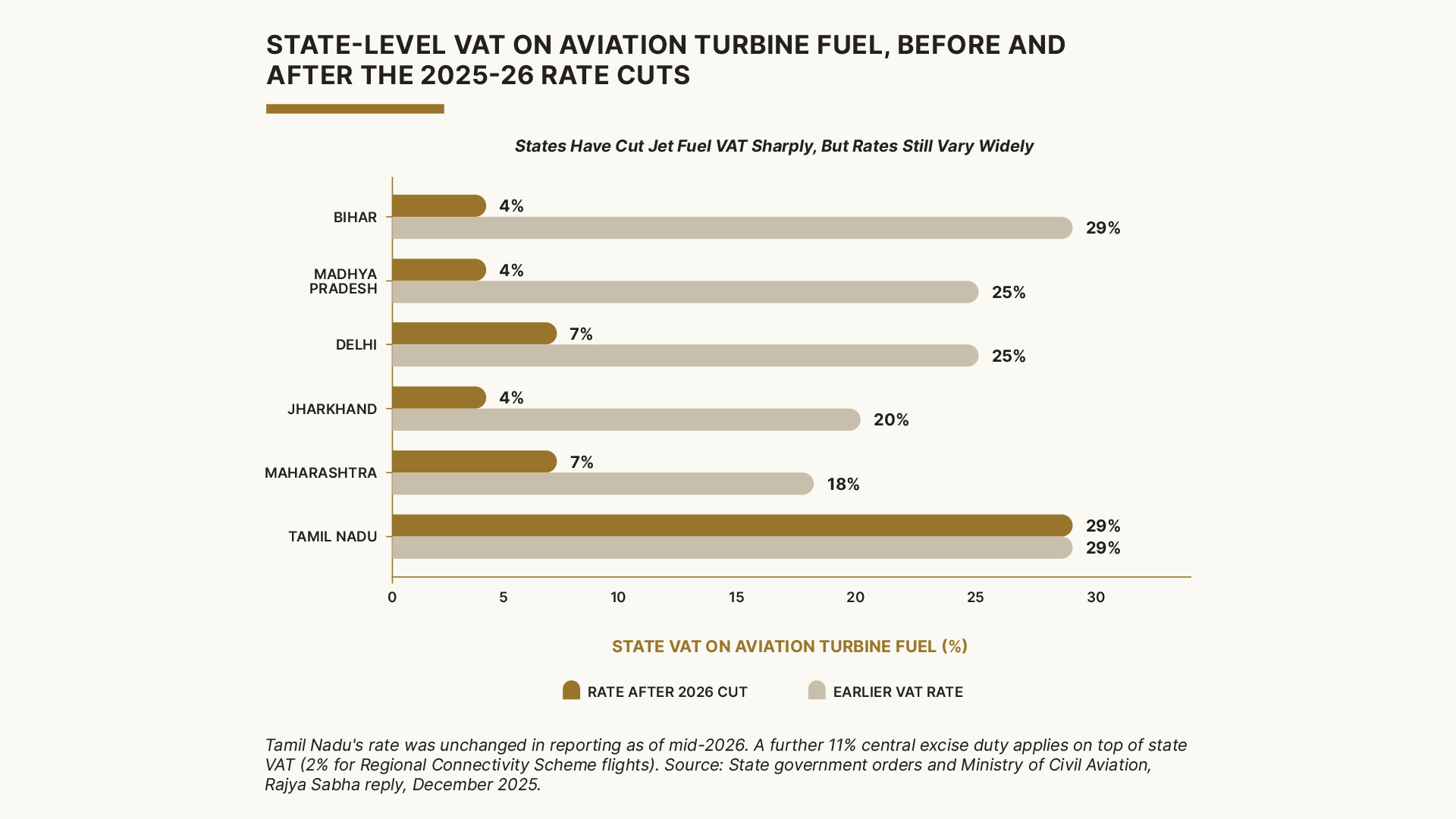
India taxes jet fuel more heavily than most aviation markets. On top of an 11% central excise duty, which drops to 2% for flights under the Regional Connectivity Scheme, individual states levy a separate value added tax that has ranged from 1% to 30% depending on where a plane refuels. Tamil Nadu and Delhi have historically charged among the highest rates, at 29% and 25%.
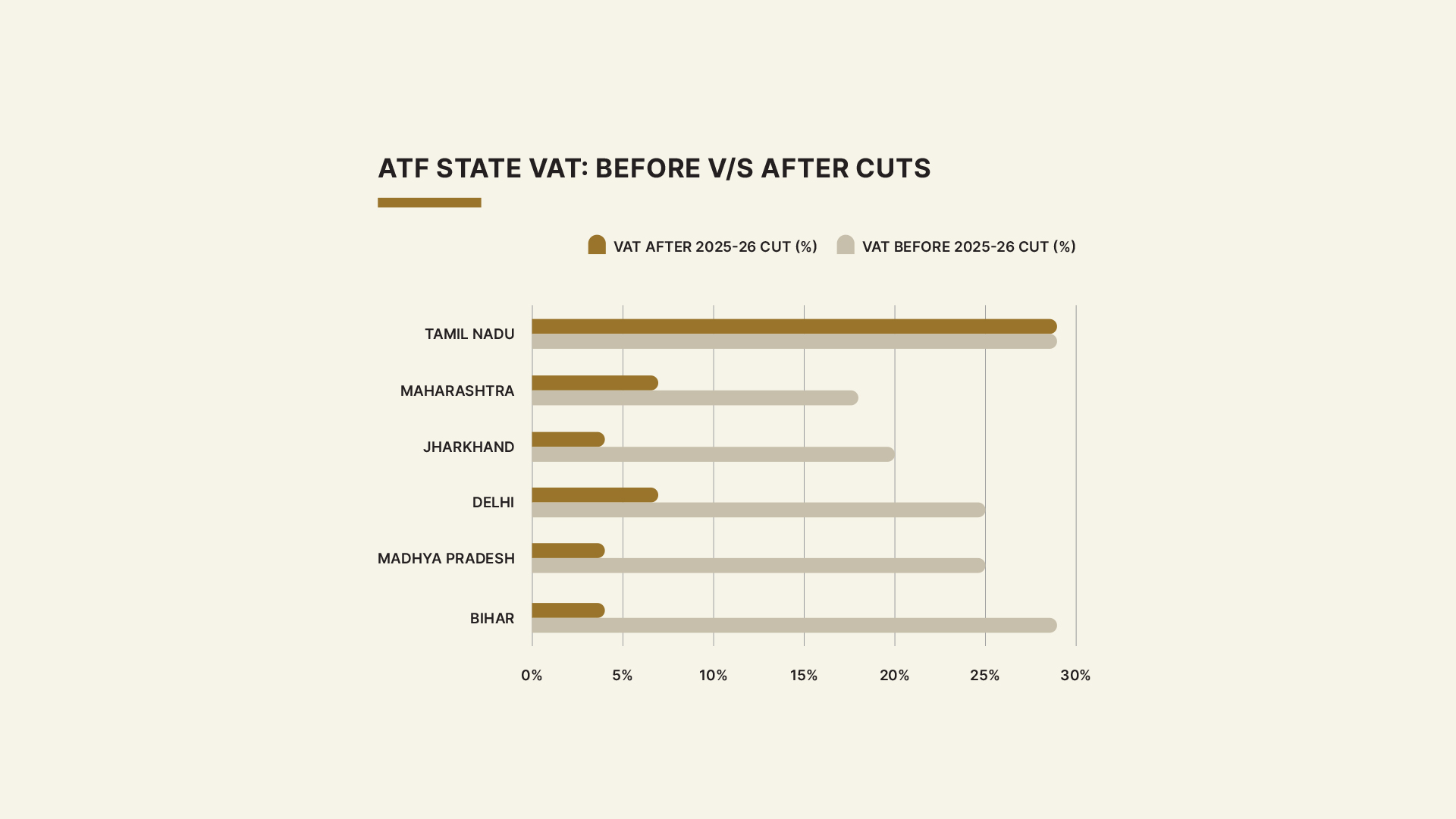
Facing airline pressure and rising fares, several states cut their rates sharply in 2025 and 2026. Bihar moved from 29% to 4%. Madhya Pradesh moved from 25% to 4%. Jharkhand moved from 20% to 4%. Delhi cut its rate from 25%to 7% in May 2026, and Maharashtra cut its rate from 18% to 7% around the same time. Tamil Nadu's rate stayed at 29% as of the most recent reporting.
The cuts help, but they are not permanent. Delhi's concessional rate is due to expire in November 2026 unless renewed, and an airline that has priced routes around a 7% VAT regime carries real exposure if that rate reverts to 25%. This is the structural risk behind India's air fares: the tax burden on the industry's highest single cost is set state by state, changes on short notice, and can reverse.
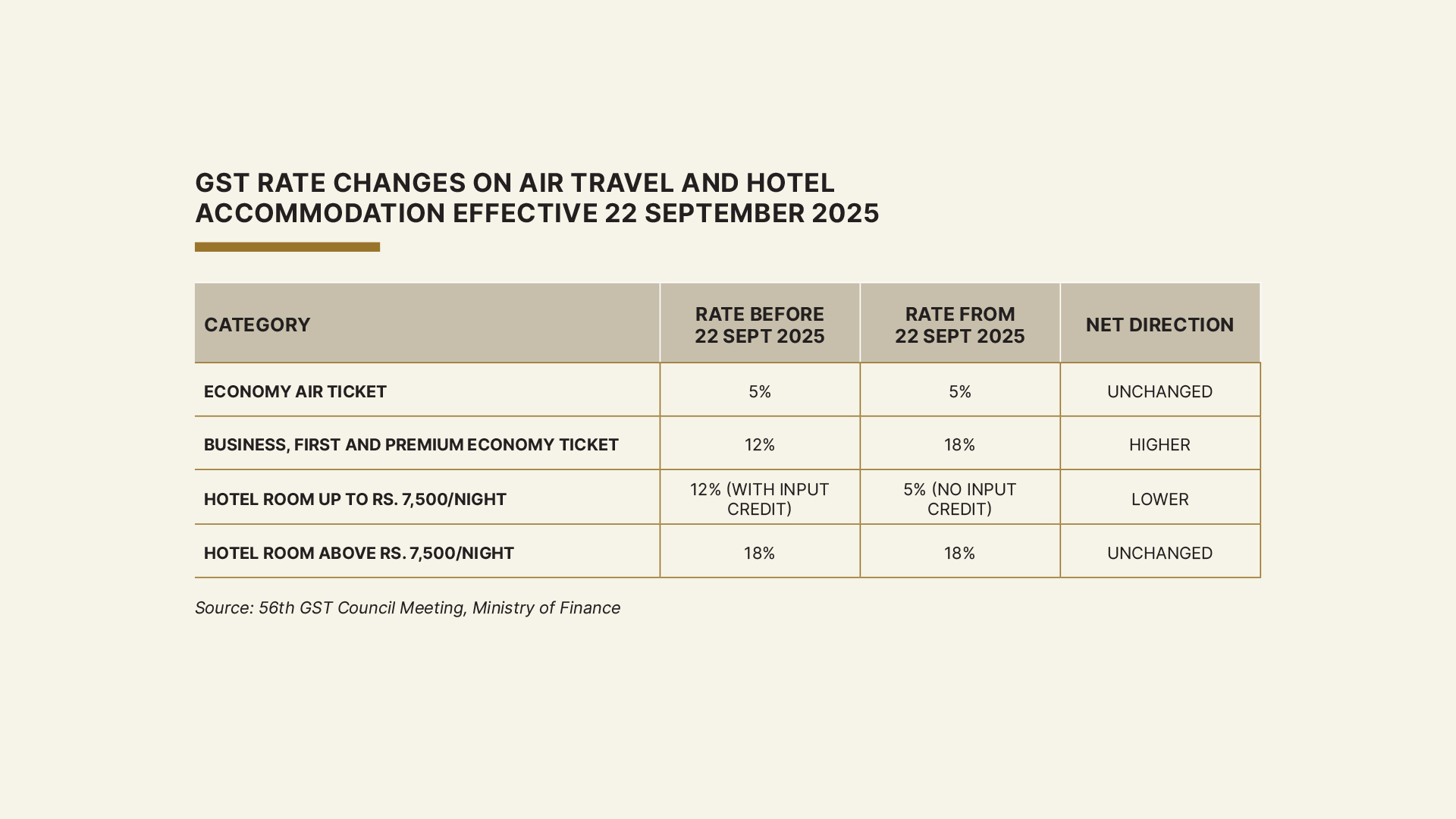
The Goods and Services Tax regime added a second layer of change in September 2025. The GST Council kept economy class air tickets at 5% but raised the rate on business, first and premium economy tickets from 12% to 18%, effective 22 September 2025. On the accommodation side, the Council cut GST on hotel rooms priced up to ₹7,500 a night from 12% to 5%, though hotels in this band lose the ability to claim input tax credit. Rooms above ₹7,500 a night stayed at 18%.
The net effect favours budget and mid-market travel and adds cost to premium travel and stays in India's higher-end hotels, the segment most closely linked to foreign leisure and business tourism. Industry estimates put the additional government revenue from the premium air travel hike at ₹6,000 to ₹8,000 crore a year.
A weaker rupee raises the real cost for foreign visitors
Currency adds a third pressure. The rupee was Asia’s worst-performing major currency in 2025, falling more than 5.5% against the US dollar for the year. It fell further in 2026, hitting an all-time low of 96.84 to the dollar on 20 May, before the Reserve Bank of India intervened with dollar sales and the rate eased back toward 94.
For Indian outbound travellers, a weaker rupee makes every foreign trip and every dollar-denominated hotel booking more expensive. For inbound visitors paying in rupees, it should in theory make India cheaper. In practice, the discount is being absorbed by higher jet fuel taxes, a higher GST slab on premium travel, and general price inflation across the hospitality chain, so the currency tailwind is not translating fully into a pricing advantage at the point of sale.
Government data on arrivals and earnings
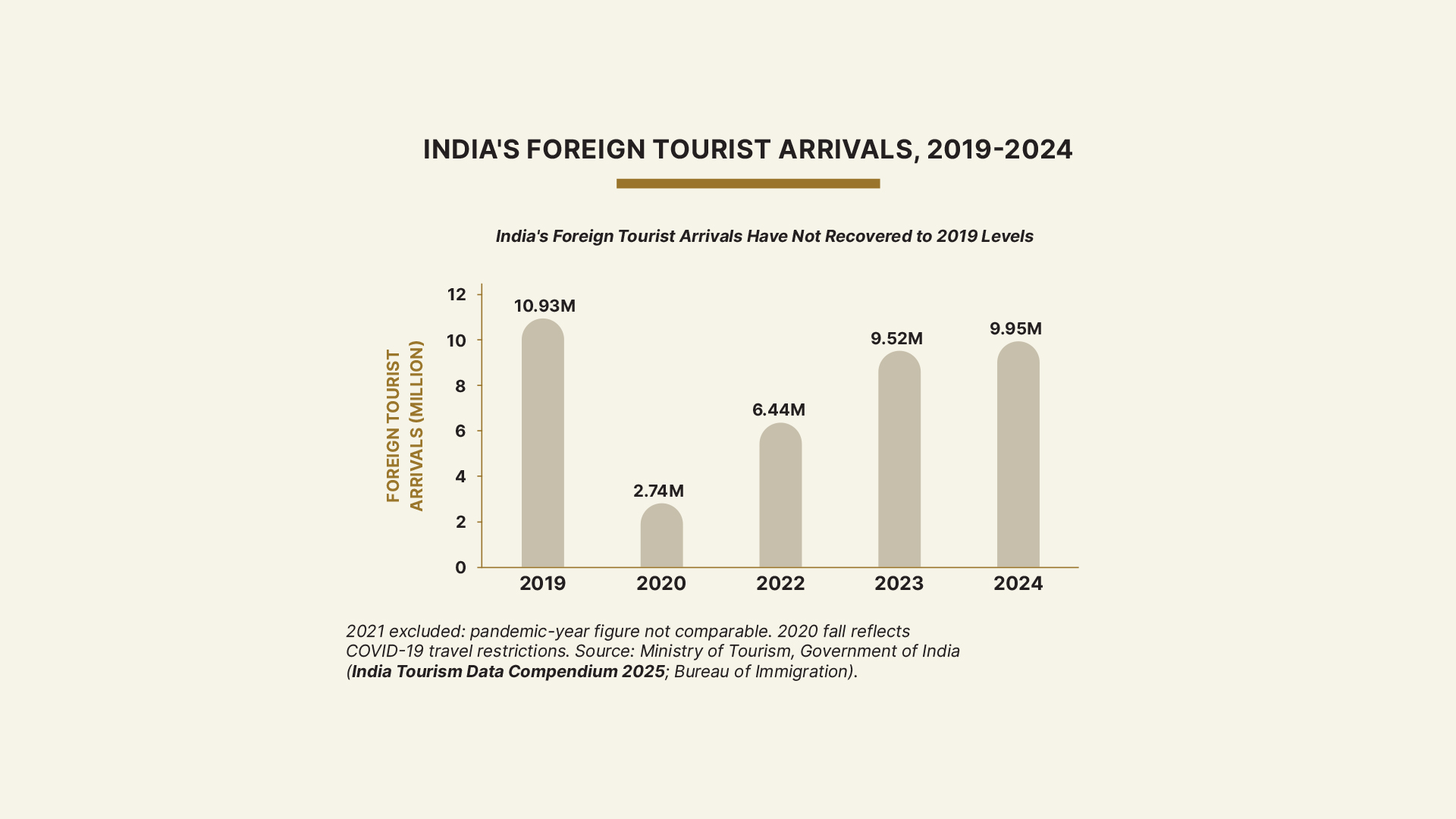
Foreign Tourist Arrivals to India have still not returned to the pre-pandemic level. The Ministry of Tourism recorded 10.93 million arrivals in 2019, a number that collapsed to 2.74 million in 2020 under COVID-19 restrictions. Recovery has been steady but incomplete: 6.44 million in 2022, 9.52 million in 2023 and 9.95 million in 2024, still short of the 2019 count by nearly a million visitors.
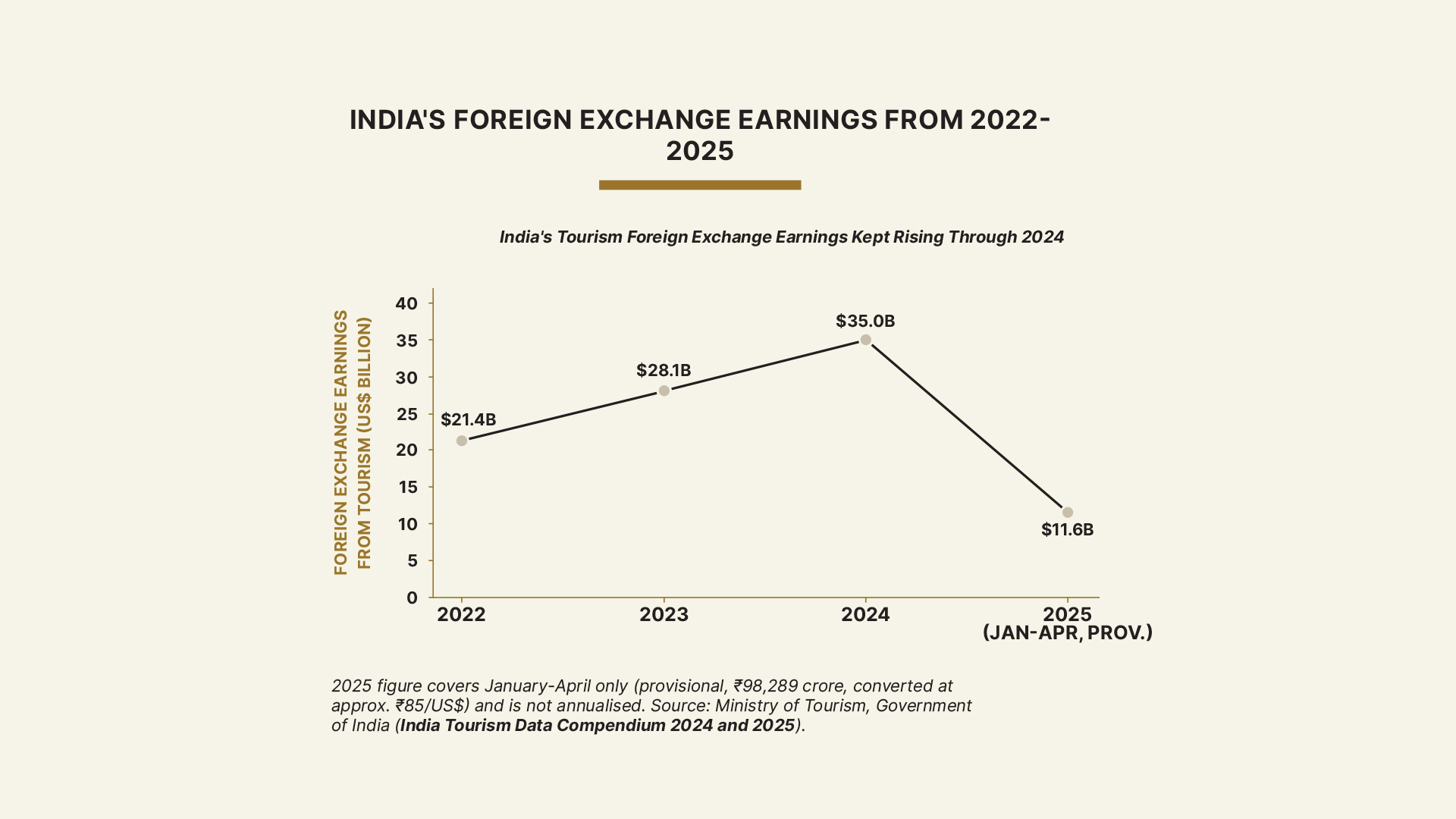
Foreign exchange earnings from tourism tell a more positive story. The Ministry's own compendium puts earnings at US$21.36 billion in 2022, US$28.08 billion in 2023 and US$35.02 billion in 2024, a rise of 31.5% and then 24.7% in successive years. Provisional data for January to April 2025 puts earnings at ₹98,289 crore, or roughly US$11.6 billion for four months, at broadly the same pace as 2024. Tourism contributed ₹15.73 lakh crore to India's GDP in 2023-24, or 5.22% of the economy, and supported close to 85 million jobs directly and indirectly, according to National Accounts Statistics and Periodic Labour Force Survey estimates cited by the Ministry.
Where India stands against competing destinations
India is not losing on price by every measure. While the World Economic Forum's Travel and Tourism Development Index 2024 ranked India 39th overall out of 119 economies, down from a 38th position in 2021, it gave India a Price Competitiveness pillar rank of 18, one of its stronger scores alongside air transport infrastructure at 26th and natural resources at 6th. The Forum also noted, across all economies it ranked, a broad decline in price competitiveness scores since 2021 due to global inflation and constrained travel supply, a pressure India shares with its competitors rather than one unique to it.
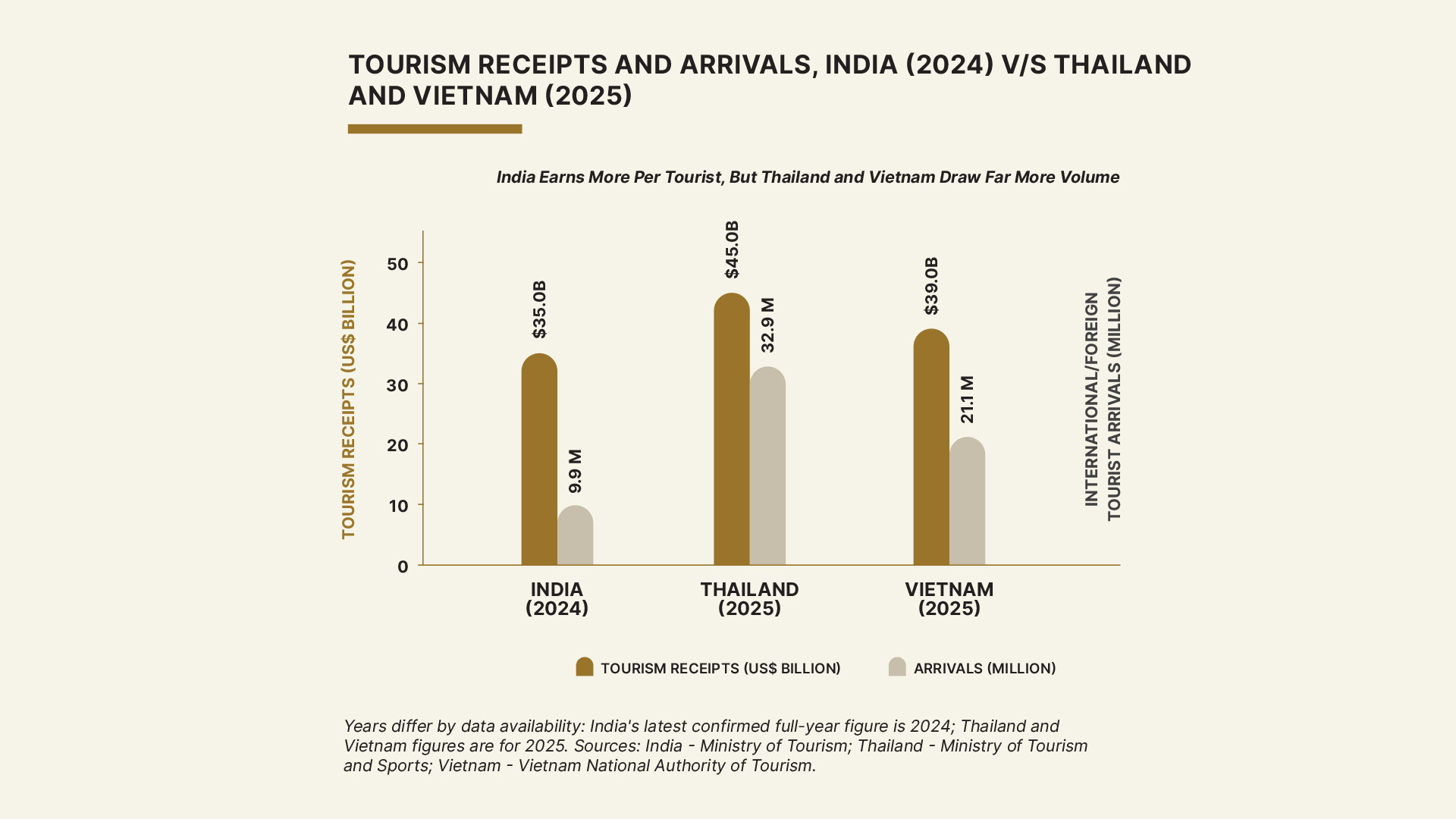
The volume gap with Southeast Asia is the sharper story. Thailand’s Ministry of Tourism and Sports recorded 32.9 million international arrivals in 2025, down 7.2% from 35.55 million in 2024 but still more than three times India’s count, and international tourism revenue of roughly US$45 billion. Vietnam had its strongest year on record in 2025, with international arrivals of about 21.1 million, up 20.4% year on year and 17.8% above 2019, and tourism revenue that crossed 1 quadrillion dong, close to US$39 billion, for the first time. Sri Lanka, a far smaller market, crossed 2 million arrivals in 2025 with India as its single largest source market.
Read together, the receipts-per-arrival math cuts in India's favour. India earned close to US$3,520 in tourism receipts per foreign arrival in 2024, well above Thailand's roughly US$1,370 and Vietnam's roughly US$1,840 per arrival in 2025, reflecting India's mix of longer-stay leisure travel, medical tourism and business visits. But that per-visitor strength has not closed the volume gap, and volume is what fills hotel rooms, seats and covers across the industry.
The counterargument
Not every indicator supports a story of eroding competitiveness. The GST cut in the budget, and mid-range hotel rooms should help exactly the segment most price-sensitive foreign and domestic travellers use. State governments cutting jet fuel VAT, even if temporary, show political appetite to bring down the largest cost line airlines carry. And India's Price Competitiveness rank of 18th globally is still ahead of several countries with larger tourist economies. The honest reading of the data is not that India has become expensive relative to the world. It is that the direction of travel on premium air tickets, on jet fuel tax volatility and on the rupee is now working against the industry at the same time the country needs stronger arrivals growth to close the gap left by 2019.
What this means for operators
If you run a hotel, a tour operation or a travel desk, three numbers are worth watching over the rest of 2026: the fate of Delhi's concessional ATF VAT rate when it comes up for renewal in November, the pace of foreign exchange earnings growth against the 2024 base of US$35.02 billion, and whether Vietnam's 20% arrivals growth in 2025 proves to be a one-year surge or a durable shift in regional market share. Each will shape how much room India's tourism and hospitality sector has to price competitively while absorbing higher input costs.
Sources: Ministry of Tourism, Government of India (India Tourism Data Compendium 2024 and 2025; Annual and Quarterly Tourism Snapshots); Ministry of Civil Aviation and DGCA; ICRA aviation sector note, April 2026; GST Council, 56th meeting notifications; state government VAT orders (Bihar, Madhya Pradesh, Delhi, Jharkhand, Maharashtra cabinets); Reserve Bank of India reference rate data; World Economic Forum, Travel and Tourism Development Index 2024; Thailand Ministry of Tourism and Sports; Vietnam National Authority
of Tourism; Sri Lanka Tourism Development Authority.