
















India Is Building World-Class Venues. But Where are the Rooms?
As world-class airports, convention centres and global events are scaling fast in India, its hotel-room pipeline is struggling to keep pace with its hospitality ambitions.


By Rachna Virdi
India is rapidly building world-class infrastructure like the airports, convention centres and event venues such as Bharat Mandapam and Yashobhoomi. But is its hotel infrastructure expanding at the same pace?
The recent BRICS Leaders Summit in New Delhi put the capital’s premium hotel inventory under intense pressure. Marquee properties sold out, rates started at ₹80,000 a night and crossed ₹2.55 lakh, while some suites reportedly reached ₹12–15 lakh.
India is commanding global attention at a defining moment. KB Kachru, President of the Hotel Association of India says, “As the nation cements its position as a premier MICE destination, the world is watching how we scale to meet our tourism targets. The summit alone put considerable focus on room inventory and that spotlight is exposing a hard truth: Our hospitality infrastructure has not kept pace with our tourism ambition.”
The central question: As India aims to become a global tourism powerhouse, can its hotel-room supply keep pace with growing demand?
Gaurav Sharma, MD, India Hotels, JLL, notes, “The room’s problem is not demand. It is delivery. India can now fly people into world-class terminals and seat them in world-class convention halls. What it cannot yet do, at the same speed and in the same cities, is put them to bed. That is not a summit anomaly. It is what happens when visitor infrastructure is built as a national mission and hotel rooms are still built as private real estate.”
He says that geography has moved faster than rooms. “New airports, expressways, convention venues and pilgrimage circuits have created demand in cities that never had a branded hotel of consequence. Tier-2 and Tier-3 already account for the majority of new brand signings and a large share of recent openings. The gap is no longer only Mumbai, Delhi and Bengaluru. It is the city next to the new airport, the temple town with a new terminal, and the industrial node with no midscale rooms within 20 minutes of the plant.”
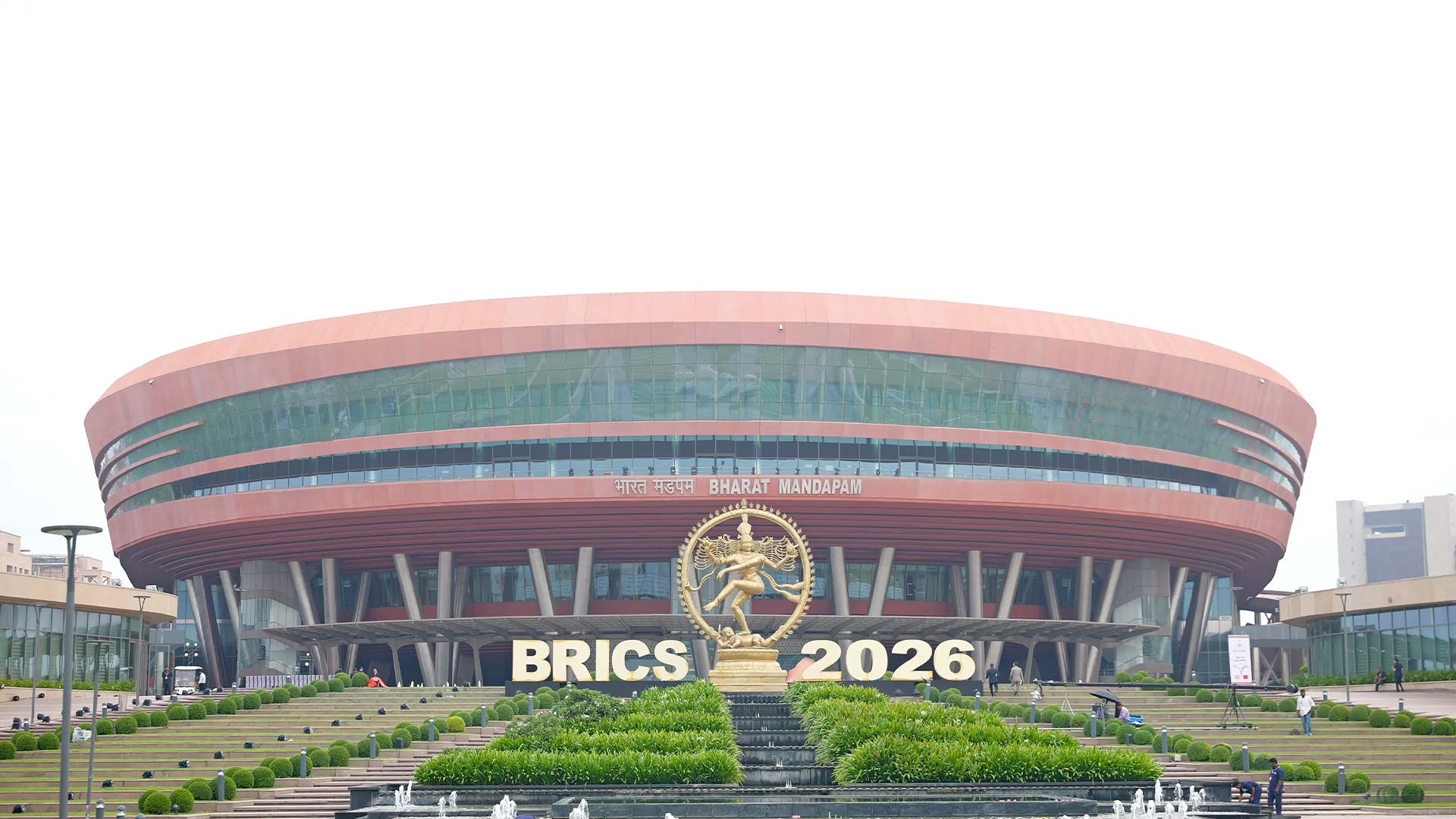
As India builds world-class venues like Bharat Mandapam and Yashobhoomi, the supply of hotel rooms is struggling to catch up.
Where the gap actually sits
“The summit had created a significant demand-led upswing in Delhi’s hospitality market, particularly for luxury hotels and the MICE segment,” agrees Atul Jain, COO, Best Western Hotels. “With international delegations, corporate travellers and event-related demand converging on the capital, several premium hotels witnessed strong occupancy and a sharp increase in room rates compared with normal periods.” He refers to the escalation as an event-driven spike, and says the underlying demand momentum should continue to support a healthy hospitality market in the longer term.
A closer look shows that the summit did not create the hotel-room crunch; it has only magnified an already tight market.
Kachru gives a fair scale of the significant room gap. “India has only about 200,000–220,000 branded hotel rooms, even as it increasingly seeks to position itself as a destination for global summits, conventions and business travel. This isn’t a metro-only story either. Tier-2 and tier-3 cities, driven by pilgrimage travel, leisure tourism, weddings, and infrastructure-led business demand, are emerging as equally urgent growth frontiers that need branded capacity just as much as our large cities do,” he says.
Can India close the gap by formalising existing unbranded inventory, or does it simply need far more branded rooms? Sharma replies, “The answer is not branded or unbranded. It is branded inventory plus conversion of the better unbranded stock, at a much faster approval and financing speed than we have today. Demand for branded rooms is projected to grow at roughly 8 to 10 per cent a year through FY28. Supply is adding, but not enough, not fast enough, and not in the right mix. A signing, however, is not a key. Execution is the bottleneck.”
He adds, “Unbranded hotels will remain the volume layer for domestic leisure, pilgrimage and price-sensitive commercial travel. But branded inventory brings the operating standards, security, distribution and financing credibility required by inbound, corporate and summit demand. Midscale and upper-midscale brands, not only luxury, are the workhorses. That is where the inverted pyramid in cities such as Delhi has to be corrected, and where Tier-2 growth will be won.”

Gaurav Sharma, MD, India Hotels, JLL.
The answer is not branded or unbranded. It is branded inventory plus conversion of the better unbranded stock, at a much faster approval and financing speed than we have today. Demand for branded rooms is projected to grow at roughly 8 to 10 per cent a year through FY28. Supply is adding, but not enough, not fast enough, and not in the right mix.
Gaurav Sharma
MD, India Hotels, JLL

How to accelerate hotel development
Capital, increasingly, is not the primary constraint, explains Kachru, pointing to more than 550 hotel signings in 2025, alongside 14,199 branded rooms added across 176 properties and another 64,118 keys signed for future development. The challenge is converting that pipeline into operating rooms.
What will determine whether this becomes capacity on the ground, especially with large global events on the horizon, is the execution speed. That, he says, requires faster clearances, genuine single-window approvals, rationalised state-level taxes and levies, wider infrastructure status and financing structures that make hotel development viable across city tiers.
Sharma too agrees that capital is available, but bankable, entitled land is not. “Delhi in particular exports demand to Noida, Gurugram and Aerocity because the capital’s own land and redevelopment rules cannot keep pace. That is a policy choice, not a market failure. Infrastructure status is still half-granted. Hotels remain social infrastructure only above a high project-cost threshold and, in older frameworks, only in million-plus cities.”
That leaves out the midscale box in a pilgrim town, the exact product India needs in volume. Without longer tenor and cheaper debt, developers default to smaller, slower or conversion-led projects rather than the 150 to 250 key hotels that events and inbound travel actually require.

KB Kachru, President of the Hotel Association of India.
India has only about 200,000–220,000 branded hotel rooms, even as it increasingly seeks to position itself as a destination for global summits, conventions and business travel. This isn’t a metro-only story either. Tier-2 and tier-3 cities, driven by pilgrimage travel, leisure tourism, weddings, and infrastructure-led business demand, are emerging as equally urgent growth frontiers that need branded capacity just as much as our large cities do.
KB Kachru
President, Hotel Association of India
So what needs to change?
India’s hotel pipeline is growing. The more consequential question now is how quickly signed projects can become operating rooms. Because as the country builds the infrastructure to bring the world in, hotel capacity is becoming the last mile of its tourism ambition.
Airports and venues are coordinated public infrastructure but hotels are not. “Airports move because they sit inside a concession, a single-purpose authority, assembled land and a financing stack that treats them as infrastructure. Hotels sit across municipal zoning, fire, pollution, food safety, liquor, police, labour and local-body layers. A hotel in India still typically takes 36 to 48 months from approval to commissioning, against 12 to 18 months in competing ASEAN markets. Every extra year at 11 to 14 per cent project-finance cost is destroyed before the first guest arrives.”
Hotels need true infrastructure status, longer-tenure financing and easier access to airport- and venue-adjacent land to accelerate development. Alongside greenfield projects, faster conversion of independent hotels into branded, standardised inventory could add rooms at scale.
“India has already shown it can build airports and event infrastructure to global standards. The remaining gap is institutional, not conceptual: treat the hotel as part of the same infrastructure stack, cut the years between signing and opening, and put midscale branded rooms next to the airports and venues already built. Until that happens, every major summit will keep teaching the same lesson, at six figures a night.” concludes Sharma.