












The Chariot Economy
Every July, the Rath Yatra brings millions of pilgrims to Puri and pushes Odisha's hotels to near-full occupancy. Hotels have begun recognising the potential of the religious festival.

By Chandreyi Bandyopadhyay
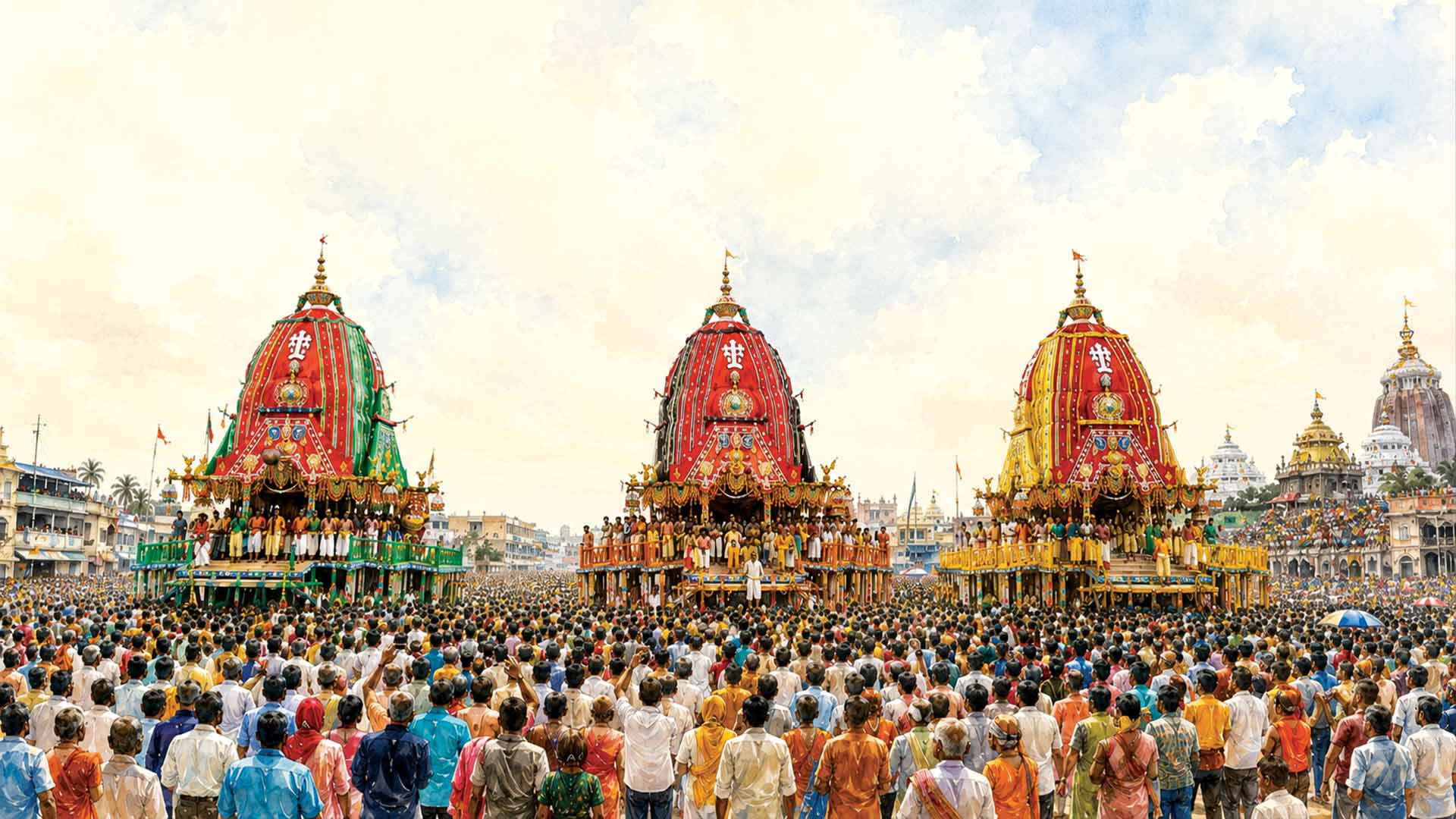
Every July, the tourist traffic in Odisha changes character: buses packed to their roofs, families walking, the occasional group singing bhaktigeet in chorus. By the time the Grand Road of Puri comes into view, multi-storey-tall wooden chariots await its carriers—the pilgrims. The Jagannath Rath Yatra has often become a traveller’s first introduction to Odisha.
Jagannath Yatra, the revered chariot procession in the beach town of Puri, surpasses many cultural phenomena in India, inviting millions of tourists seeking the blessing of the deity, believed to be an avatar of Lord Vishnu. As the story goes, the idol was carved by Vishwakarma, the divine architect, who left the work unfinished when the king broke his promise of not looking in before the sculpture was complete. Odia tradition, however, doesn't read that as a flaw, but as a god who resists being fully rendered, in a state of perpetual impermanence.
For nine days, the god leaves the sanctum and becomes part of the people. The chariots are pulled by hand, on ropes anyone can grab, and pilgrims who would ordinarily be barred from the temple's inner sanctum (by caste or by circumstance), can stand beside the deity, forming the appeal of the unique festival to masses.
Big budgets
The festival draws millions of visitors, filling hotels, homestays and guest houses. “It brings visitors to the state, but it also encourages them to experience Odisha more deeply. As a homegrown brand, it’s rewarding to be part of that journey and introduce guests to the warmth and character of the region,” says Sonal Sahoo, Co-founder, Lyfe Hotels & Resorts Bhubaneshwar.
Recognised as an economic driver, the 2026-27 Odisha State budget set aside ₹1,000 crore for a Shree Jagannath Interpretation Centre, alongside funds to restore other key sites to appeal to tourists beyond the already popular beach, Konark Temple, Dhaulagiri stupa and the Udayagiri and Khandagiri caves. A coastal tourism project at Shamuka, tied to the upcoming Puri International Airport, is meant to extend that appeal well past the festival calendar.
About 95% of rooms in the region were booked for the 2026 Yatra. Taj Puri Resort & Spa welcomed a diverse mix of guests this year, including corporate leaders, entrepreneurs, HNIs, leisure groups and families for the 10-day period. “Many chose to extend their stay beyond the festival, combining the spiritual experience with wellness, regional gastronomy, beach time and explorations of Odisha's rich heritage,” says K Mohanchandran, Senior Vice President - Operations, Taj Puri Resort & Spa.
From Bhubaneshwar to Puri, the impact of the event is far reaching. “While Puri is naturally the centre of the celebrations, Bhubaneswar benefits as the gateway to the state. Many guests begin or end their journey here, giving them time to explore the temples, museums and a growing food scene,” informs Sahoo.
Room for growth
Tourism accounts for close to 13% of Odisha’s state GDP, and the Rath Yatra is a concentrated demonstration of that weight. In fact, the state tourism board recorded a 22% jump in visitor numbers with over 5.6 million in 2026, driven majorly by the event, reaffirming its tourism potential.
Accor is expanding in eastern India, opening Novotel Bhubaneshwar Janpath in July 2026. “As the first internationally branded hospitality destination in the Temple City, this marks an important milestone,” says General Manager Neelabh Sahay. Designed for families and business travellers, the hotel located near the Biju Patnaik International Airport offers great connectivity and convenience for movement between venues of the festival.
Responding to cultural tourism growth, hotels such as The Belgadia Palace in Mayurbhanj exposes guests to the state's second most auspicious Rath Yatra, where only women have pulled Goddess Subhadra’s chariot for the past 50 years. “This is one of our most popular experiences booked out weeks in advance with a 10% year-on-year growth in inbound tourists,” says Akshita M Bhanjdeo, Co-Owner, The Belgadia Palace.
Since monsoon rains are an essential element of the festival period, it is not traditionally considered a tourist season. “We get additional bookings for spillover crowds around Bhubaneshwar at this time, but beyond the festival, the impact does not stay for long as we attempt to showcase the offbeat art and crafts and culture of Odisha that the hype crowd is not interested in,” informs Indrani Chakraborty, Founder, Svanir Wilderness Ecostay.
For MAYFAIR Hotels & Resorts, which has three properties in Puri and adjoining areas, it translates directly into near-full occupancy during the festival window and one of their strongest yield periods of the year. Bjorn DeNiese, Managing Director, MAYFAIR Elixir says, “With travellers from across India and overseas, it creates a ripple effect way beyond the nine days of the festival. It benefits hotels, local businesses, artisans, and transport operators.”
For an event that just lasts nine days, the Rath Yatra is increasingly influencing investment decisions that extend far beyond the festival itself.