










Where Art Checks In
From the M.F. Husain triptych at the Taj Mahal Palace, Mumbai to Fairmont Udaipur Palace's native art influences, art has become infrastructure, shaping identity, sustaining craft, and offering what no loyalty programme can.

By Deepali Nandwani
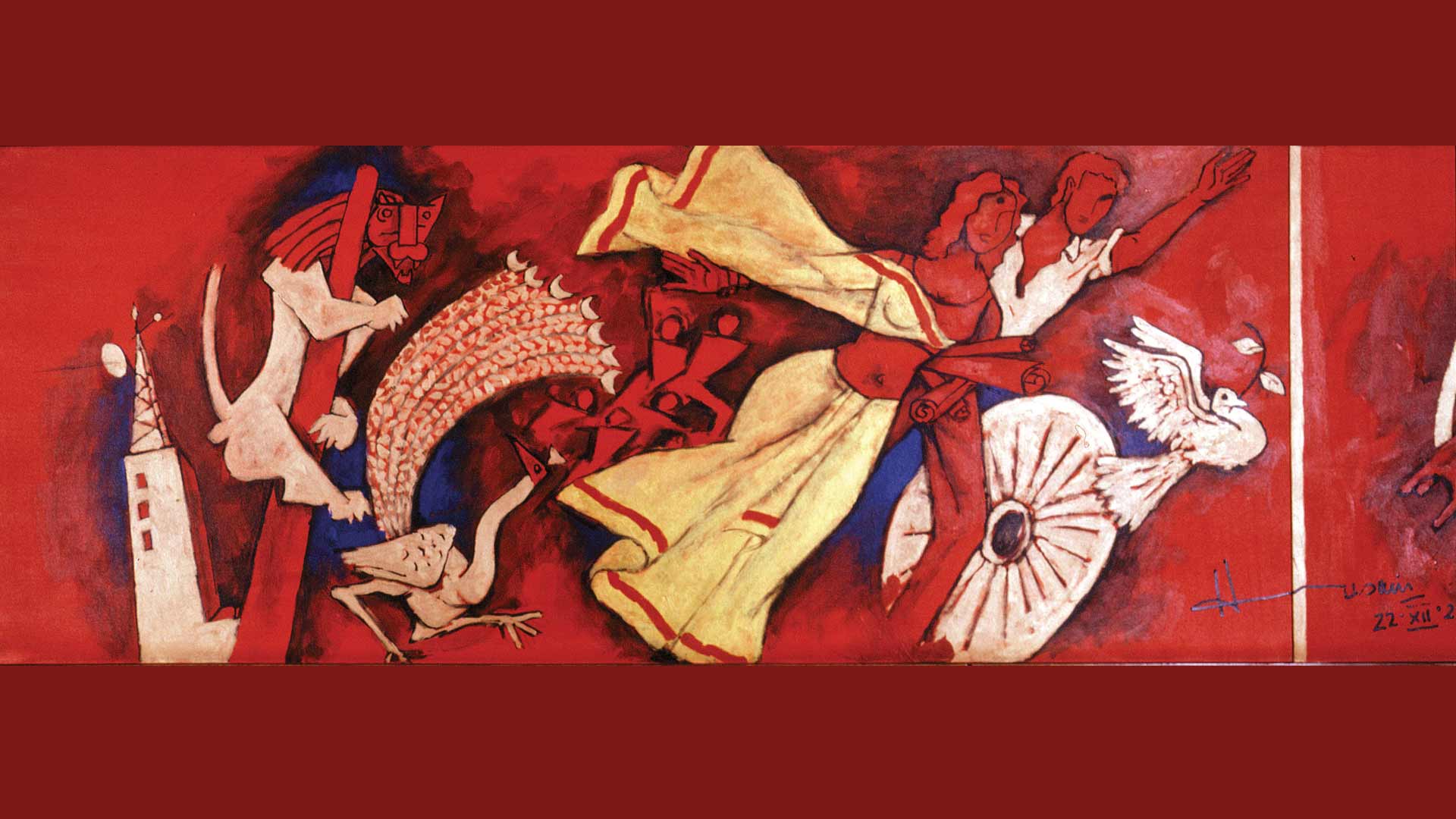
It is hard to miss Three Stanzas of the New Millennium as you walk into the lobby of The Taj Mahal Palace, Mumbai. The triptych by M.F. Husain hangs where every arriving guest must see it, bold and busy with the horses and women that recur across his work, with equations and molecules threaded between them. Less obvious is how it got there. Husain did not send the painting in a crate; he set up an easel in the lobby itself and, by his own admission, took far longer than he needed to—close to six months of living in the hotel—because he was in no hurry to leave. Commissioned by the hotel's then general manager Ravi Dubey around the turn of the millennium, it was the first artwork at the Taj created for a specific spot rather than bought and hung.
That distinction—art made for a place versus art acquired and installed—is the story of Indian hospitality at the moment. For most of the last century, art in a grand hotel signalled wealth and permanence. But in the last two decades, it began to localise global brands, giving a room in a global chain a reason to feel like Mumbai or Mewar; it became the largest source of private patronage for crafts that state culture departments only promise to protect; it started shaping the guest's path through a building; and, increasingly, it became commerce in its own right, with collections that are catalogued, valued, walked through on guided tours, and occasionally sold.
Ask the country's biggest hotel collector what the art is for, and the answer stays close to identity. "For over a century, Taj has celebrated India's rich cultural heritage," says Taljinder Singh, Senior Vice President, IHCL. "Our art collection, spanning more than 4,000 works and over 100 museum-quality masterworks, reflects the diversity of our country's artistic expression. These pieces serve as cultural touchpoints that connect guests with the contributions of some of India's most noted artists. We remain committed to preserving these works, creating an archive of modern Indian art."
The Leela Palaces, Hotels & Resorts, which has built one of the country's fastest-growing hotel collections, puts it more bluntly. "For us, art has never been an element of decor; it is an expression of identity and one of the defining pillars of luxury," says Anjali Mehra, Executive Vice President, Brand and Communications. "Today's luxury traveller seeks meaning, craftsmanship and experiences that cannot be replicated. Art creates an emotional connection to place, transforming a stay into an immersive cultural journey." Two of India's largest collectors describe their walls in almost identical terms: not as decoration, but as identity.
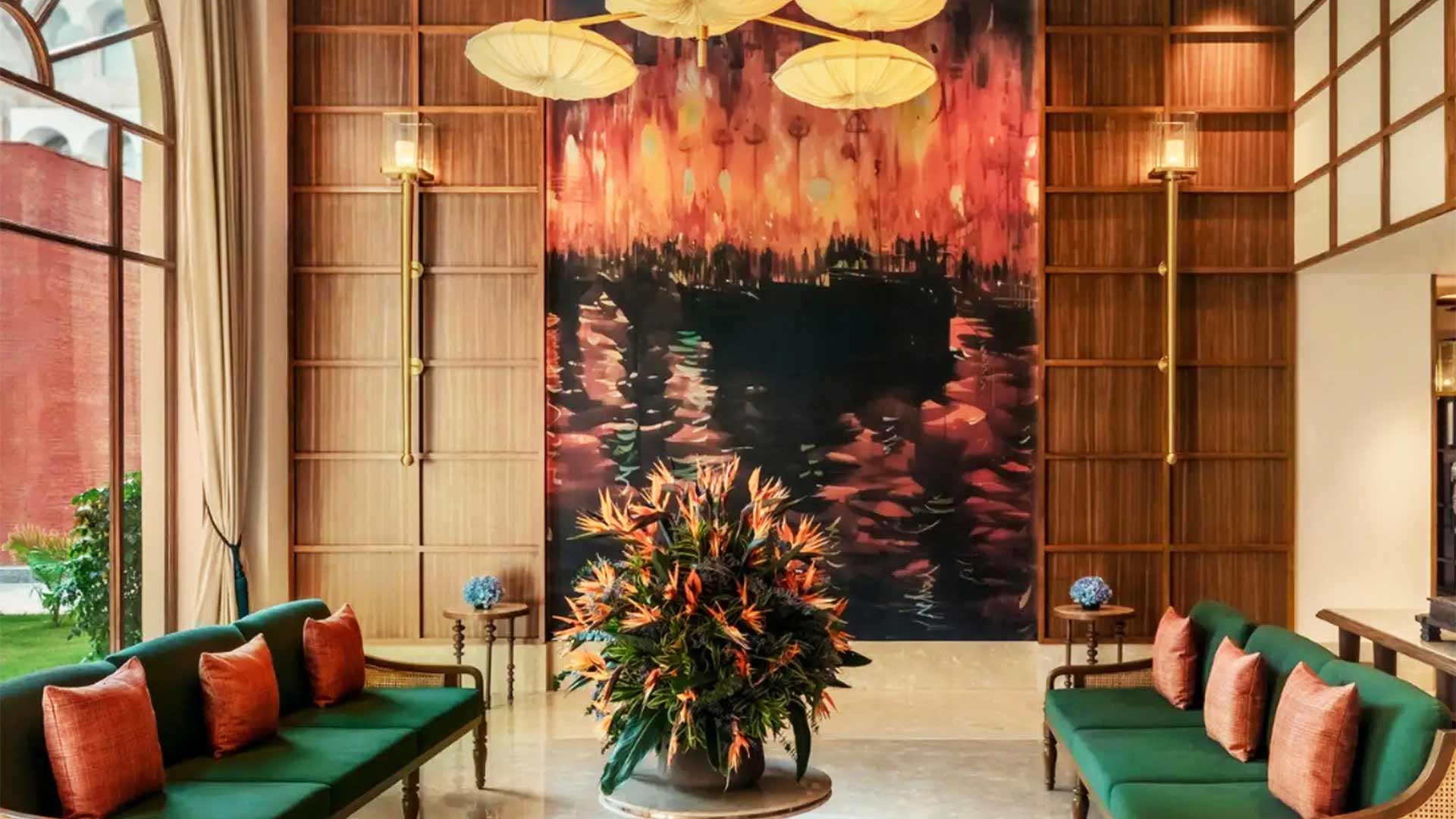
Taj Ganges, Varanasi, designed by Bobby Mukherji, draws its palette from the city's ghats and temples—marigold yellows, auspicious reds and golden ochres carried through bespoke artworks, sculptural accents and stained glass.
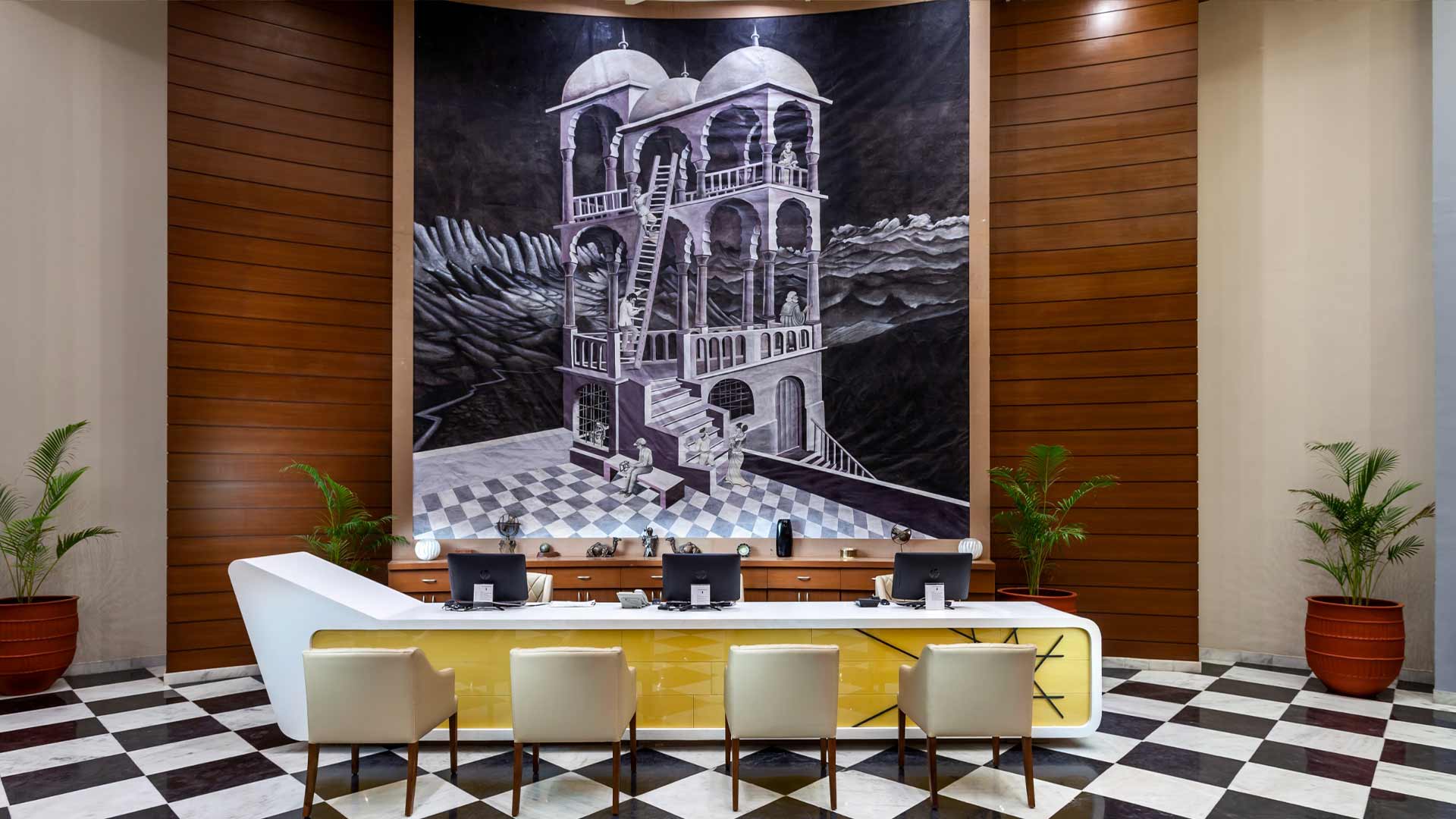
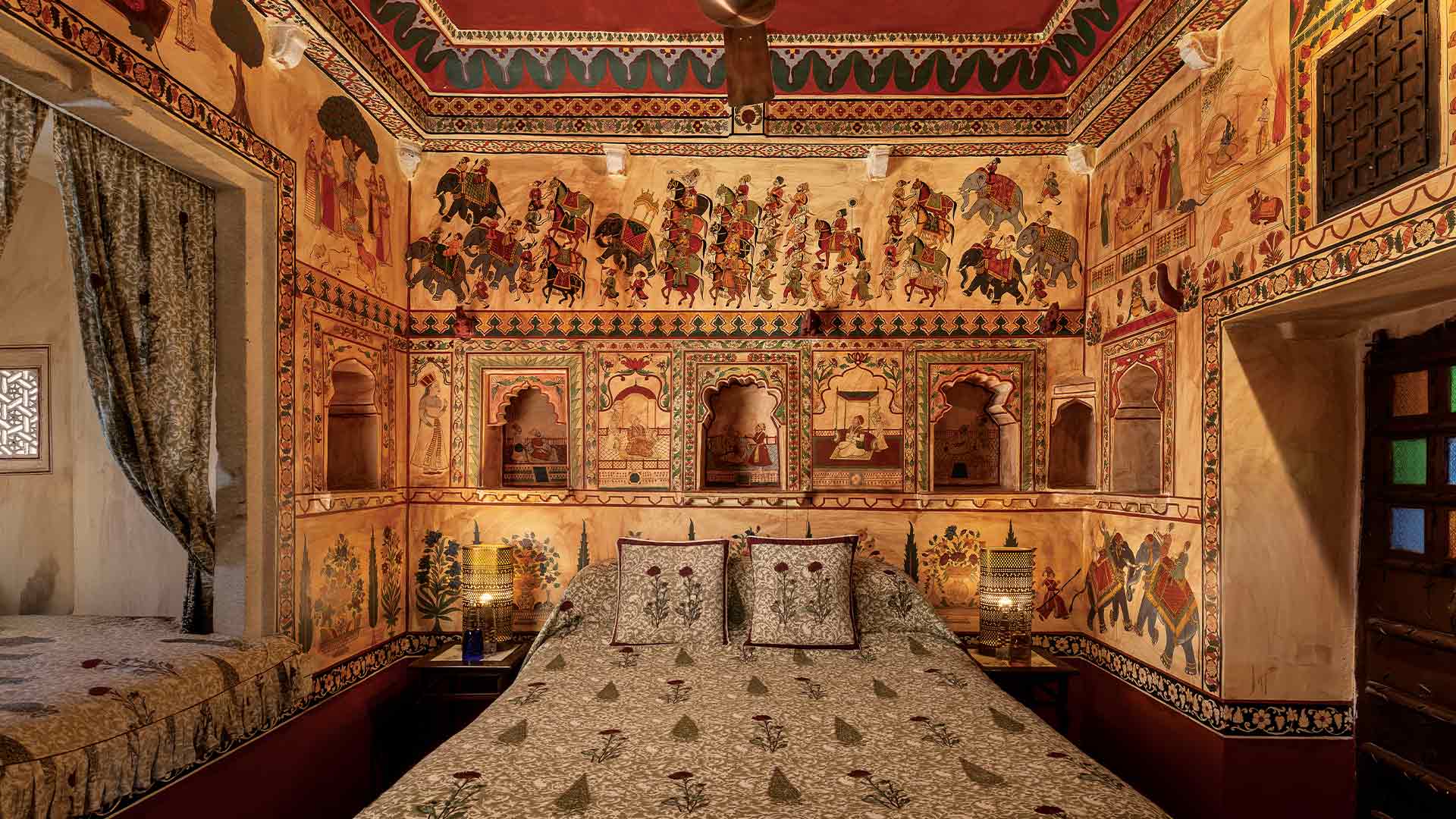
Chitrashaala, jüSTA's annual artist residency at Lake Nahargarh Palace, borrows its name from Bundi's storied painted gallery and gathers artists to paint in the spirit of that legacy.
From trophy walls to lived encounters
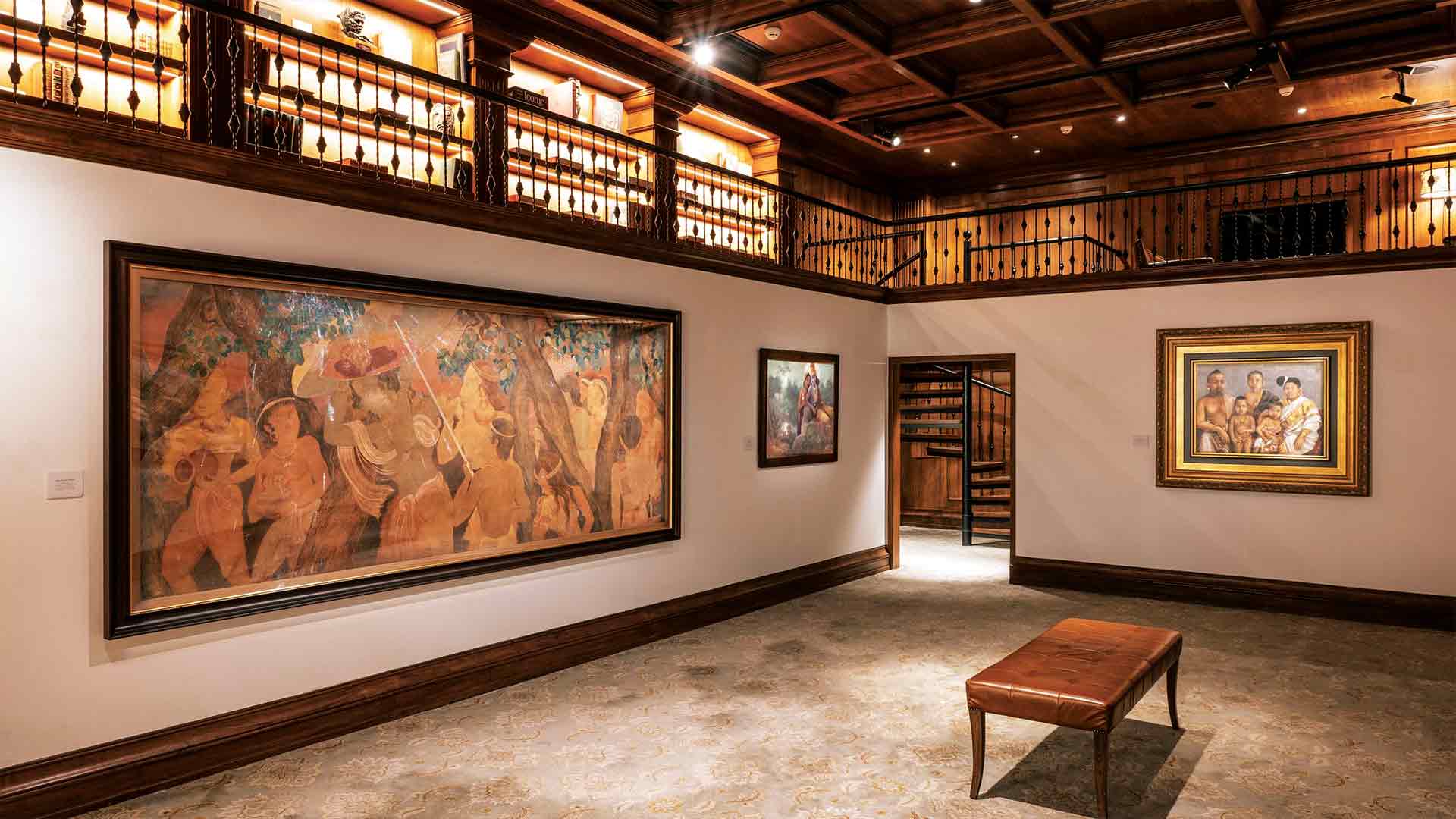
The old model of art bought rather than commissioned on-site, is best read at the Taj Mahal Palace, Mumbai, whose collection traces Indian modernism from the mid-1960s to the early 1980s, with works by V.S. Gaitonde, Ram Kumar and Jehangir Sabavala, the last of whom had a personal association with the hotel, his father having been part of its senior management. Much of it was gathered through the Taj Gallery, which operated inside the hotel for decades. A 2002 cataloguing exercise rediscovered works that had slipped from view; two Gaitonde abstractions later travelled to the Guggenheim Museum in New York. The hotel has hosted Amrita Sher-Gil and, of course, Husain.
Some pieces carry stories now part of history: in the Palace Wing reception hangs a canvas jointly painted by the modernist Laxman Shreshtha and Ratan Tata for the Khushi charity auction in 2006, valued then at around ₹75 lakh. Tata had offered to contribute a single brushstroke; Shreshtha insisted that real collaboration took time, and Tata reportedly spent several days working up to nine hours under the artist's guidance. Hidden in the finished work is one stroke that is his alone: "The Tata Stroke".
ITC built its own version through corporate policy rather than a single family's taste, under a decades-old initiative called WelcomArt. At the ITC Maurya in Delhi, Krishen Khanna's The Great Procession was painted onto the lobby dome over years, and remains one of the most significant murals in modern Indian art. Tthe collection around it runs to hundreds of works and includes Akbar Padamsee's Metascapes.
The new model of commissioned art looks nothing like this. At The Postcard Mandalay Hall in Kochi, five rooms have been turned over to artists entirely: Sushanta Maharana works through the idea that heaven always existed alongside the realities of earth in one; another holds Anju Acharya's work; another nods to Dibin Thilakan's Ode to Home; the top-floor room carries Giuseppe Stampone's drawings made with blue and black BIC pens. You do not walk past this art; you sleep next to it, and you engage with it in public spaces.
Between these poles sits a third instinct, smaller and more personal. jüSTa Hotels, a two-decade-old Bengaluru group, has organised an entire brand identity around art, not by buying masters but by working with artists. Through an annual residency called Chitraashala, begun in 2009, it brings artists together, acquires what they make, and hangs it across its hotels. "We are not a cookie-cutter brand," says Founder and CEO Ashish Vohra. "One of the reasons we have got all these people here is that we want to own that art positioning very honestly. Because unless you communicate it and people talk about it, that association is never reinforced. It is truly a differentiator for us. That makes us feel proud."
Vohra's foray into art was sheer serendipity. On a buying trip to China, he picked up art he thought was cheap and good, until a friend asked where he had found the trash, then took him to Shantiniketan instead. "I was really amazed and touched by the level of creativity, and the amount of poverty," Vohra recalls. One artist needed ₹50,000 for his pregnant wife; Vohra sent the money and told him to send back whatever he wanted, and 25 to 30 works arrived. He and his wife, designer Deepika Govind, began paying small monthly scholarships to young artists. Today the group buys 100 to 200 works a year, and Vohra is candid that his interest sits below the top of the market. "The moment you leave the top-end of the spectrum—the A-listers—the costs are not so prohibitive. Yet the value they deliver in terms of experience or visual delight is phenomenal." He wants each hotel to hold work it can sell, so the artists benefit too. "Art creates an identity," he says. "Over a period of time, it can only get strengthened."
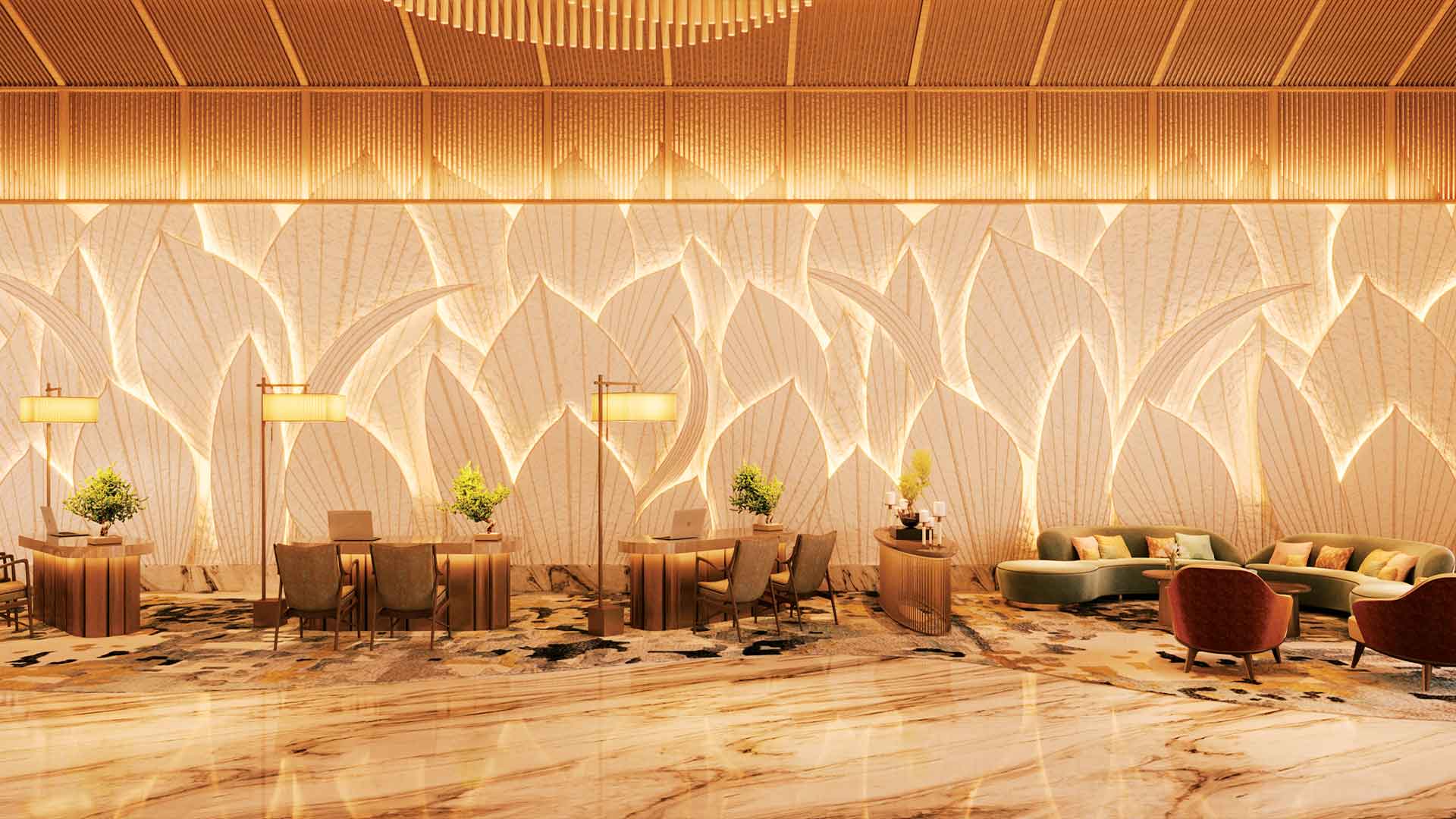
A luminous sculptural installation lights the lobby of Taj Mussoorie Foothills, Dehradun, designed by Bobby Mukherji, echoing the Himalayan foothills that frame the hotel.
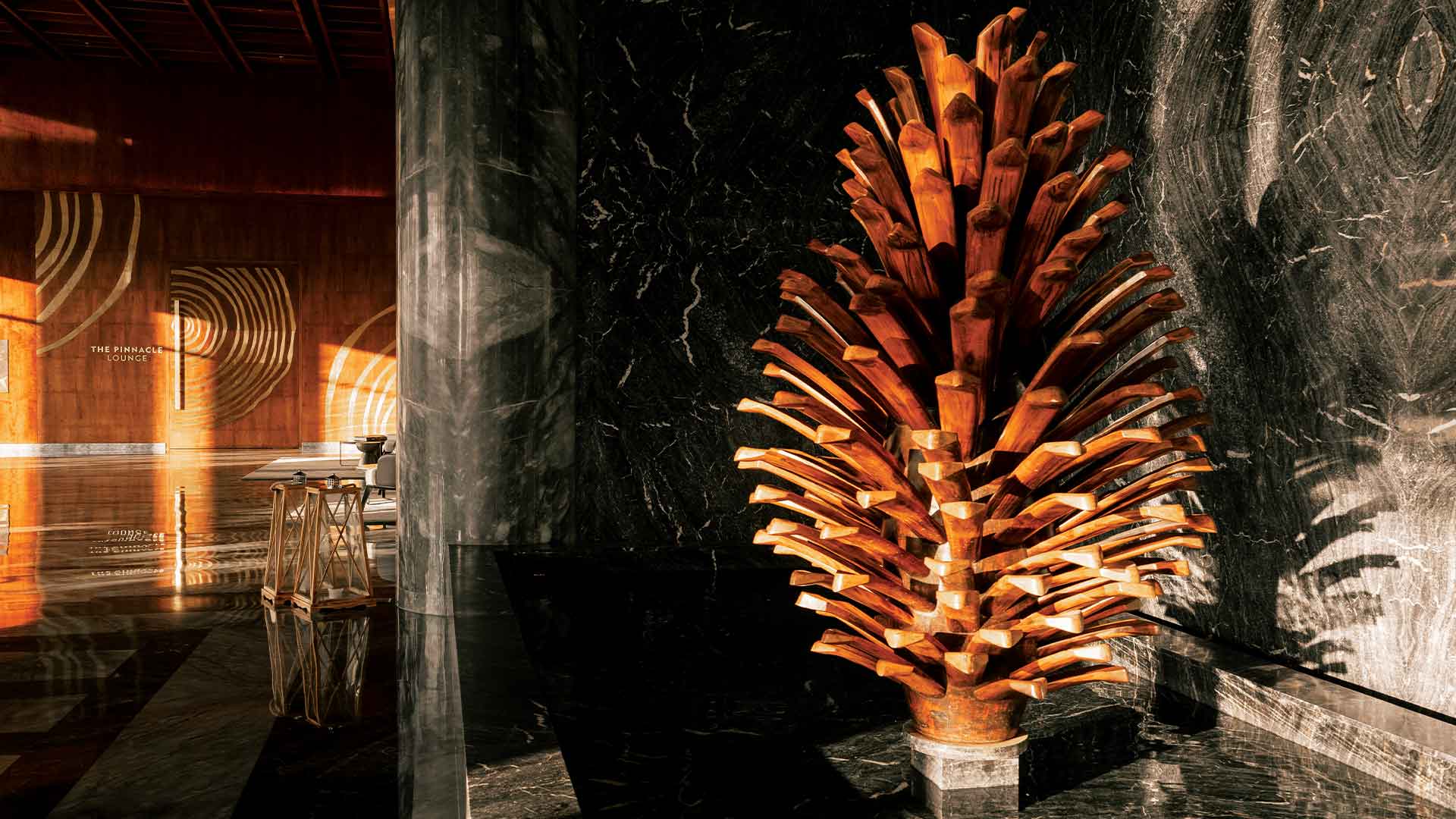
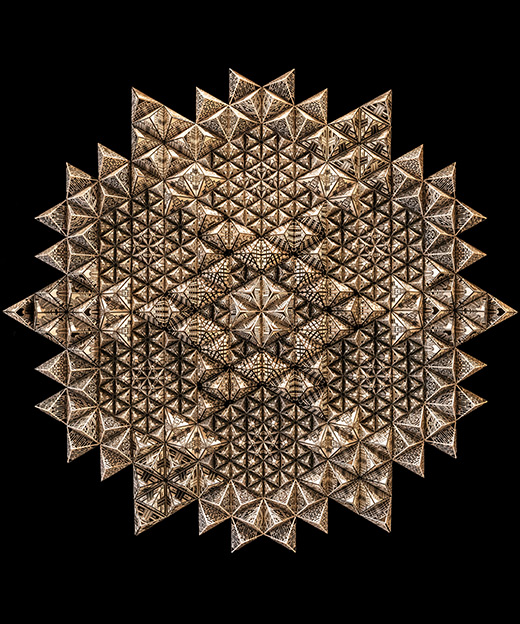
Baaya Design's brass pinecone sculpture anchors the lobby of Hyatt Regency Dehradun, a nod to the Malsi Forest and the pine-clad Himalayan foothills just beyond the glass.
For over a century, Taj has celebrated India’s rich cultural heritage. Our art collection, spanning more than 4,000 works and over 100 museum-quality masterworks, reflects the diversity of our country’s artistic expression. These pieces serve as cultural touchpoints that connect guests with the contributions of some of India’s most noted artists. We remain committed to preserving these works creating an archive of modern Indian art.
Taljinder Singh
Senior Vice President, IHCL

Curating for hospitality
Curating for a hotel is a different craft from curating for a gallery. A guest arrives to sleep, eat, work and leave, and the art has to work around all of that: without wall texts, in corridors designed for circulation, in coastal humidity, on surfaces guests will touch.
Venu Juneja, who curated both Fairmont Mumbai and its eclectic neighbour Roswyn, A Morgans Originals Hotel, describes the job as storytelling before it is art-buying. "When I work, it is never about the artist. It is never about me either. It is about the story you have to tell," she says. "I am not looking for a fancy artist. I am looking for someone who can translate my story into the art they are really good at." That someone is often not an artist at all in the gallery sense. "It doesn't have to be an artist. Just someone really good at their craft. I have picked up people from the street. When I am walking, and I see someone doing great pottery, I know this person knows the inside of that pottery, and I would take that person." For the embroidered canvases behind the sofas at Roswyn, worked in Kantha and Phulkari, she went looking for a Kantha artist, "the typical people who do great work in villages".
That emphasis on storytelling is echoed by Shibani Jain, Founder and Creative Director, Baaya Design, who describes her practice not as curation but as "art design": her team develops a narrative that runs through an entire property. "We create a story around the art across the property," she says. “For hospitality, you really have to tell a story and spin it across in an interesting way, giving the space an identity that resonates with its environment and, sometimes, with local crafts.”
Her sharpest point is one every honest curator makes eventually: freedom is a myth, and constraint is the point. "You work as a team, and you are the person who carries the story forward from the interior designer. It could be tough sometimes, but that is my job." What she fights for is not autonomy but meaning. Handed a business leadership club to fill, the kind of space that usually ends up with "corporate art, the typical leadership photographs, which is actually very, very boring", she built the room around wellness instead: playful, reflective work about the human body, a "brain vending machine," a thousand-book library on wellbeing. "Why would someone come here but for the money and the space? To look at the art? No."
Interior designers and architects, who often make the actual art decisions, are blunter about the economics. Bobby Mukherji, Founder, Bobby Mukherrji Architects, points out that art frequently does a job nobody in the brochure will admit to. "In a more frugal interior spend on finishing the surfaces, art can play an important role in camouflaging that frugality," he says. "You can tastefully create an interior space where art distracts your eye, which covers up the flaws in the rest of the space. I do this often when budgets are tighter." Art here is not a trophy but a tool, cheaper than stone cladding. He is impatient with the lazy version of local flavour, "some scenes of the Brooklyn Bridge or a jazz scene of New York, which is so typical"; real sense of place means going deeper, not a clear photograph of Jantar Mantar, for instance, but its surreal geometric forms.
For Asha Sairam, Principal, Studio Lotus, the danger is leaving art too late: once the building and its surfaces are resolved, the artist or craftsperson can easily be reduced to embellishment. Get in early and craft becomes structural—the façade, an enclosure, a floor, a piece of furniture. She is wary of the universal, brand-led look: "It may offer expediency, but it can also create a situation where you no longer know whether you are in Delhi, Mumbai, Gangtok or Paris." At RAAS Chhatrasagar, a flock of flamingos is hand-carved in relief along the bar counter, functional and sculptural at once, rooted in the birdlife outside.
Ayush Kasliwal, Founder at AKFD and AKDS, puts it most flatly: the line between art and craft is not worth drawing. "The idea that they are different comes from traditions and social conventions we have inherited, not because they are fundamentally different," he says. "An object can be functional and still be deeply expressive. In India especially, these boundaries have historically been much more fluid than contemporary classifications suggest." His credo, "objects are messages in physical form", turns the commissioning question on its head: not what category this belongs to, but what it communicates.
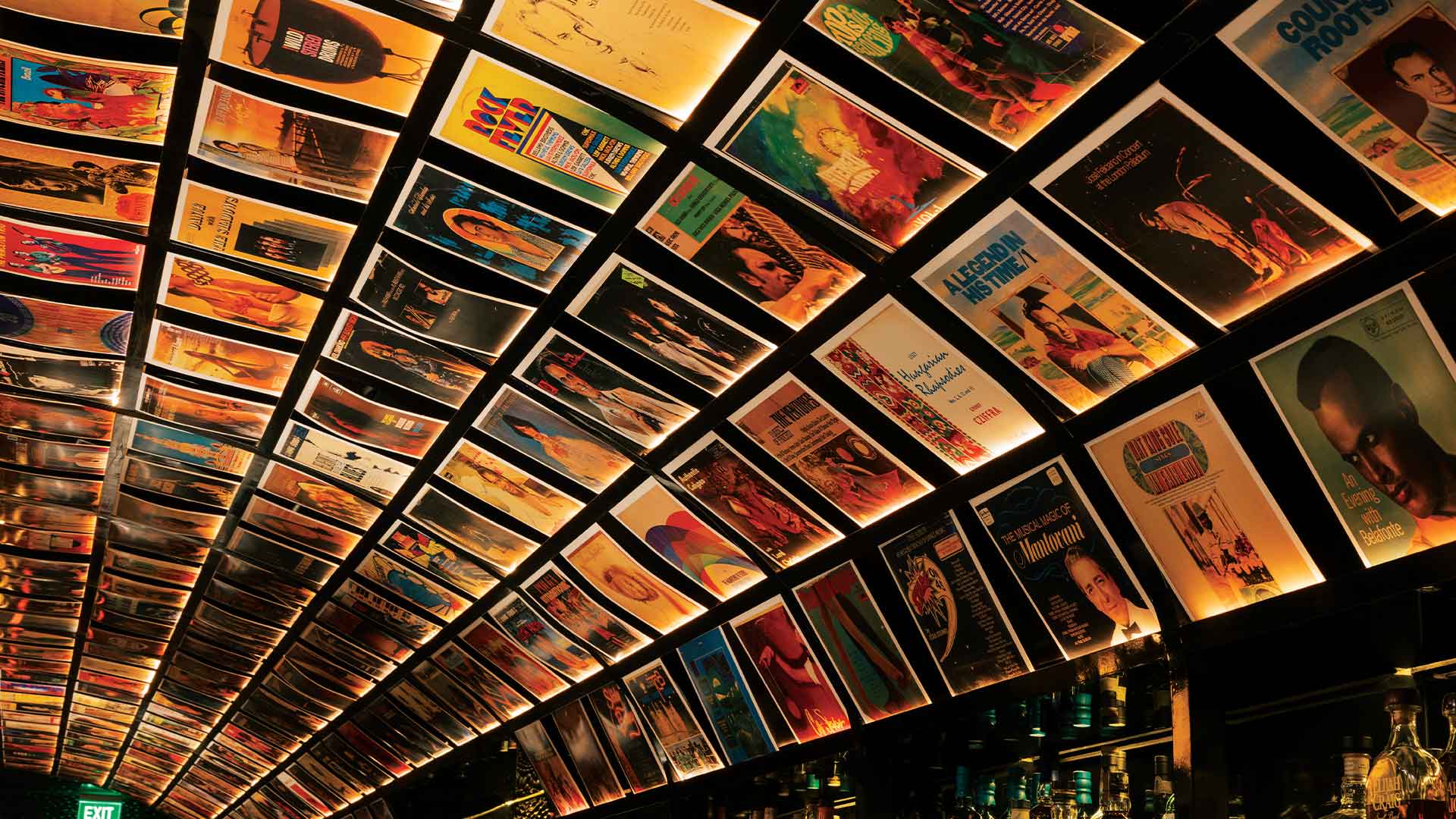
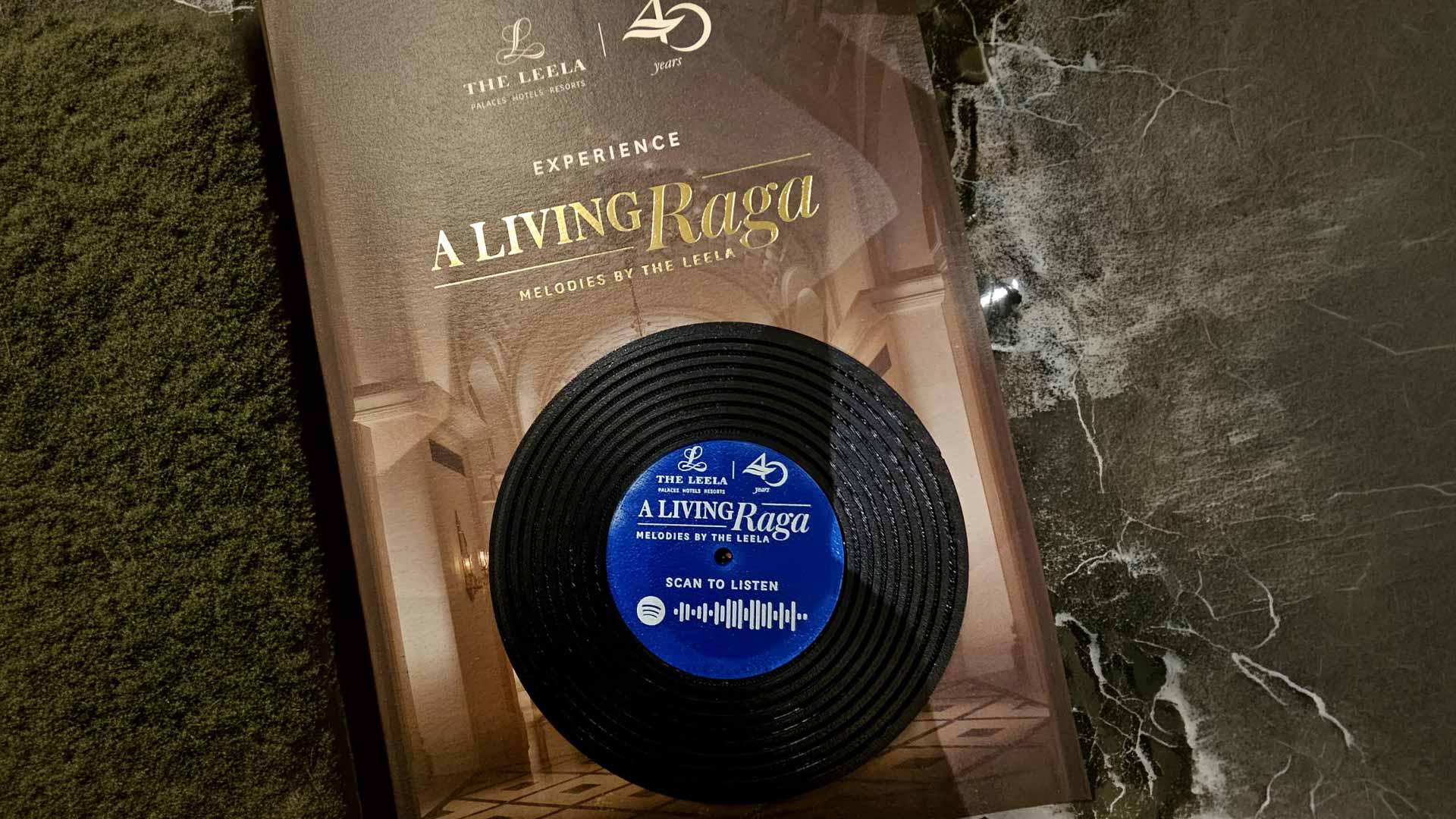
Vinyl record covers line the walls at Black Lacquer, Roswyn's subterranean vinyl bar inspired by Tokyo listening rooms.
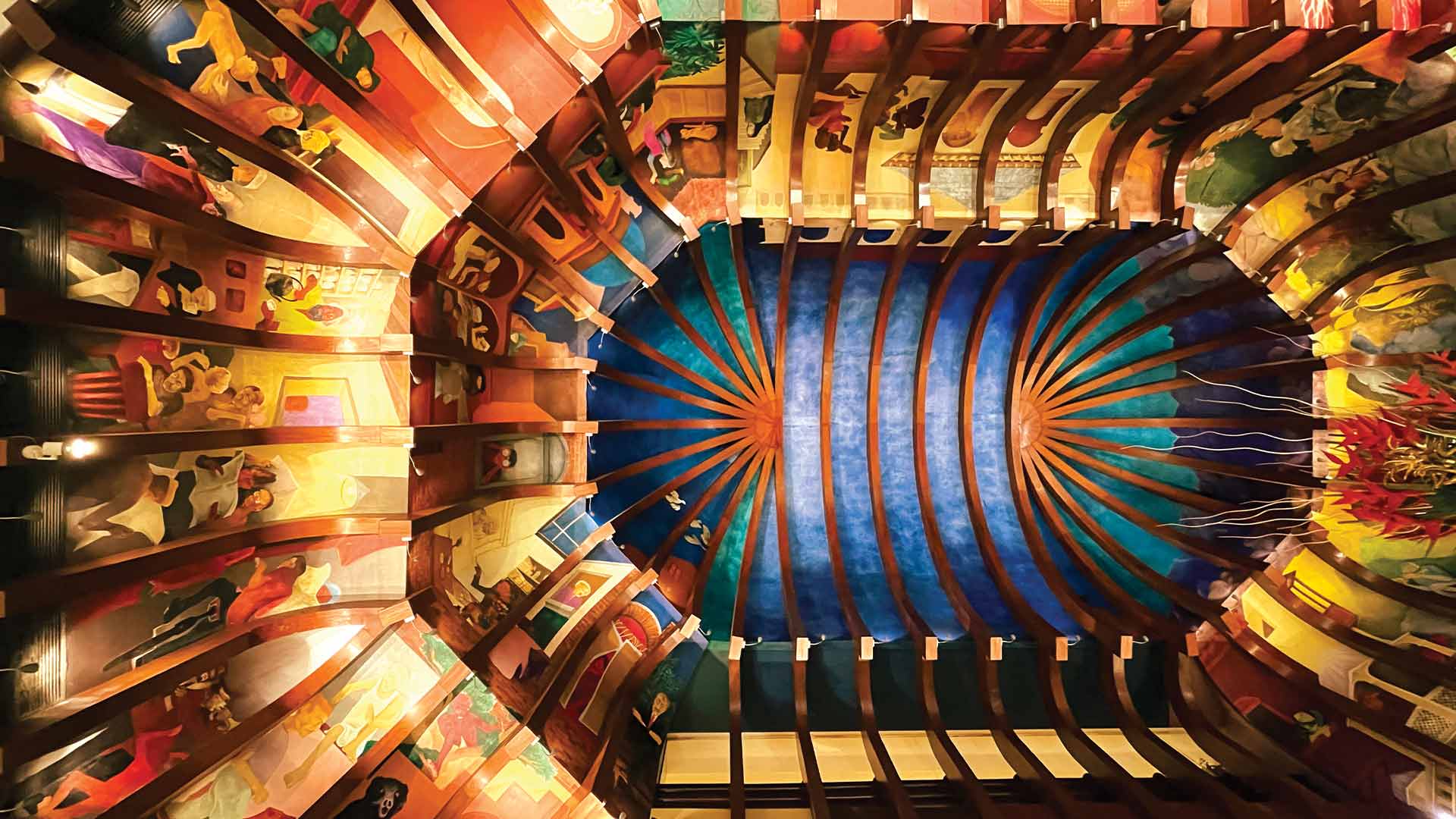
Krishen Khanna's The Great Procession sweeps across the domed lobby ceiling of ITC Maurya, New Delhi, among the grandest works of public art in any Indian hotel, painted over four years across the vault's curved expanse.
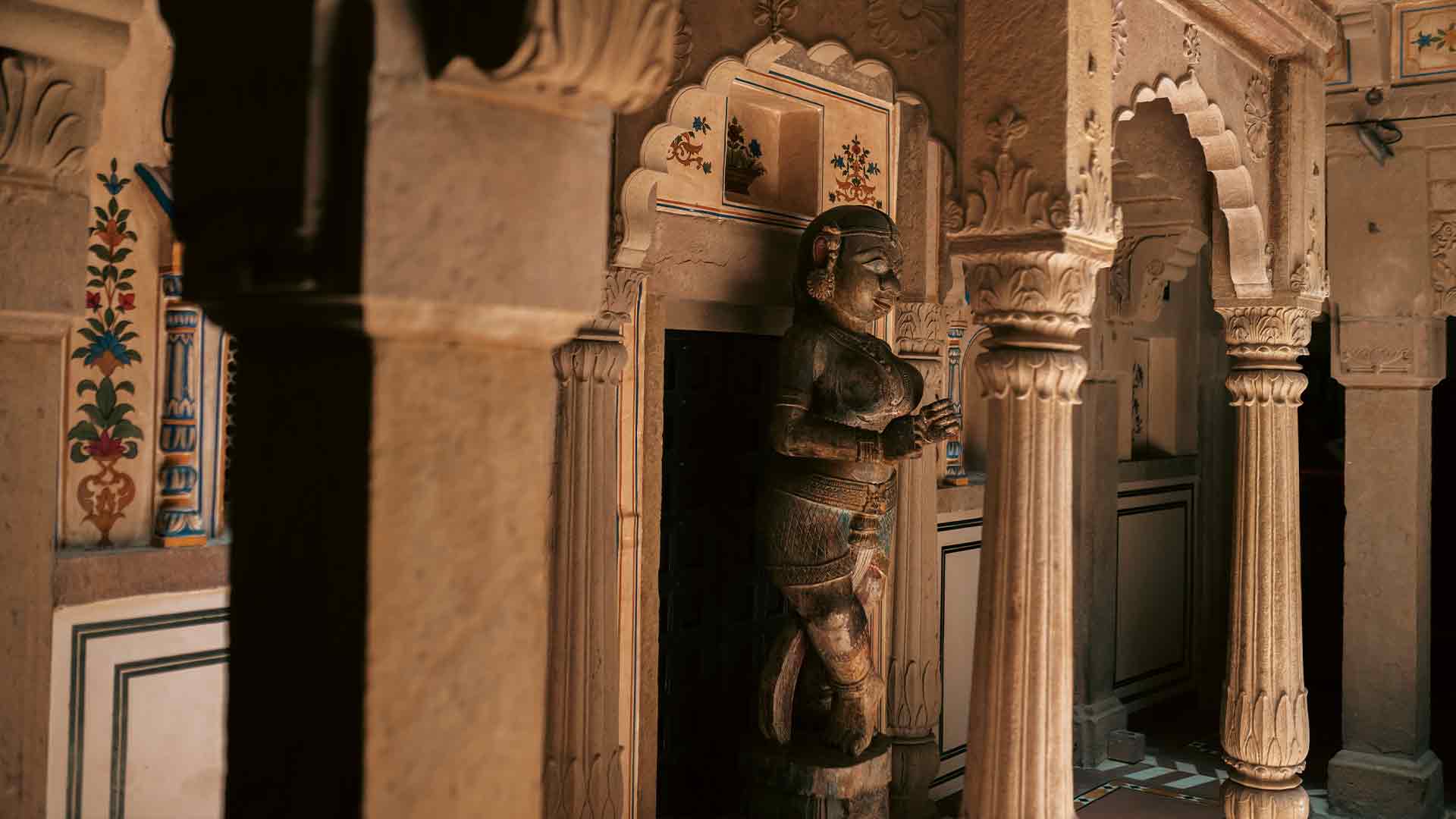
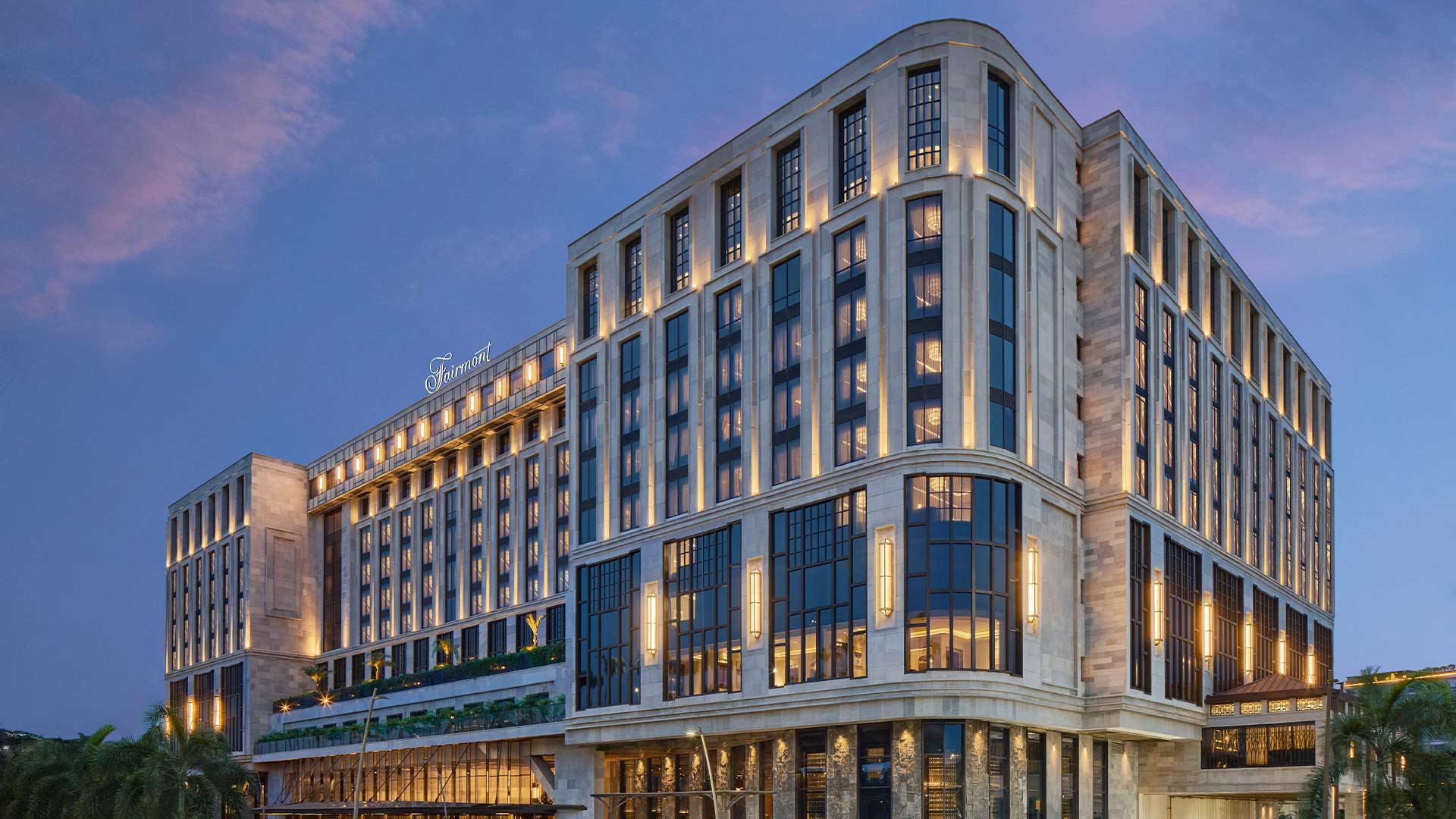
Fairmont Udaipur Palace is the result of the dedication of over 500 master artisans, with almost an entire village of craftspeople from Pindwara, nearly 100 kilometres away, contributing to its creation. Their collective expertise shaped the Palace's signature pillars, domes, hand-carved marble and intricate stonework, preserving techniques that have been passed down through generations.
Somesh Agarwal & Swati Agarwal
Co-Founders, Fairmont Udaipur
The guest journey
Read a hotel spatially, and the art arranges itself by function. The arrival demands a statement: the Husain in the Taj lobby, the leopard motif at Fairmont Udaipur Palace (inspired by feline visits), Surendra Pal Joshi's Basant at The Leela Palace Chennai, a wash of mustard-field yellow with a British-era Pai Paisa coin at its centre. Corridors are where craft lives; rooms and suites offer more intimate encounters. "In an airport, people move quickly and process a great deal of information, so art there often needs to operate at an immediate, large scale," says Sairam. "In a hotel, a guest may pass the same object several times, and even notice a minuscule intervention on the third day that they did not see when they arrived. Those moments of surprise are etched into their memory of the space." Kasliwal calls it art that reveals itself in layers. "An immediate impression, but also layers of texture, detail and narrative that unfold slowly over time," which he built into the suites at Narendra Bhawan in Bikaner, where a strong first gesture gives way to references to the Maharaja's personal history the longer you stay.
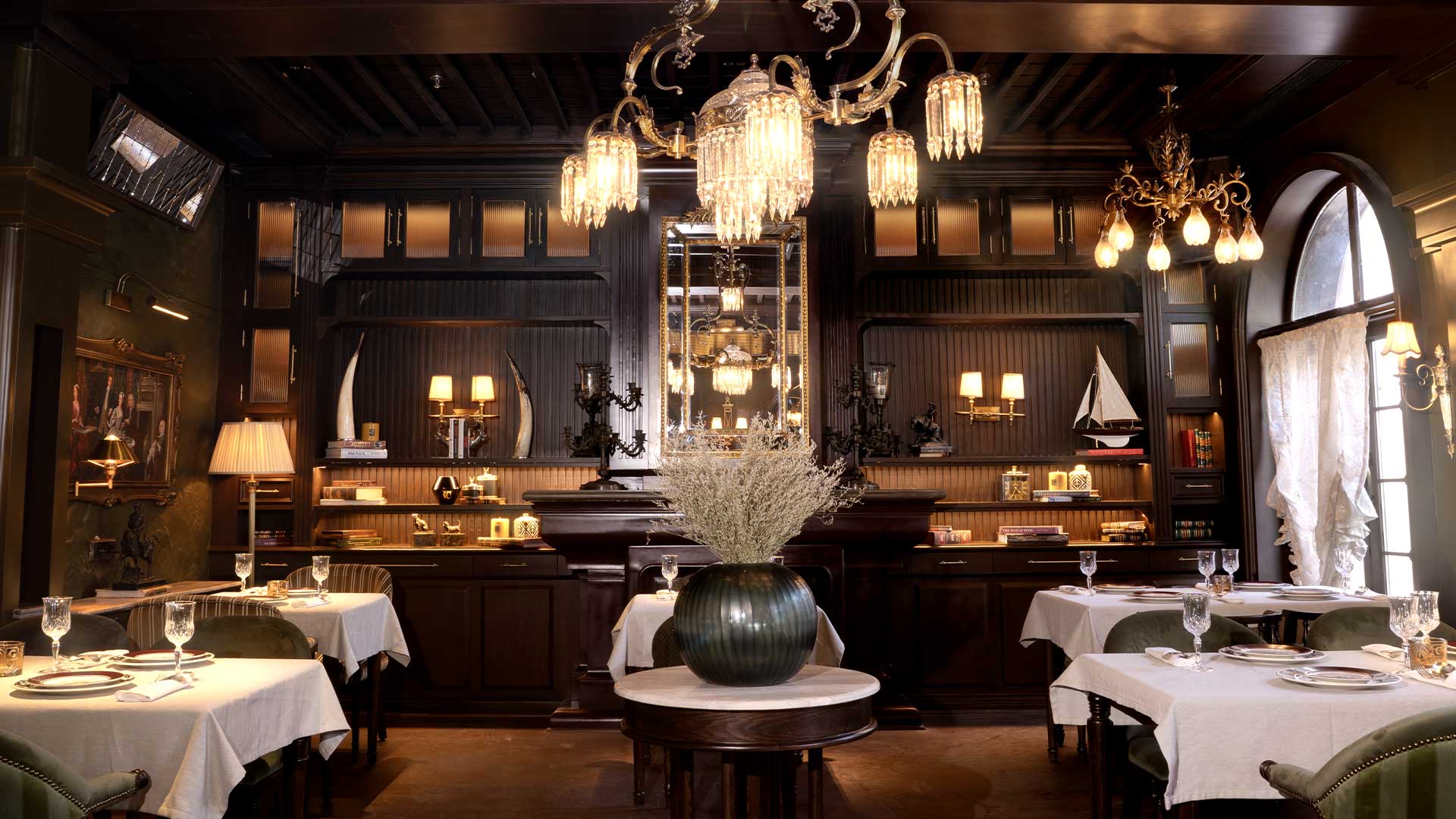
Juneja designed Roswyn's suites, which function as living spaces for long stays, on this logic, filling them with quieter readings of the same city—an artwork made of vintage Indian matchboxes echoing the visual density of Dharavi, embroidered golden waves standing in for a beach. "You are bringing in the contrast, bringing in India, and yet making it very eclectic," she says. "But nothing is that serious; everything is playful, and meant to be taken lightly."
At Hyatt Regency Dehradun Resort and Spa, Baaya Design took the Himalayan landscape as the core principle. Pine forests became six-foot timber sculptures in the arrival lobby, geometric wood carvings animated the restaurant, beaten brass echoed the concentric rings of tree trunks. The suites carried photographic impressions of misty pine forests alongside stoneworks embossed with fern motifs, the story unfolding differently in each space, what Jain calls "very differentiated art for different areas" while rooted in the landscape outside.
In restaurants and bars across hotels, art increasingly defines the room outright. At Taj Mahal, New Delhi, Varq draws its entire identity from the murals of Anjolie Ela Menon; House of Ming is anchored by the Ming Princess, an installation of 565 hand-painted brass chains; the Chambers holds original works by the cartoonist R.K. Laxman.
Some hotels are galleries in the older sense, where art is the daily route. The Imperial in New Delhi—a "living museum" that opened in 1936—was conceived as an art hotel from the start and already had a prized collection then, since having grown to more than 5,000 pieces of 17th to 19th-century colonial, Mughal and Sikh-era work: original Thomas and William Daniell, Emily Eden, James Baillie Fraser, William Simpson. Its corridors function as gallery space, part of a guest's ordinary movement through the building.
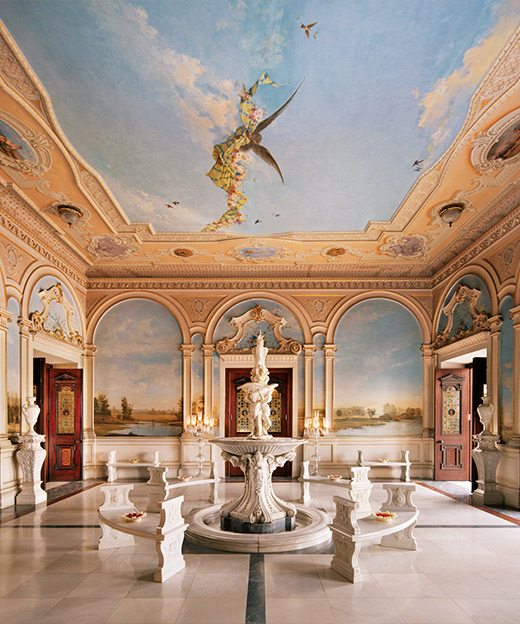
The palace hotels carry this furthest, because in them the art was never separable from the building. At Taj Falaknuma Palace in Hyderabad—built between 1884 and 1892—hand-painted 19th-century wall and ceiling frescoes, adapted from European academic technique to royal and natural motifs, remain integral to the architecture, lit through an important collection of F.C. Osler chandeliers and a library whose rarest holding is the eleventh edition of the Encyclopaedia Britannica, gifted by King George to the sixth Nizam.
At Rambagh Palace in Jaipur, art is woven through every carved surface, nowhere more so than in Suvarna Mahal, the grand dining room, whose post-Renaissance ceiling frescoes are believed to have been painted by an Italian prisoner of war under the architect Sir Samuel Swinton Jacob, framed by Venetian-glass chandeliers and gilt-carved mirrors. These are collections you cannot rehang, because the wall is the work. Umaid Bhawan Palace, Jodhpur’s collection includes Stefan Norblin's monumental Art Deco, including works in the Maharaja and Maharani suites—Indian mythology rendered in a 1940s European hand—made for these rooms and inseparable from them, with a dedicated Norblin Gallery.
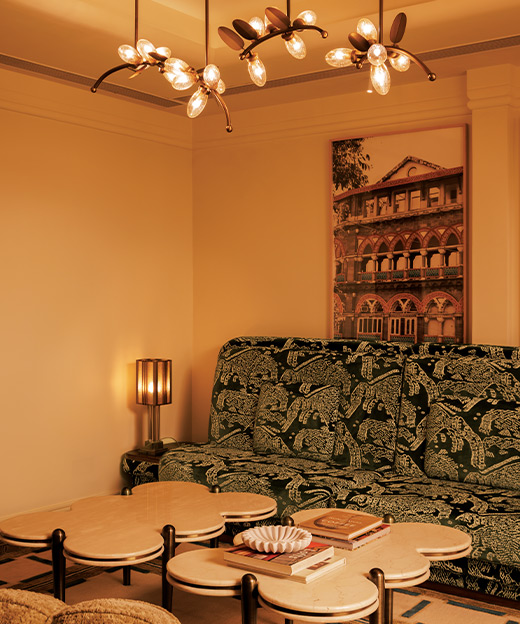
A study of Mumbai's colonial architecture lines the corridor at Roswyn, A Morgans Originals Hotel, one of the city-rooted artworks curator Venu Juneja wove through the hotel.
Art and craft can be part of how a hotel itself is built—within the architecture, the landscape, the interiors, the furniture and the smaller things guests touch every day. The property is then not simply displaying craft; it is positioning itself as a patron of a particular form of knowledge and making.
Asha Sairam
Principal, Studio Lotus
Craft as art
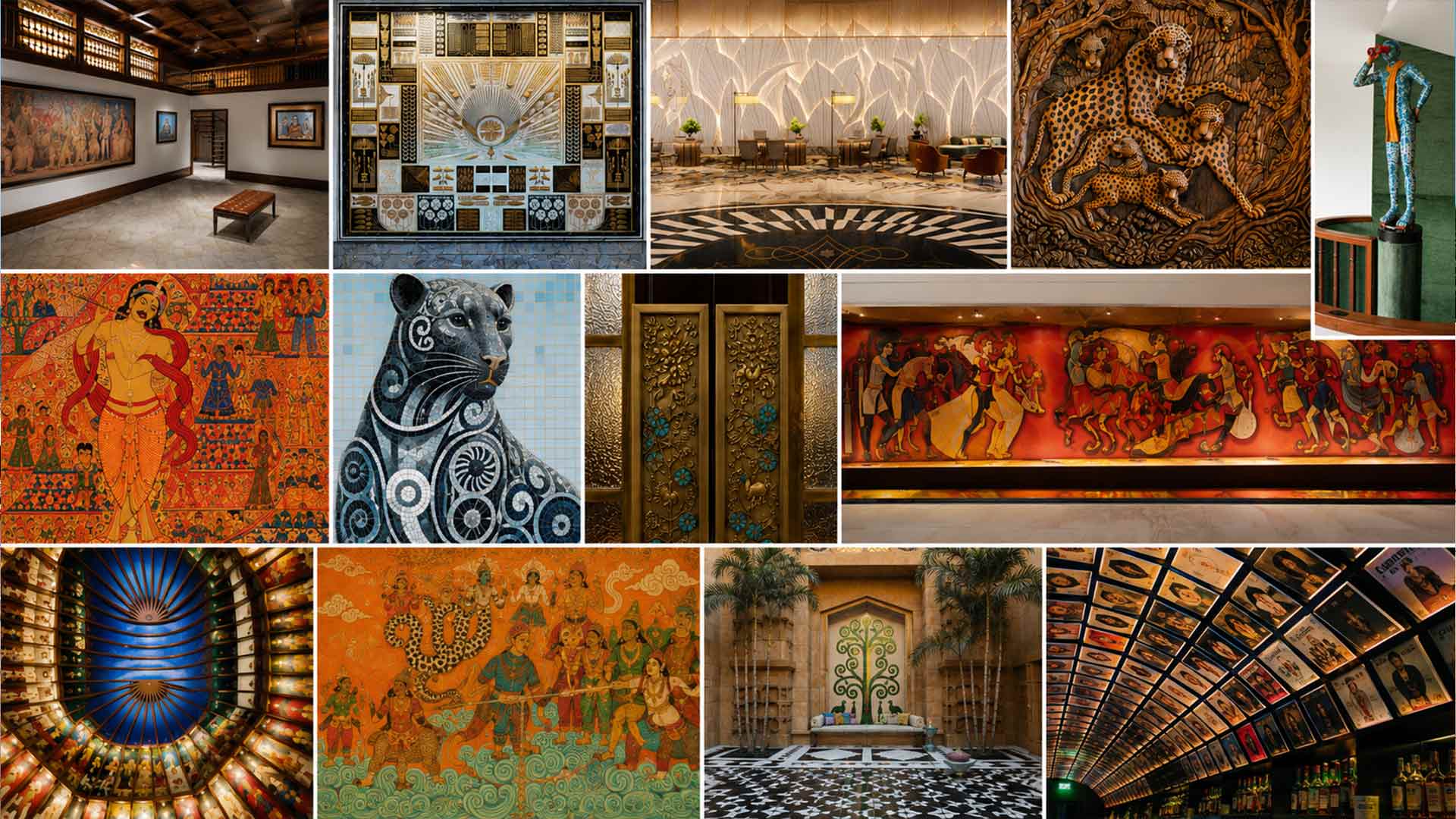
Indian hotels have become significant private patrons of endangered craft in the country, and the crafts they have revived are not incidental finishes. They are the collection. Nowhere is this clearer than at Fairmont Udaipur Palace, which chose craft over a contemporary art collection deliberately. "The Palace draws from Mewar's own visual language rather than reaching outside it," say co-owners Somesh and Swati Agarwal. Makrana marble pillars rise to a hand-painted dome; Thikri mirrorwork catches light in a way no framed piece could. "Craft brings an authenticity that cannot be manufactured. It carries the memory of generations of artisans, the integrity of time-honoured techniques, and a sense of permanence that gives the Palace its soul."
The palace is the work of over 500 master artisans, with almost an entire village of craftspeople from Pindwara, nearly 100kms. away, shaping its pillars, domes and hand-carved marble. Thikri work, seen at Amber Fort and Udaipur's City Palace, finds home in the modern palace hotel, and the relationship did not end at opening. "Many continue to work with us on restoration, conservation and new commissions, and are now helping shape our new Haveli Wing," the owners say. "Whenever we visited the artisans in Pindwara, they spoke with quiet pride about how projects like this helped sustain their families while allowing generations of craftsmanship to continue. Preserving craftsmanship is not just about restoring heritage: it is about supporting the communities that carry these traditions forward."
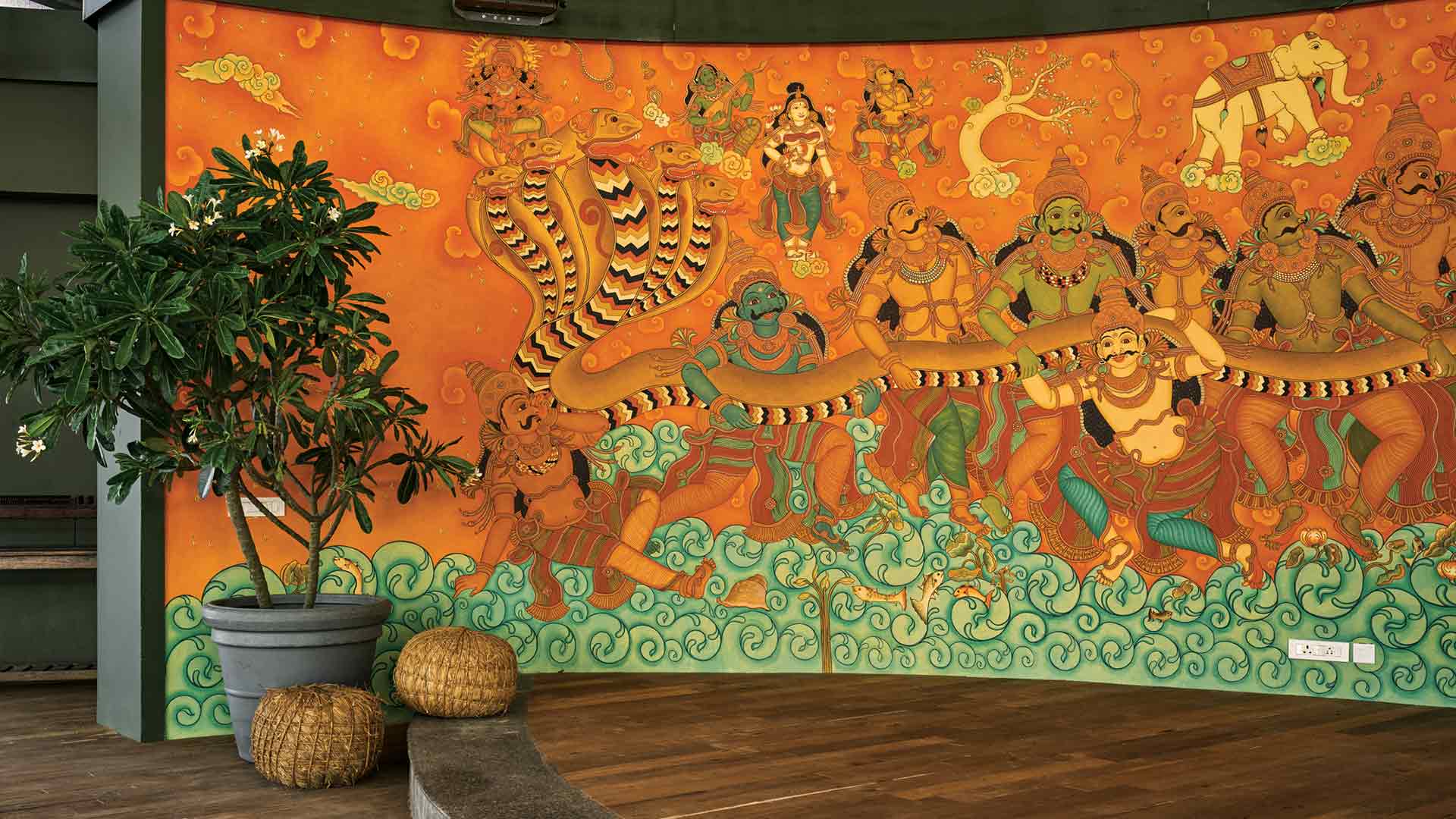
Custom commissions can also push traditional crafts into unfamiliar territory. At Sarovar Premiere Tirupati, Baaya Design, working with architect Shimul Kadri, reinterpreted the Dashavatara theme through monumental abstract brass reliefs while encouraging local Dhokra artisans to work in new ways. Traditional Dhokra, prized for its organic irregularity, had to be painstakingly engineered into precise, fully functional door handles inspired by Vishnu's incarnations, with motifs such as Kurma, Rama's bow and the lotus associated with Narasimha. "It was very interesting for the artisans because they did something completely new," says Jain. The project won design awards and demonstrated how hospitality commissions can expand a living craft's vocabulary rather than simply preserve it.
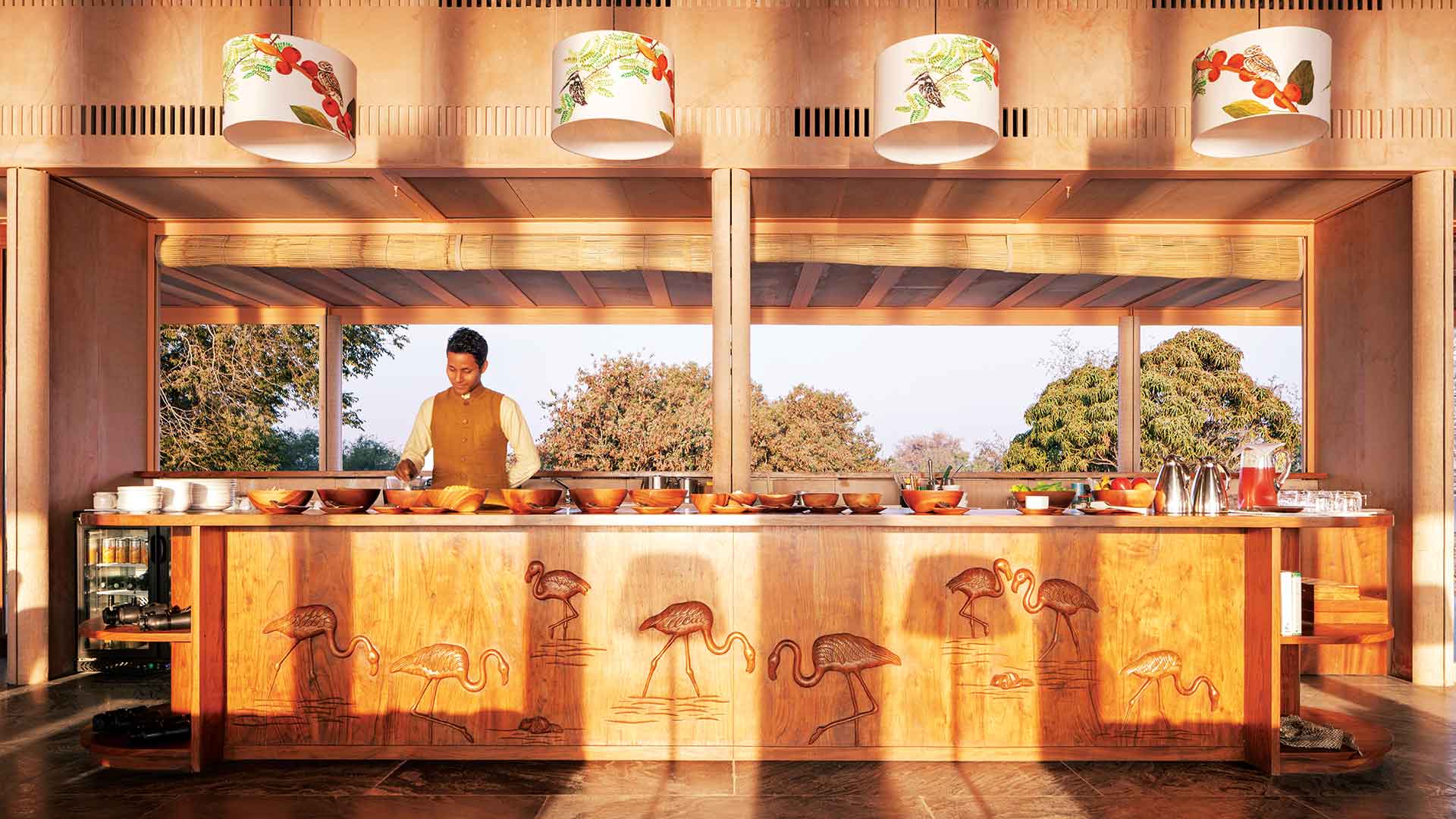
A flock of flamingos runs in hand-carved relief across the bar counter at RAAS Chhatrasagar, a nod to the birdlife of the lake it overlooks.
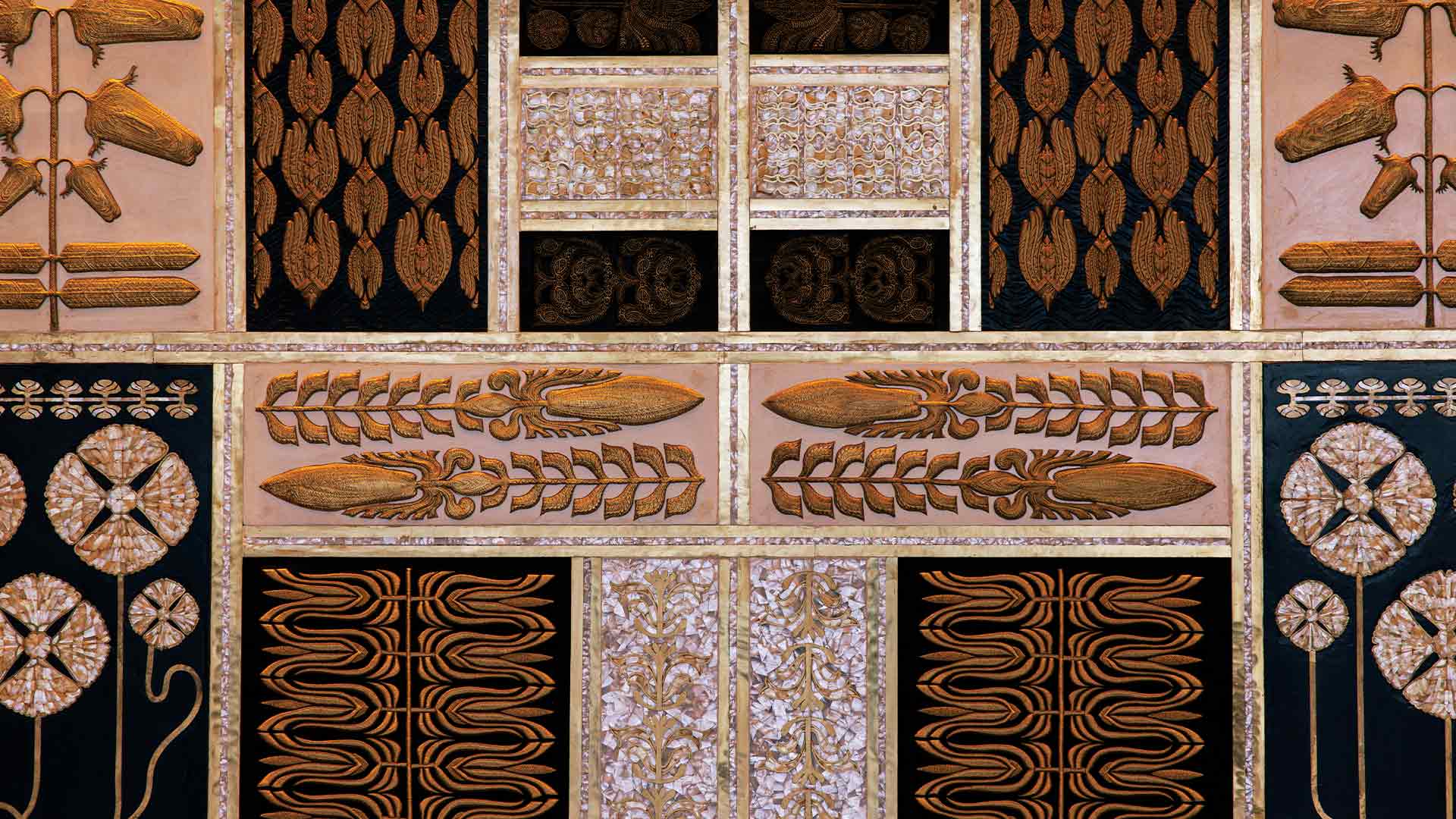
Embroidered and woven textile pieces feature among Fairmont Mumbai's 100-plus artworks, part of Venu Juneja's craft-led curation of the hotel's Art Deco interiors.
Art and craft are most powerful when they are not treated simply as decoration. In hospitality, they become part of the architecture, the narrative and, ultimately, the memory of a place. Collaboration with artisans should be a dialogue, not simply the execution of a drawing.
Ayush Kasliwal
Founder, AKFD & AKDS
Art that pays homage to the location
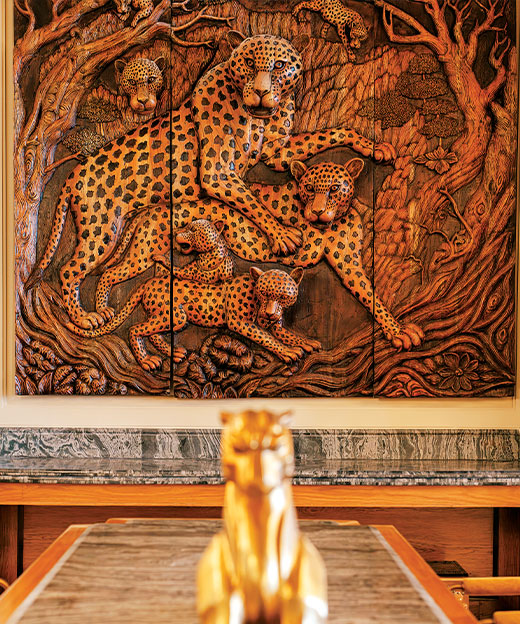
Fairmont Udaipur Palace even took its central motif from the land itself. During construction, leopards from the surrounding Aravalli hills would climb to the highest point of the site—where the library bar Dahaad now stands—to drink from the construction team's water tank. "It was a humbling reminder that we were building within their habitat, that we were guests in a landscape they had called home long before us," the Agarwals say. The motif now runs through the palace: a sculptural metal leopard in mirror mosaic anchoring Dahaad, and a family of wooden leopards hand-carved over nine months by Jaipur-based artisan Akanksha Mathur.
Asked whether Thikri risks becoming Rajasthan-luxury shorthand, the owners are clear: "It was never about using it as a symbol of luxury. It was about honouring a craft deeply rooted in the region's heritage. What matters is not whether Thikri is used, but how thoughtfully it is woven into the story a space is trying to tell."
The Leela Palaces, Hotels & Resorts has built an entire brand identity on this fusion, and refuses to rank the gallery above the workshop. "We don't see contemporary art and traditional craftsmanship as separate worlds; they are complementary expressions of India's creative excellence," says Mehra. "One may take the form of a celebrated commissioned artwork, another the result of centuries-old techniques practised by master artisans, but each represents an equally important chapter in India's cultural legacy. Whether it is a contemporary canvas or an intricate handcrafted Thikri installation, every piece is curated because it contributes meaningfully to the identity of the space." That traces to the founding vision: "From the very beginning, Captain C.P. Krishnan Nair envisioned The Leela as a celebration of India's artistic, cultural and architectural heritage, where every palace would tell a story rooted in its destination rather than follow a uniform aesthetic."
At The Leela Palace Jaipur, that principle came with a livelihood attached. "The revival of traditional craftsmanship was never intended as a decorative exercise," says the palace's VP and General Manager Anoop Pandey. The hotel sought out artisans across Rajasthan who had inherited skills—Thikri, Tarkashi, Bidri—but were seeing demand decline, and put teams of them to work for months and sometimes years. "While no single project can sustain an entire craft tradition, thoughtful and long-term patronage can play a significant role in preserving these living legacies," he says.
At Raffles Udaipur, craft and architecture blur until you cannot say where one ends. "Much like the architecture, the collection brings together different artistic traditions in harmonious dialogue, creating an environment where heritage is experienced naturally rather than displayed in isolation," says Hotel Manager Sukhpreet Singh Bath. The building, designed by architect Clive Gray, folds European Palladian form into Rajput and Mughal elements, with local jaali panels and Thikri mirror work woven through.
The designers who work across such projects see both the promise and the trap. Sairam is cautious about the word everyone reaches for. "I am a little careful about using the word ‘revive'. These are often living traditions that have continued to evolve; they do not necessarily need to be rescued by architects," she says. What design can do is give existing knowledge new applications; at RAAS Jodhpur, she notes, the luxury comes not from rare imported material but from the labour and knowledge invested in local sandstone, terrazzo and lime.
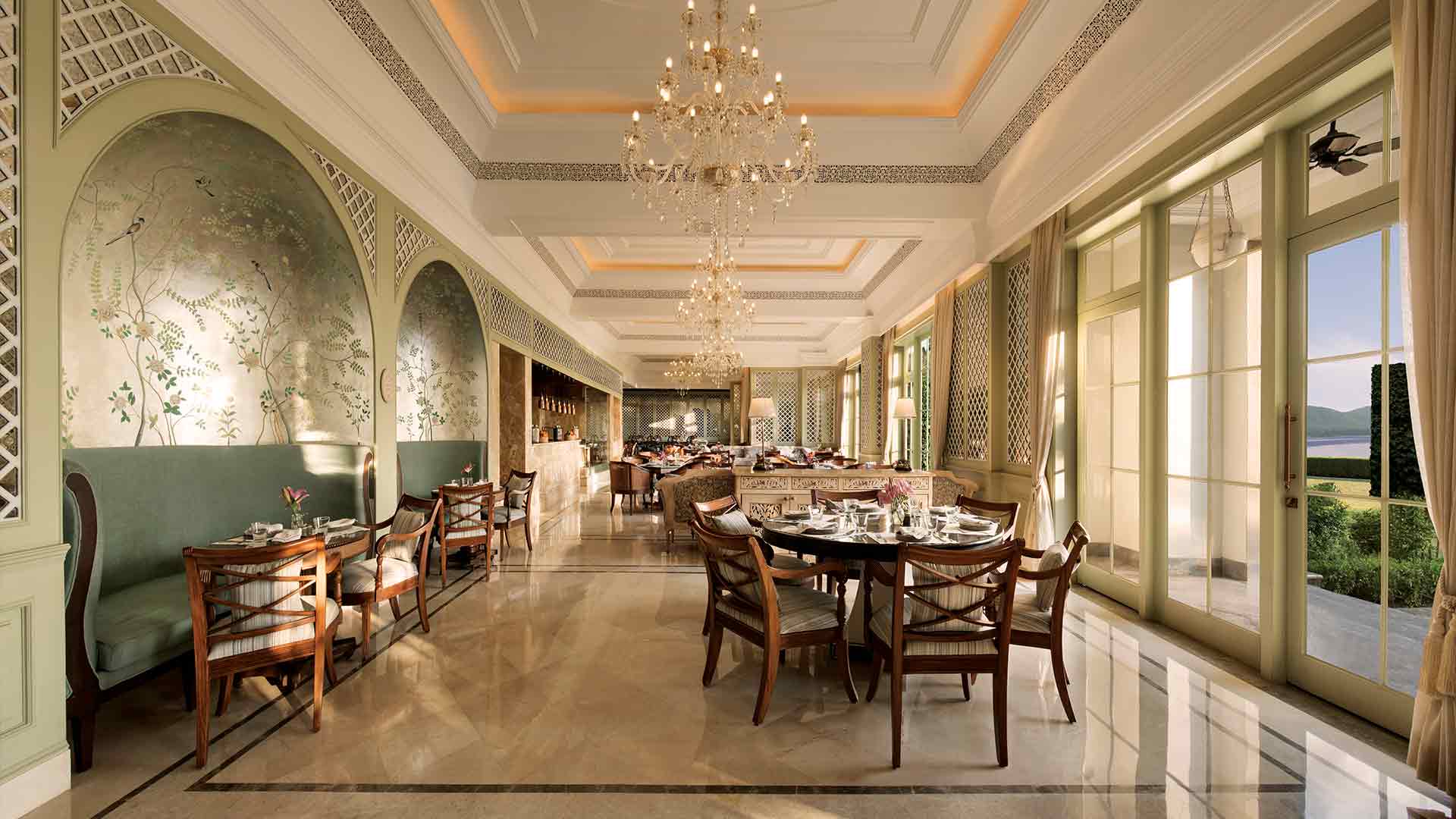
Set by Udai Sagar Lake, the Trellis Room at Raffles Lakeshore Udaipur pairs reimagined regional Indian cooking with alfresco ease.
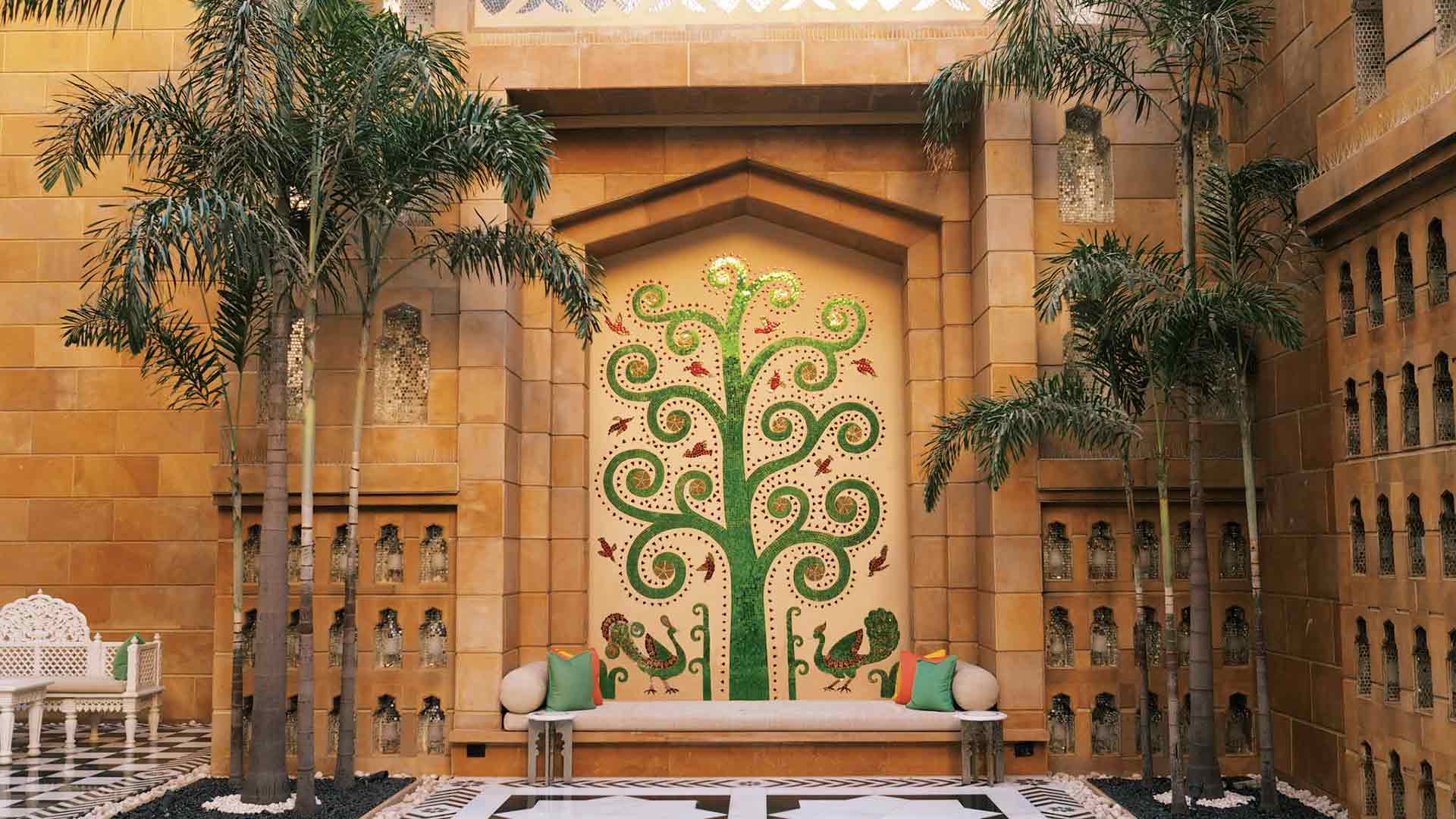
Hand-cut thikri mirror work shimmers under open skies in the courtyard at The Leela Palace Udaipur.
Today's luxury traveller seeks far more than exceptional accommodation; they seek meaning, craftsmanship and experiences that cannot be replicated. Art enables that. It creates an emotional connection to place, transforming a stay into an immersive cultural journey. As The Leela celebrates Four Decades of True Indian Luxury, this philosophy continues to define who we are.
Anjali Mehra
Executive Vice President, Brand & Communications, The Leela Hotels
India's new art-hospitality ecosystem
Behind the collections sit three distinct models. There is the owner's eye, the individual collector whose taste becomes the hotel's (a story told in the box above); there is corporate policy; and there is the institutional partnership.
Corporate policy is ITC's route. WelcomArt is the clearest case: a collection that grew not from one family's eye but from a company's decision to treat patronage as part of its identity. The Leela, four decades on from Captain Krishnan Nair's founding vision, now runs a codified programme, an Art Walk that turns guests into gallery visitors across its palaces, and a philosophy Mehra describes as art being "a foundational element of placemaking, not a finishing touch." What that walk reveals, she says, is how much guests want the story rather than the surface. "One of the most rewarding aspects is seeing guests engage with the stories behind the works rather than simply admire them visually. They are often surprised by the scale of the collection, and the fact that many pieces were specially commissioned or created using traditional techniques that continue to thrive today." While the brand won't claim art directly moves room rates, Mehra is unhesitating about the return. "In luxury hospitality, the most enduring memories are often shaped by moments of discovery—the story behind a sculpture, the craftsmanship of a centuries-old technique, or a conversation sparked by an artwork. Art becomes more than an amenity; it becomes part of what makes a stay unforgettable."
Then there is institutional partnership, where a hotel ties up with a gallery or art body to bring in expertise it doesn't hold in-house. Delhi Art Gallery has operated inside the Taj; Raffles Jaipur has partnered with the Jaipur Centre for Art. This is patronage professionalised. It points to where the ecosystem is heading: art as a managed programme rather than an accumulation.
The most interesting properties now bake art in from the first blueprint. Fairmont Udaipur Palace and Roswyn were designed around their collections, not decorated after completion, which is why Juneja could describe the two as a married couple, "the man in a crisp black-and-white tuxedo with a dash of gold, very structured," and "the other partner, a woman in a flowy silky gown, minimal but fresh," both speaking of Mumbai.
Jain sees another advantage: art gives hotels a visual language guests remember long after check-out. "Art is a very visible part of a hotel," she says. "Brands can integrate their stories through it—the message they want to give, how people remember the property, and whether there is any recall value every time they visit." The best outcomes, according to Mukherji, come when artists, architects and designers collaborate from the earliest stages, and depend less on brand standards than on ownership. "It's not just about the brands," he says. "It's about how passionate the owner is about the art. That's when you see greater quality, when the owner understands the value of the art." Thoughtfully commissioned work creates "a timeless sort of an environment”, he says, which quick-fix art and generic prints rarely do.
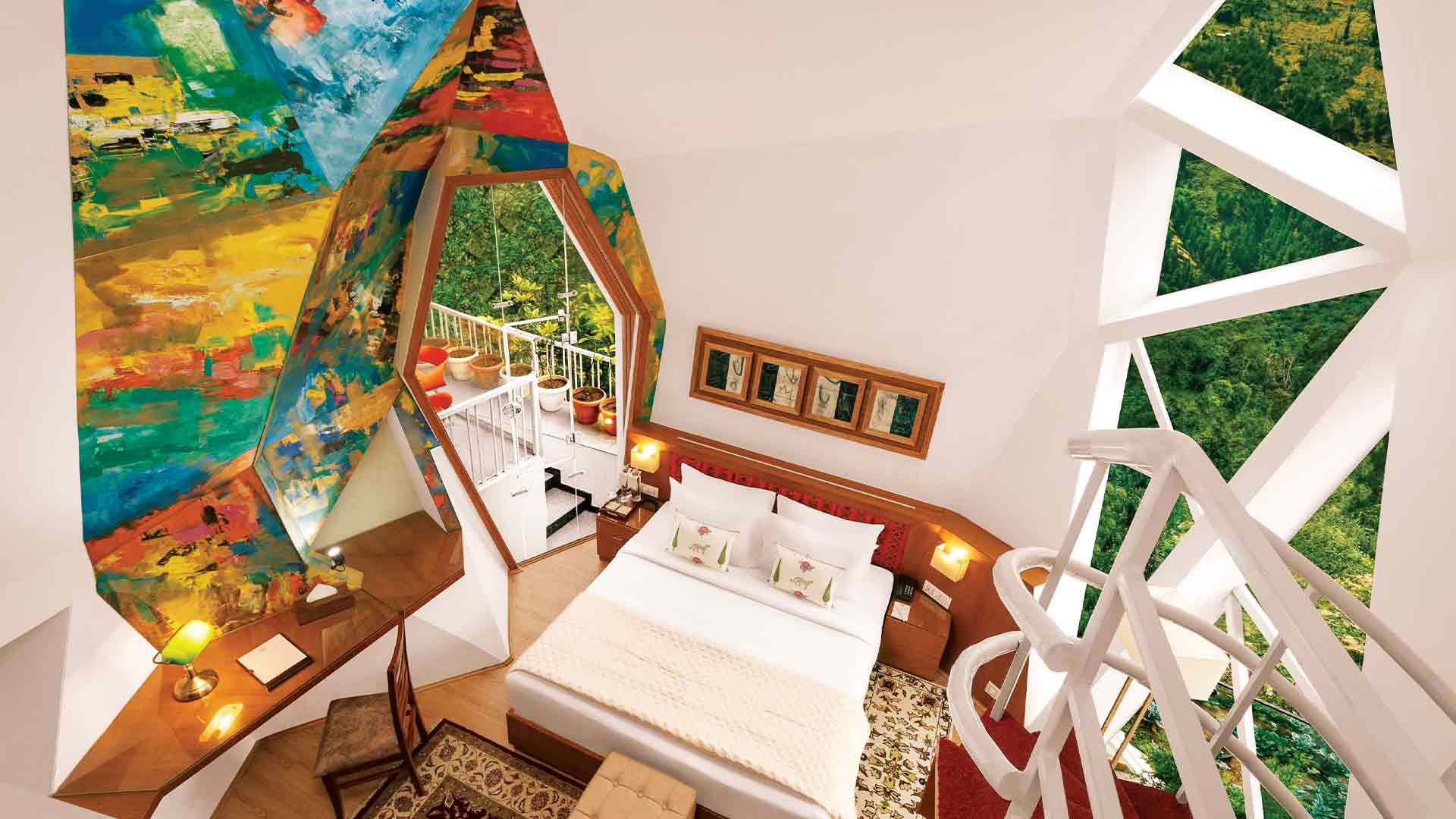
Sculpture and artwork fill the Tree of Life Eila Art Hotel, Naggar, its custom-crafted spaces reading like a sculpted art museum against the Dhauladhar range.
The storied Delhi Art Gallery is known to collaborate with several luxury hotels to help build their art collection.
In Roswyn, it wasn't about depicting Mumbai. It was about the feelings of Mumbai—its layers, its contrasts, and its playfulness. We wanted guests to experience the character of the city rather than simply look at pictures of it. I'm not looking for a famous artist; I'm looking for someone who can translate that story into the art they do best.
Venu Juneja
Curator, Fairmont Mumbai and Roswyn, A Morgans Original
So, where does it go from here?
Towards programmes rather than purchases. Rotating collections, artist residencies such as jüSTa's Chitraashala, institutional partnerships, and site-specific commissioning are turning the hotel collection from a fixed asset into a living one. The Leela frames its next chapter around "new artistic collaborations, interdisciplinary practices and immersive cultural experiences," says Mehra. "The essence of our philosophy will remain unchanged, even as its expression evolves.
The risk is obvious. When every hotel has an art programme, an art walk and a curator, the whole apparatus threatens to flatten into another amenity. The properties that will still mean something are the ones where the art answers a real question about the place: what is particular here, whose hands made this, why this work on this wall. The hotel should sell, Juneja says, but a guest should also walk a corridor on the third morning and notice something they missed on the first.
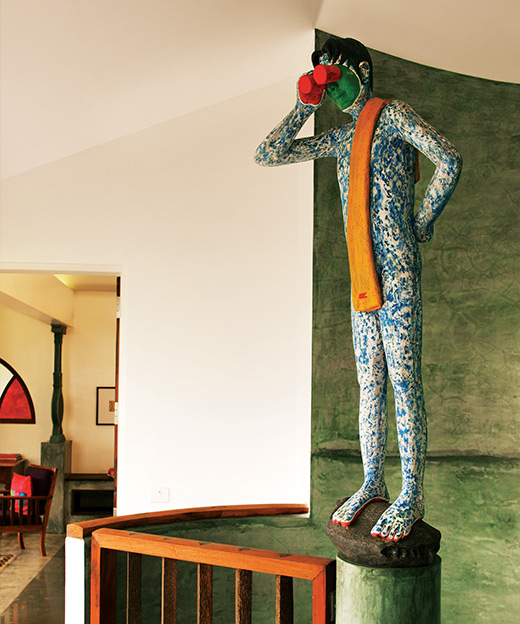
Artist Raghunandan's sculpture anchors the art collection at Purity, the Malabar Escapes lakefront villa on Lake Vembanad.
The thing about hospitality is that you have to tell a story through art. It should give a space its own identity, one that resonates with the environment, the local crafts and the place itself.
Shibani Jain
Founder & Creative Director, Baaya Design