











A Lotus for the Long Haul
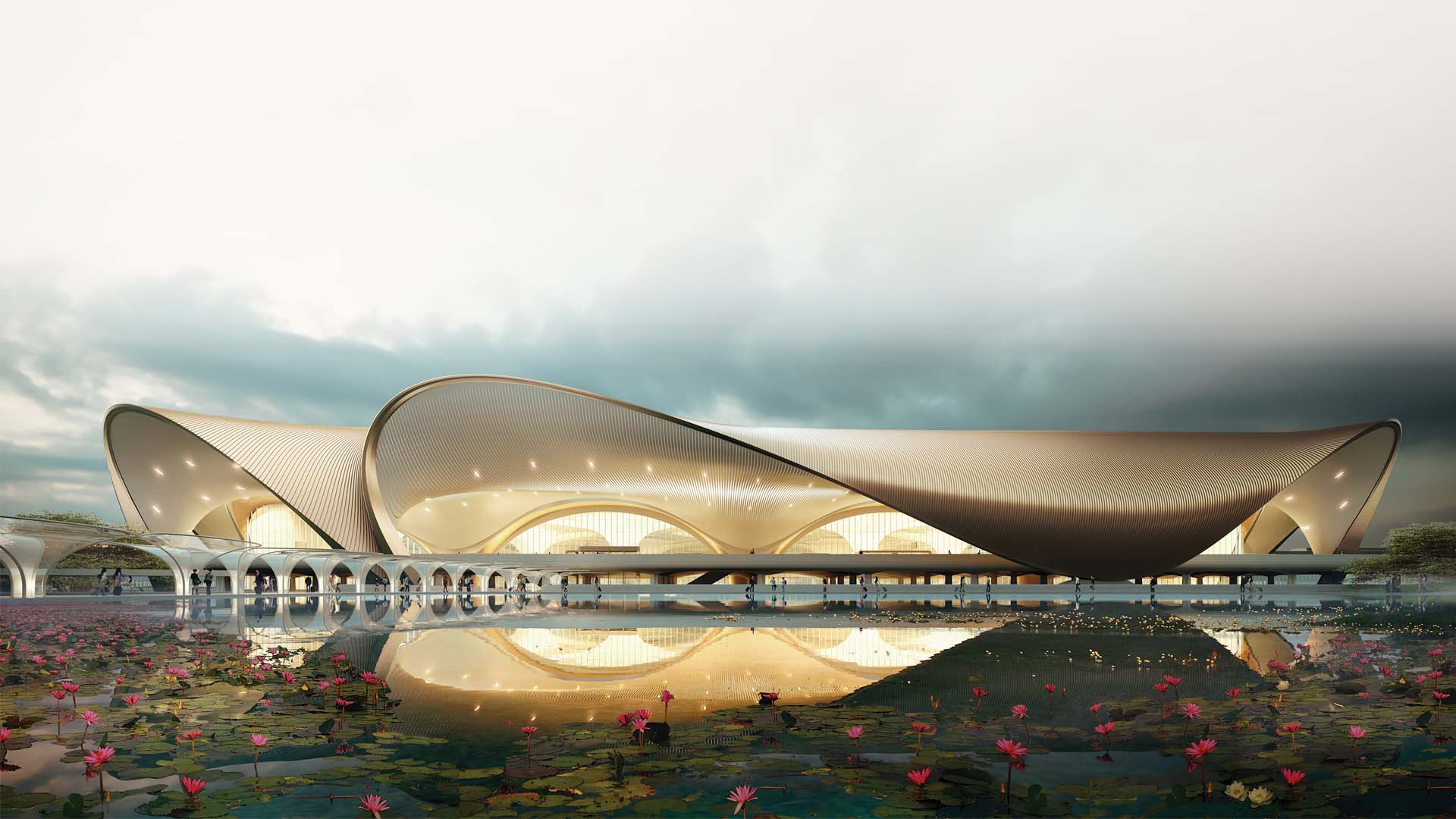
At Navi Mumbai International Airport, Zaha Hadid Architects translate India’s national flower into form, light and movement—crafting an airport that reflects India’s growing confidence on the world stage.

By Rupali Sebastian
India is travelling like never before. Domestic passenger numbers have surged past pre- pandemic levels, international routes are expanding at pace, and airports are no longer treated as mere transit points but as powerful statements of intent. Increasingly, they function as destinations in their own right—places where first impressions are formed, time is spent, and identity is encountered. In the last decade alone, the country has quietly assembled a portfolio of aviation architecture that stands shoulder to shoulder with the world’s best—from Delhi’s light-filled Terminal 3 and Mumbai’s sculptural Terminal 2, to Bengaluru’s garden-led Terminal 2 and Hyderabad’s efficient, art-forward hub.
It is into this confident, fast-moving landscape that the Navi Mumbai International Airport (NMIA) enters—not as an add-on or overflow facility, but as a long-anticipated second act to India’s financial capital. Designed by Zaha Hadid Architects (ZHA), NMIA arrives with a clarity of ambition: to handle scale without stress, to embed cultural meaning without spectacle, and to offer travellers an experience that feels unmistakably Indian yet globally fluent.
Now operational, the airport is more than an addition to India’s aviation infrastructure. It reflects a generational shift in how the country is beginning to imagine its gateways to the world. Inaugurated by Prime Minister Narendra Modi, the airport was framed as part of India’s next phase of infrastructure-led growth, with emphasis placed on connectivity, regional development and the role of world-class airports in shaping a confident global image for the country.
From catching up to setting benchmarks
For years, India’s aviation narrative was defined by catching up—expanding capacity, unclogging terminals, keeping pace with demand. That phase is decisively over. Mumbai’s Terminal 2, with its peacock-inspired columns and the monumental Jaya He GVK New Museum, demonstrated that scale and soul could coexist. Delhi’s Indira Gandhi International Airport brought efficiency and clarity to one of Asia’s busiest hubs. Hyderabad proved that passenger comfort and operational logic need not be mutually exclusive. And Bengaluru’s new Terminal 2, with its living walls and biophilic ethos, reframed the airport as a garden rather than a machine.
NMIA enters this lineage with a slightly different emphasis. Rather than foregrounding narrative through applied art or interior interventions, ZHA’s approach allows form, structure and spatial sequencing to carry meaning. The story unfolds through geometry, light and movement—experienced gradually, rather than announced.
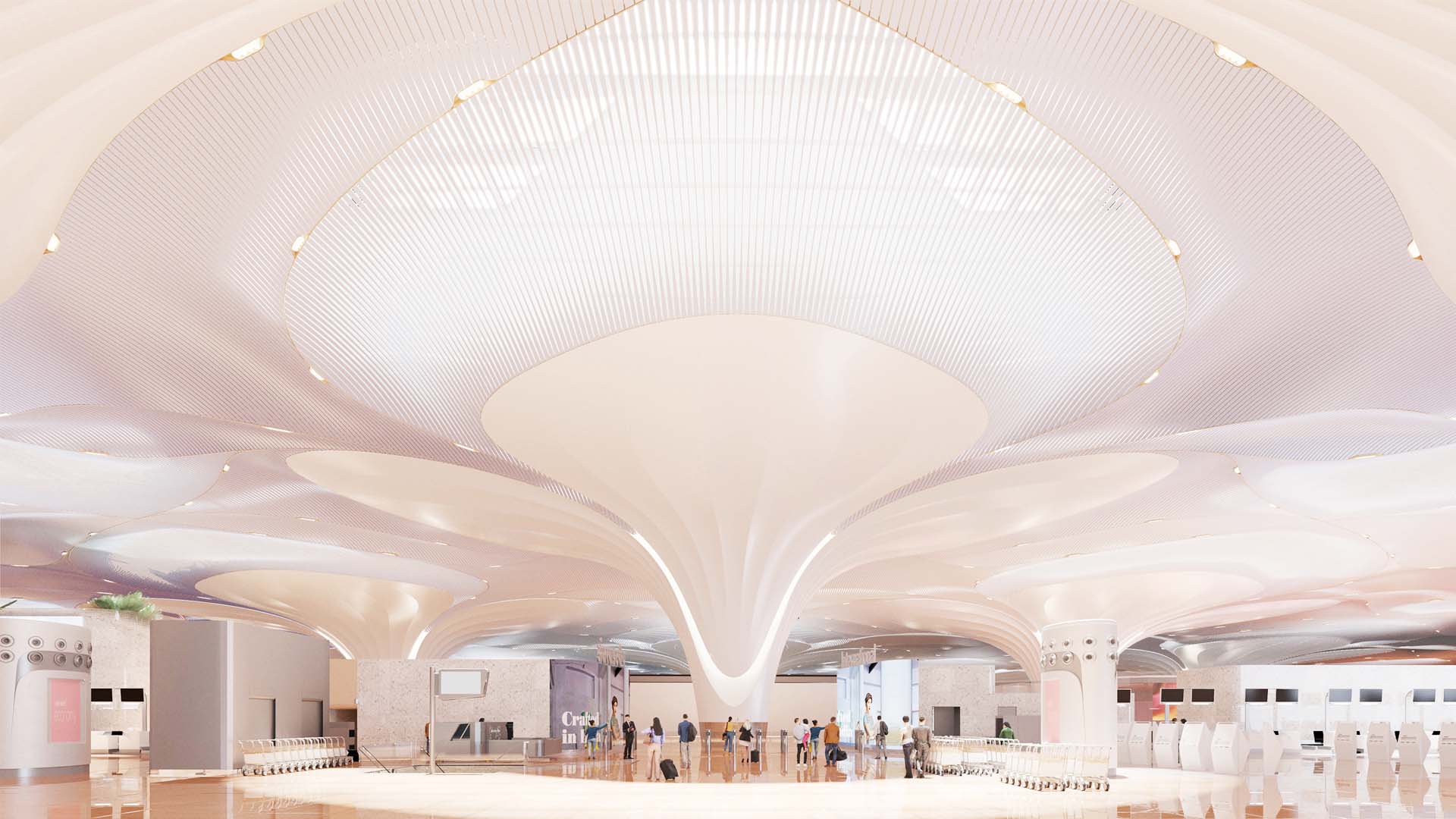
Light filters through sculpted columns, creating an interior that feels expansive without overwhelming scale.
The lotus as structure, not motif
At the heart of NMIA’s design lies the lotus—India’s national flower and a symbol layered with cultural, philosophical and artistic resonance. In Indian thought, the lotus stands for
purity, resilience and transcendence, rising untainted from murky waters. It appears in Hindu, Buddhist and Jain traditions, in temple ceilings and palace reliefs, and in everything from classical painting to modern iconography.
For ZHA, the lotus is not a decorative reference but a generative idea. The terminal’s roof unfolds as a series of overlapping, petal-like forms that radiate from a central point, creating a spatial logic that is both intuitive and expressive. The fluidity of these forms echoes the studio’s long-standing exploration of curves and movement—an architectural language closely associated with the late Zaha Hadid herself, often described as the Queen of the Curve. From above, the airport reads as a flower in bloom; from within, the geometry guides movement, light and orientation.
The central terminal space is conceived as a metaphorical lotus pond, with concourses extending outward like petals. This radial planning simplifies wayfinding while also allowing the airport to expand in future phases without disrupting its core logic.
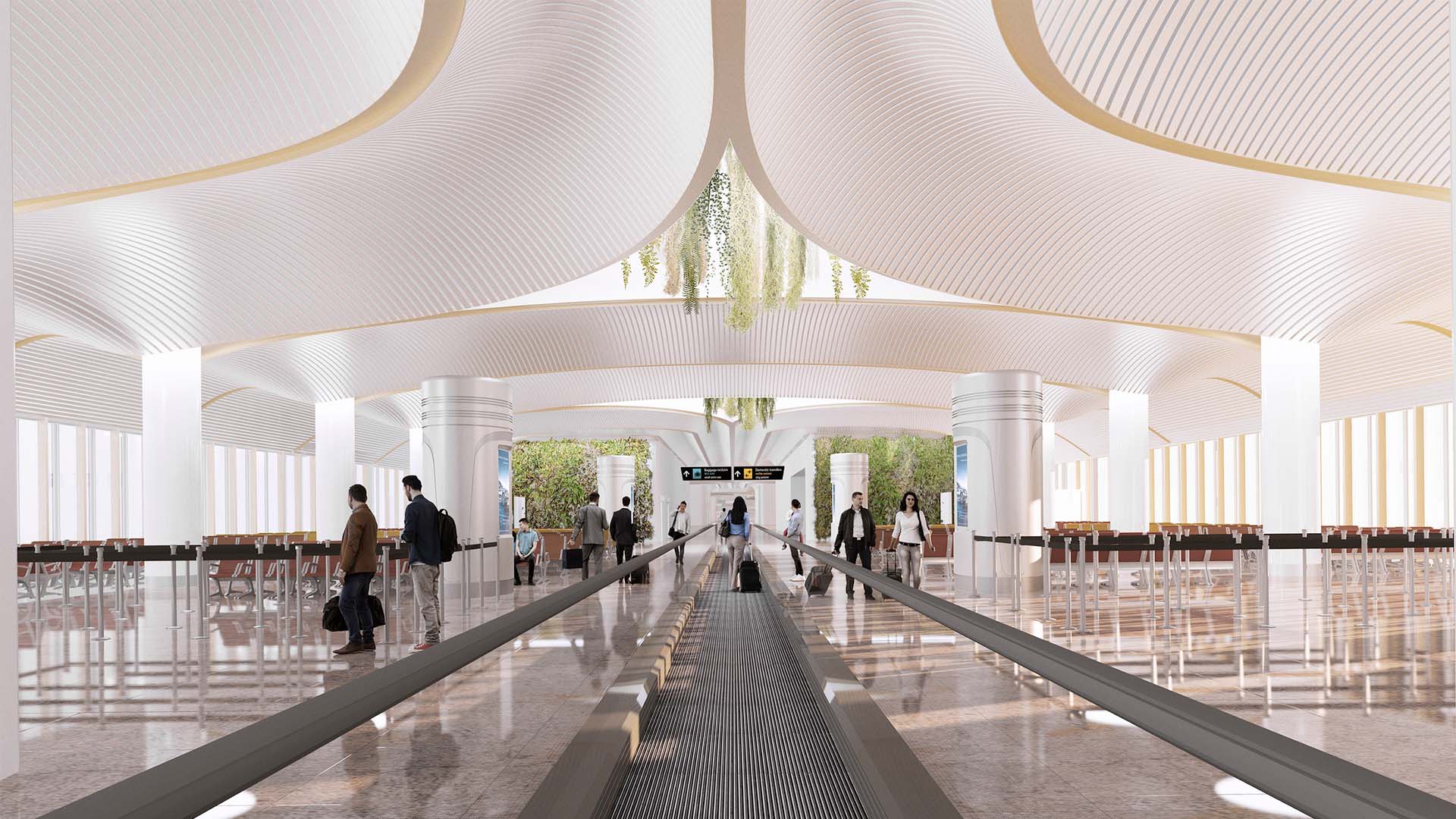
Movement becomes measured and intuitive within a space designed for flow rather than haste.
Engineering grace at scale
What makes NMIA particularly compelling is how seamlessly its expressive form is reconciled with engineering discipline. The roof structure is supported by a sophisticated system of columns—some sculptural and visible, others massive and concealed—working together to carry vast spans while maintaining visual lightness.
Daylight plays a starring role. Continuous skylights trace the curves of the roof, calibrated to admit soft, diffused light while minimising heat gain. Glass façades and carefully articulated latticework draw inspiration from lotus leaves and traditional jaali patterns, allowing natural light to filter through while providing shade and ventilation. In a city defined by humidity, monsoons and glare, these decisions are as pragmatic as they are poetic.
The construction itself has relied heavily on modular, prefabricated components, allowing for precision at scale and faster assembly on site. It is a reminder that contemporary airport architecture is as much about logistics and sequencing as it is about form.
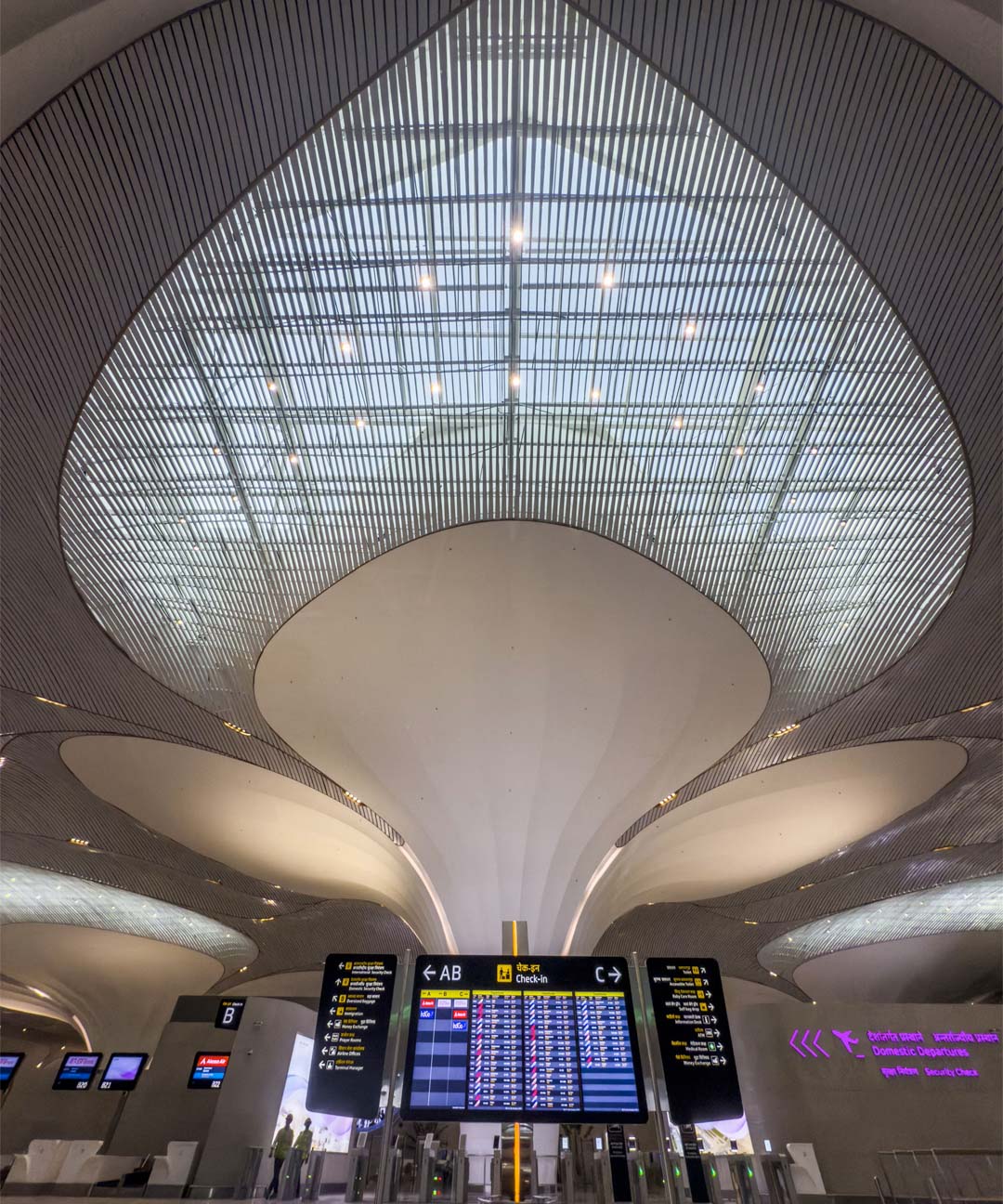
Curved ceilings soften scale and perception.
A new geography for Mumbai
NMIA’s significance extends far beyond architecture. For decades, Chhatrapati Shivaji Maharaj International Airport operated as one of the world’s busiest single-runway airports, stretching capacity to its limits. Navi Mumbai was always envisioned as the release valve—but also as an opportunity to rebalance the region’s growth.
Located in Ulwe, NMIA anchors a new aviation geography for the Mumbai Metropolitan Region. With direct links to the Mumbai Trans Harbour Link, upcoming metro corridors and suburban rail connections, the airport is designed as a true multimodal hub. Travel times from South Mumbai have already reduced dramatically, and the ripple effects on real estate, hospitality, logistics and employment are inevitable.
At full build-out, NMIA is expected to handle up to 90 million passengers annually, placing it firmly among the world’s major aviation hubs. Cargo operations are also set to expand over time, strengthening Mumbai’s role in global trade networks.
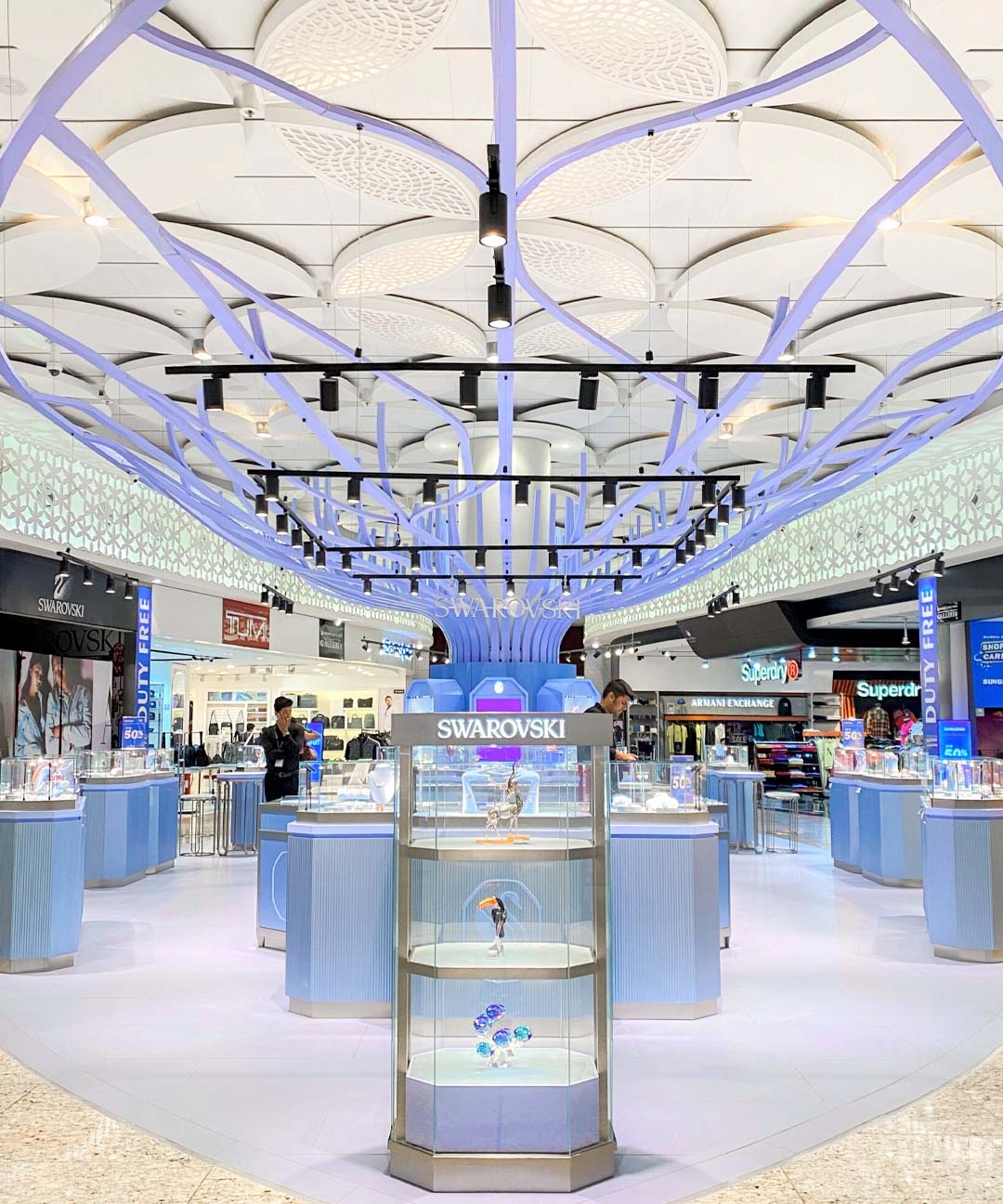
Geometry replaces ornament across interiors.
Sustainability as an operating logic
Sustainability at NMIA is embedded quietly rather than advertised loudly. The lotus- inspired roof aids passive cooling and daylight optimisation. Water management systems are designed to respond to heavy monsoon cycles, with rainwater harvesting and recycling integrated into the airport’s operations. Renewable energy generation and future-ready infrastructure for cleaner aviation fuels form part of the airport’s longer-term vision.
What stands out is the absence of performative green gestures. Instead, sustainability is treated as an operational necessity—woven into planning, structure and services.
In many ways, Navi Mumbai International Airport feels less like a statement and more like a signal. Its ambition lies not in spectacle, but in how assuredly it handles scale, complexity and cultural reference without insisting on attention. The experience of moving through the terminal—guided by light, curvature and spatial clarity—reflects a growing maturity in how India is shaping its public infrastructure.
For a city-region long defined by pressure—of density, demand and constant movement—NMIA offers a different rhythm. It suggests that growth need not always be frantic, that infrastructure can be expansive yet humane, expressive yet efficient. As travellers arrive and depart through its lotus-shaped roof, what they encounter is not a symbol to decode but an environment to inhabit.

Structure and light guide intuitive movement.
Navi Mumbai International Airport at a Glance
• Location: Ulwe, Navi Mumbai
• Site Area: ~1,160 hectares
• Passenger Capacity:
– Phase 1: ~20 million passengers annually
– Ultimate build-out: ~90 million passengers annually
• Runways: Two parallel runways (phased activation)
• Terminal Planning: Modular, multi-terminal masterplan allowing expansion without
operational disruption
• Role: Designed to operate as part of Mumbai’s multi-airport system alongside CSMIA
Design Highlights: Navi Mumbai International Airport
• Architect: Zaha Hadid Architects, UK
• Location: Ulwe, Navi Mumbai
• Design Motif: Lotus-inspired roof and radial concourse layout
• Planning Logic: Centralised terminal with intuitive, petal-like circulation
• Façade Strategy: Glass and jaali-inspired screens for daylight control and ventilation
• Key Spatial Element: Central atrium conceived as a lotus pond metaphor
Airports as Cultural Statements
Across the world, major airports are increasingly conceived as expressions of place rather than neutral transit infrastructure. Architecture, form and landscape are being used to communicate identity at the scale of national gateways.
• Beijing Daxing, China: Phoenix-inspired roof symbolising unity and movement
• Denver International, USA: Tensile forms evoking the snow-capped Rocky Mountains
• Changi Airport, Singapore: Nature-led planning with gardens and immersive landscapes
• Hamad International, Qatar: Fluid forms referencing desert dunes and marine geography
• Navi Mumbai International Airport, India: The lotus—purity, resilience and transcendence—reimagined through contemporary architecture