











India’s Alcohol Market Is On Track To Double By The 2030s
The numbers behind a market that is drinking more, and better.

By Deepali Nandwani
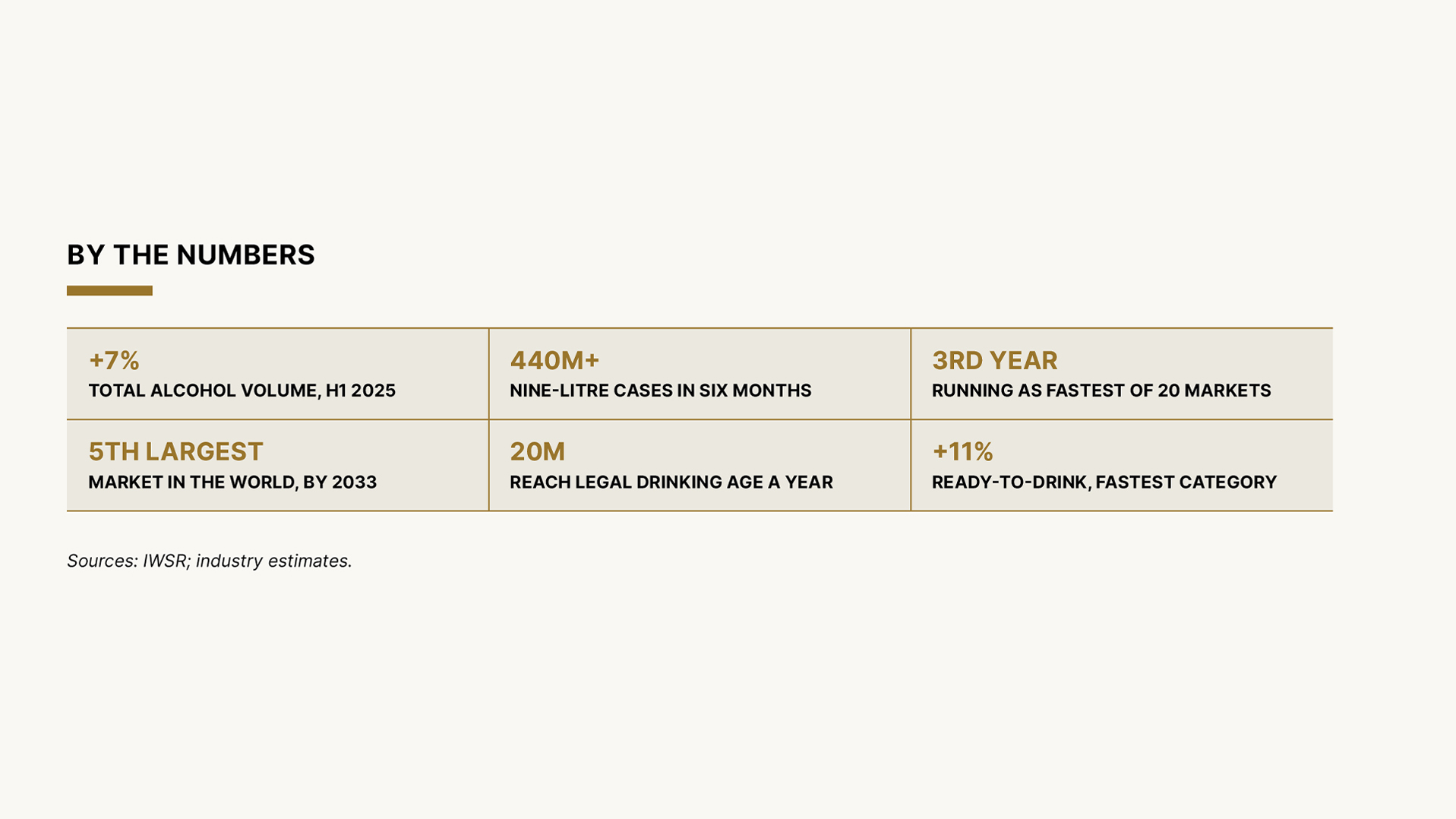
India was the fastest-growing alcohol market among 20 major economies in the first half of 2025, the third year running according to IWSR (formerly International Wine and Spirits Record). The total volume rose 7% year on year and passed 440 million nine-litre cases in six months. While much of the world moderates, the numbers here point the other way, and towards more expensive, more experimental drinking.
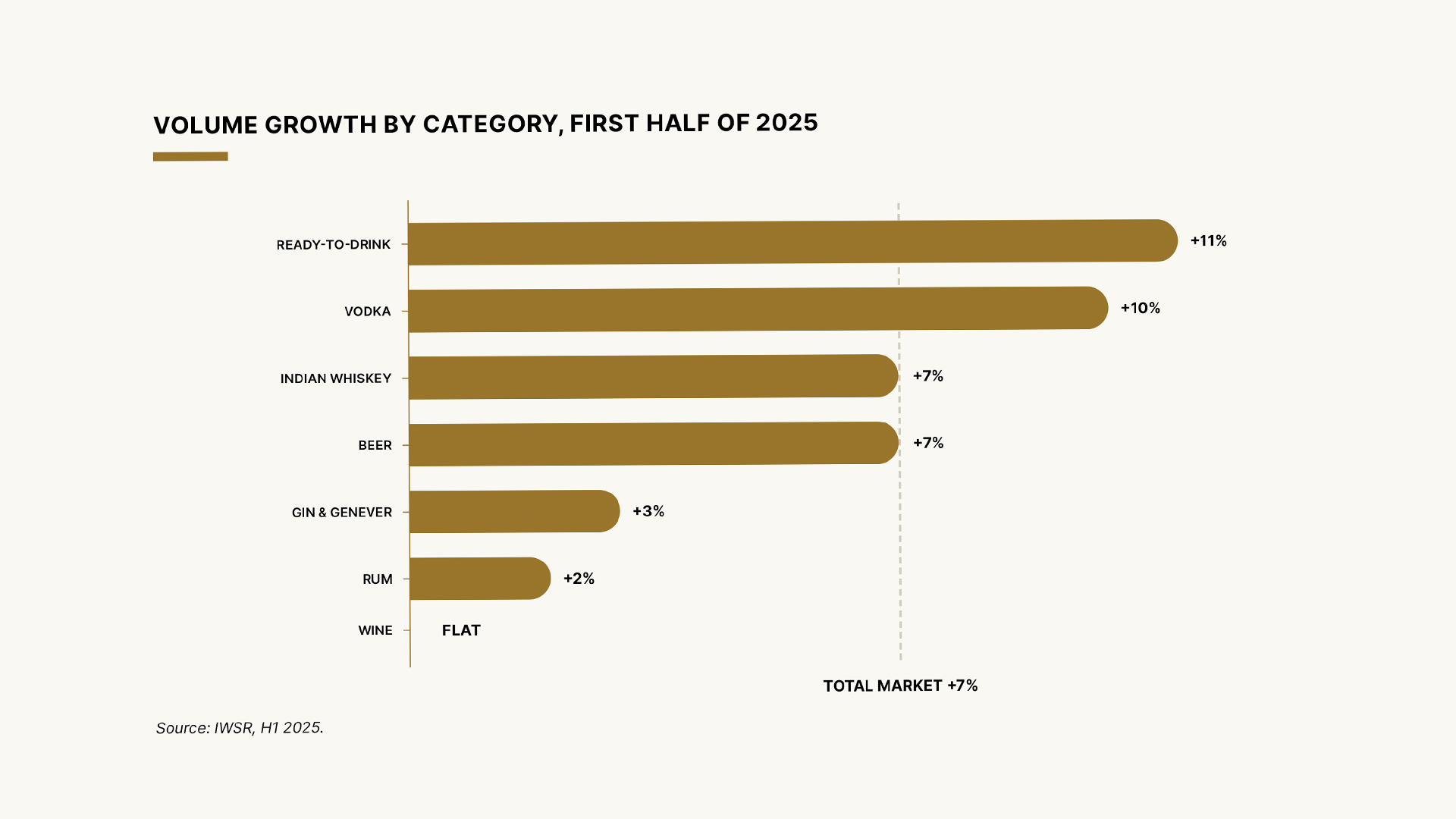
Spirits did most of the lifting. IWSR data put Indian whisky up 7% over the half, on sales above 130 million nine-litre cases, with vodka the standout at 10%. Gin and genever rose 3% and rum 2%, beer matched the market at 7%, and wine held flat. Ready-to-drink formats grew fastest of all at 11%, carried by younger urban buyers.
The value is climbing faster than volume. Premium-and-above categories rose 8% in both volume and value, ahead of the overall market, and industry estimates describe a K-shaped market, with premium and super-premium spirits up 9 to 12% through 2025, while mass-market and rural segments moved erratically. For Diageo and Pernod Ricard, both of which count India as their largest market by volume, the answer is a shift towards premium products and margin over sheer volume. Marketing heads at both have framed younger consumers' choices as drinking better: fewer, higher-quality pours and cocktails in place of the old whisky and soda. IWSR records the same "trading up" to better brands across the market.
The trajectory is steep. IWSR expects India to pass Japan in total consumption by 2027 and Germany by 2033, which would rank it among the five largest markets in the world, after China, the United States, Brazil and Mexico. Sarah Campbell, the agency's Asia-Pacific head, has called India a "global hotspot for beverage innovation and growth."
The base remains low, which is part of why the runway looks long. The World Health Organization put per-capita consumption at 4.9 litres in 2019, under the global average of 5.5, and projected 6.7 litres by 2030. About 31% of Indians are current drinkers on those figures, 40.9% of men against 20.8% of women, and consumption skews by region, higher in the south and north-east than the north-west.
India is set to surpass Japan in total alcohol consumption by 2027 and Germany by 2033, placing it among the world's five largest alcohol markets alongside China, the United States, Brazil and Mexico.

The on-trade tells the same story. What India Is Drinking (WIID) 2026, published by 30BestBarsIndia with the agency The Outlier, drew on bar owners, head bartenders and beverage leads at 125 bars across 17 cities. Premiumisation ran through every category the report examined, including non-alcoholic ones such as water. Homegrown spirits are taking shelf space once reserved for global staples, with Indian single malts, craft gins and heritage liqueurs building followings of their own. Most 2024 category leaders held their ground into 2025.
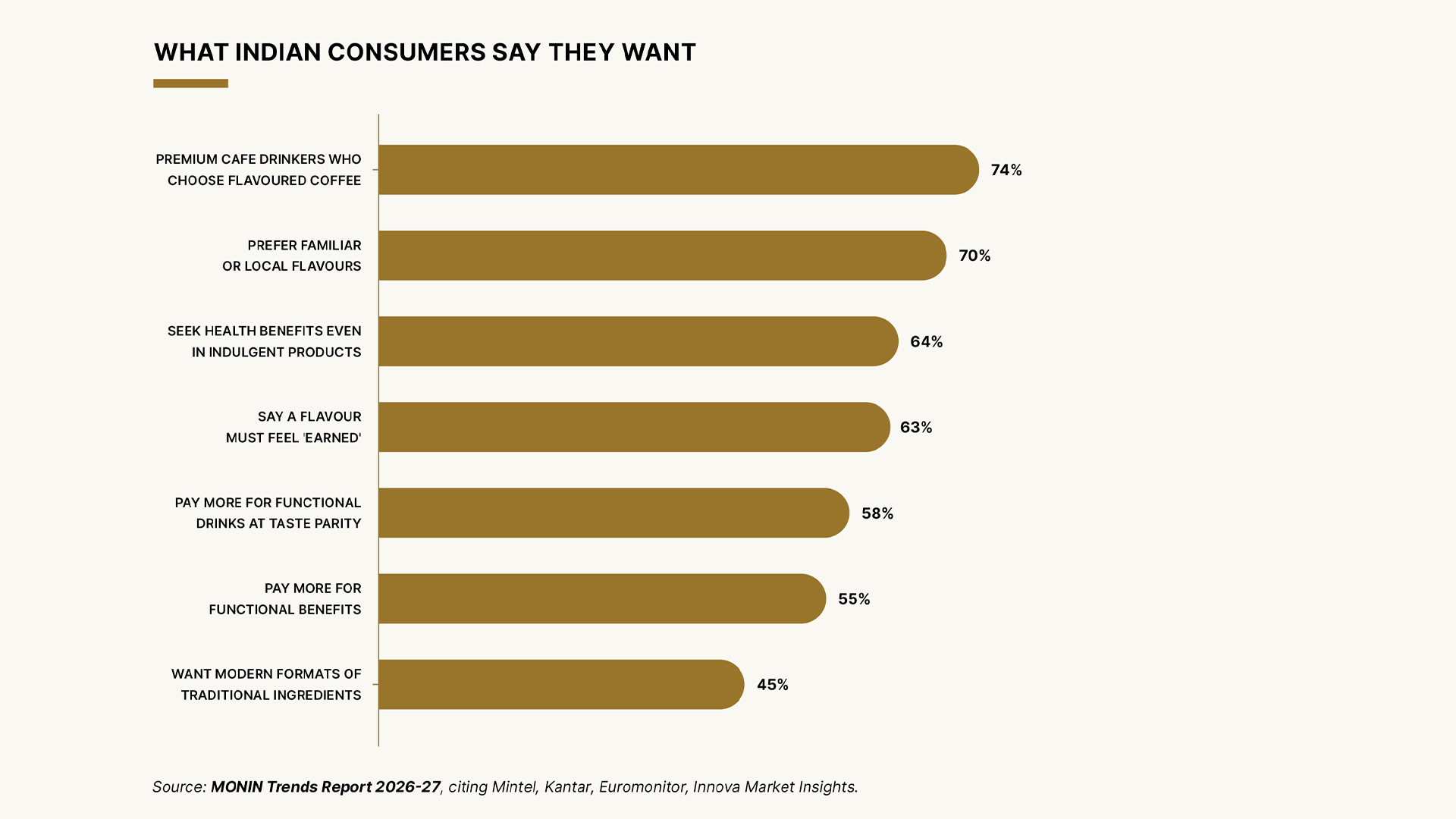
A second market is growing beside the spirits boom. The MONIN Trends Report 2026-27 values India's premium non-alcoholic beverage segment at about ₹15,000 crore and growing at 14% CAGR between 2025 and 2028, citing Euromonitor International and Market Xcel's Beverage Consumer Trends 2025. Its consumer readings, drawn from Mintel, Kantar, Innova Market Insights, NielsenIQ and Bacardi, show where taste and spending are moving. The same report records a 35% rise in daytime out-of-home drinking occasions in urban India, even as 32% of Gen Z worldwide cut back on alcohol.
Germain Araud, Managing Director, Monin India, reads the two currents as compatible rather than opposed. "India's low alcohol consumption was always a trend somehow," he says. "It was nothing new. Alcohol was a taboo topic." Spirits sales, he adds, are rising from a low base: "The alcohol sales are growing because it started as such a low consumption per consumer on average that it can only go up." No- and low-alcohol drinking holds its place at the same time. "Both somehow seem contradictory," he says, "but can be true at the same time."
Monin, founded in France in 1912 and selling in India since 1999, is backing both sides. The company employs close to 200 people in the country and has put more than ₹350 crore into the first phase of a 40-acre factory at Tilaknagar, near Hyderabad, its most advanced anywhere, due to open before the end of the year. An Indian research and development centre set up about six years ago adapts recipes to the local palate and to FSSAI requirements. The Indian range now runs past 70 flavours, led by a chai concentrate, a raw mango aam panna and a kala khatta take built on jamun, with Araud pointing to a wider jamun trend across both alcoholic and non-alcoholic drinks this year. The alcohol segment is not just going strong but also going desi.
Reports referenced: IWSR, H1 2025 beverage alcohol data; Outlook Business, on the K-shaped premium/mass divergence (industry estimates); What India Is Drinking (WIID) 2026, 30BestBarsIndia with The Outlier; MONIN Trends Report 2026-27, citing Euromonitor International, Market Xcel, Mintel, Kantar, Innova Market Insights, NielsenIQ and Bacardi; World Health Organization, Global status report on alcohol, per-capita and prevalence figures; Author interview with Germain Araud, Managing Director, Monin India, 1 September 2026.