




















The ePlane Co. Unveils India's Most Compact Electric Aircraft for Urban Air Mobility
After five years of R&D and over 10,000 km of test flights, IIT Madras-incubated startup reveals its first full-scale eVTOL prototype designed to operate from existing city infrastructure.

By SOH Edit Team
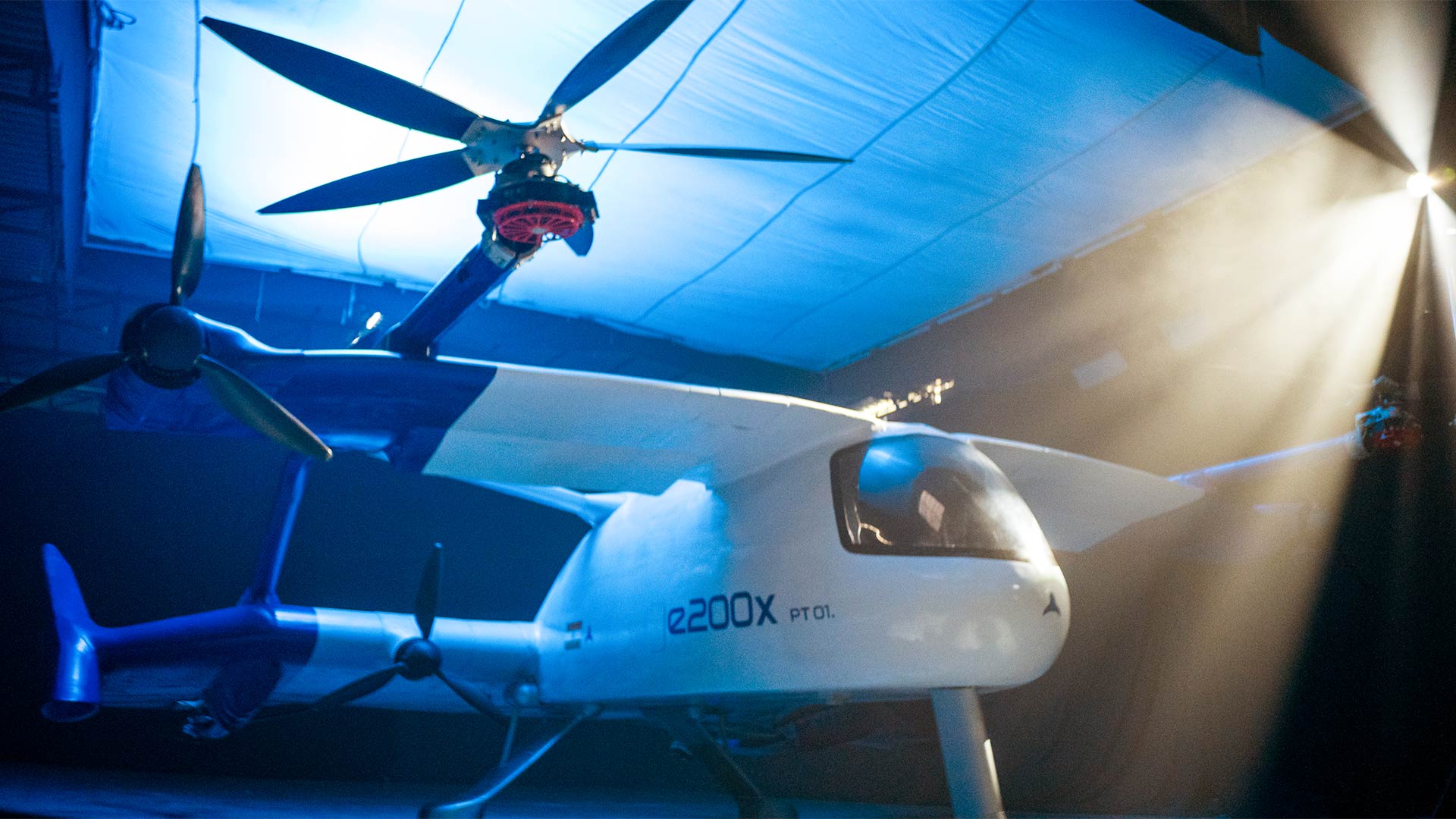
The ePlane Company has unveiled the e200X (PT-01), its first full-scale electric vertical take-off and landing (eVTOL) aircraft, marking a significant milestone in India's advanced aerospace ecosystem. Developed over five years of research and validated through more than 10,000 km of subscale test flights, the aircraft is designed to make urban air mobility possible using existing city infrastructure rather than requiring purpose-built landing hubs.
Built at the company's new 60,000 sq. ft. manufacturing facility in Chennai, the 2.2-ton carbon-fibre aircraft features an 8m x 11m footprint, making it one of the world's most compact winged passenger eVTOLs. The compact design enables operations from existing helipads and open urban spaces today, while paving the way for rooftop-to-rooftop mobility as regulations and infrastructure evolve.
Built for Practical Urban Mobility
The e200X is powered by a fully electric propulsion system built around ePlane's patented Synergistic Lift architecture, which separates vertical lift from forward cruise propulsion. This eliminates the complexity of tilt-rotor systems, improving efficiency while reducing potential single points of failure.
The aircraft can carry a pilot and up to 200 kg of payload—equivalent to two passengers or emergency medical cargo—with an operational range of 110 km. The company says it has already secured commitments for more than 800 aircraft, with emergency medical transport expected to be one of its earliest commercial use cases.
The e200X also introduces several technology firsts for India's aviation sector. It is built on the country's first 800V electric aircraft architecture, designed to reduce wiring weight, improve thermal efficiency and enable faster charging.
Its onboard computing platform is powered by NVIDIA IGX Thor, while development was accelerated using NVIDIA Omniverse digital twin technology. Mission-critical avionics are supplied by HENSOLDT, and Tata Consultancy Services (TCS) has developed the aircraft's battery management software and predictive fleet analytics platform.

Prof. Satya Chakravarthy, Founder and Technical Lead of The ePlane Company and Professor at IIT Madras.
Leadership Perspective
Prof. Satya Chakravarthy, Founder and Technical Lead of The ePlane Company and Professor at IIT Madras, said: "An aircraft that demands a city rebuild its entire skyline around it is a failure of engineering, not a triumph. We started with the market, not the technology. That discipline is what led to the Synergistic Lift architecture we patented back in 2019, now granted in more than 30 countries. We built our first prototype, flew it for over 10,000 kilometres, and earned our Design Organisation Approval from the DGCA in 2023, one certified step at a time. PT-01 is what that patience looks like when it finally takes physical shape."
On the company's transition to full-scale aircraft development, he added: "PT-01 shifts us from subscale testing straight into full-scale validation. The e50 heavy-lift drone completed flight trials and manoeuvres that validated the scaling learnings we're now carrying into this aircraft."
The e200X builds on ePlane's flight-testing journey that began in 2021 with its ATVA demonstrator and later the e50 heavy-lift drone, collectively logging more than 10,000 km of test flights—roughly a quarter of the Earth's circumference.
The PT-01 prototype will now enter an extensive ground-testing programme before progressing to certified flight trials targeted for mid-2027, bringing the company a step closer to commercialising electric urban air mobility from India.