











The River, the Rhino and the Spell
The world’s densest rhino habitat is also its most overlooked, until now. On the banks of the Brahmaputra, Assam's newest luxury retreat, Rhino & River Wildlife Retreat & Spa, is making the case for a destination that has always deserved more than a passing glance.

By Deepali Nandwani
Pobitora Wildlife Sanctuary, all of 38.8sq.kms., home to over 107 rhinos, just an hour’s drive from Guwahati (three hours on a bad day, when Guwahati’s chaotic traffic mimics big-city sprawl), is exactly the kind of country you would expect to go to when you want to escape. This is the land touched by the beauty and fierceness of the mighty Brahmaputra, the only Indian river referred to in the male gender.
Though at a comfortable driving distance from Guwahati, it feels a world apart—accessible, and yet such an immersive experience that blends wildlife, an ancient culture, and a cuisine built around balance, not spice. You can go from the airport to a rhino sighting in under two hours, rare for serious wildlife destinations.
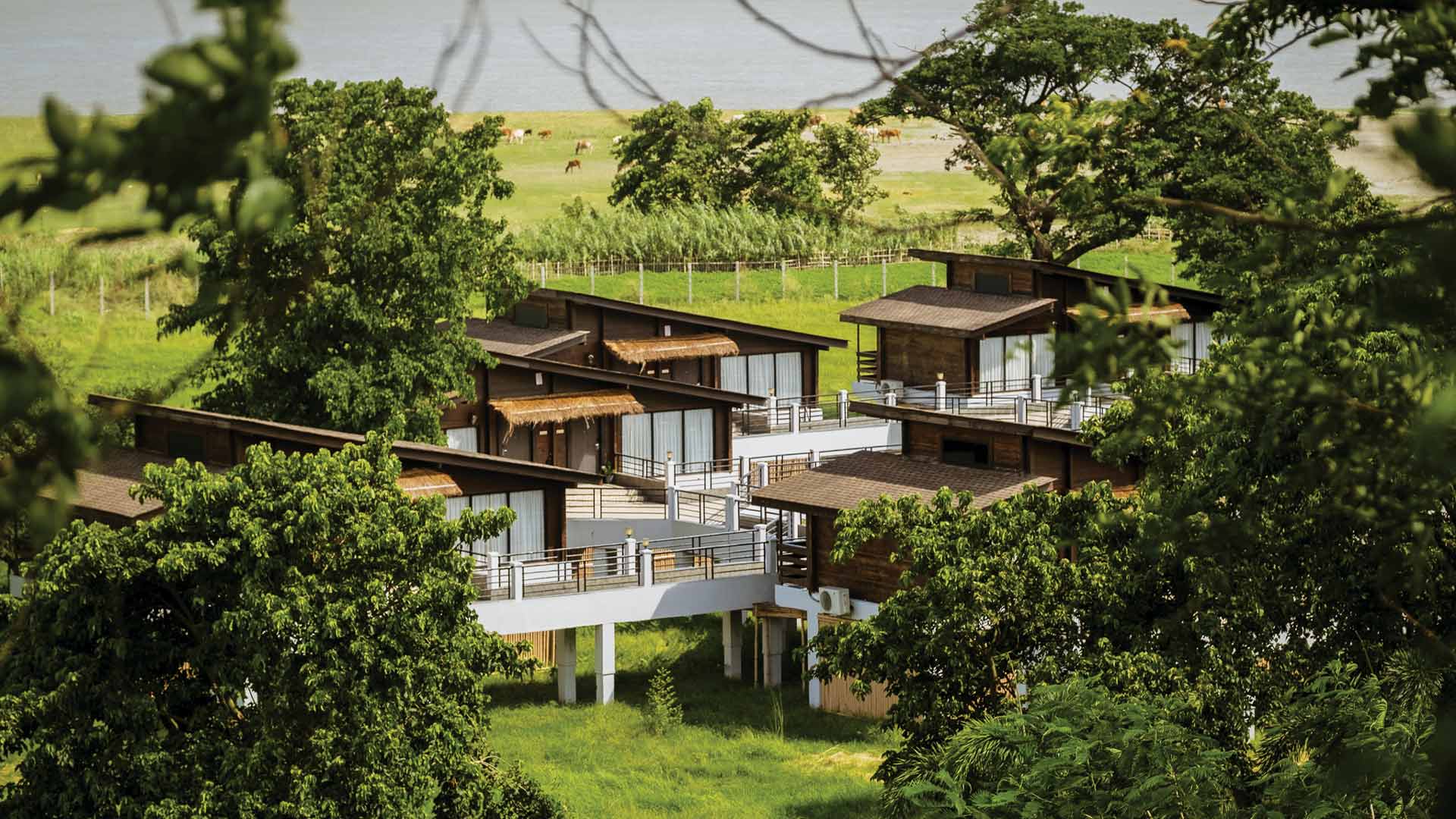
Seen through the trees, the retreat feels less like a resort and more like part of the river’s own landscape.
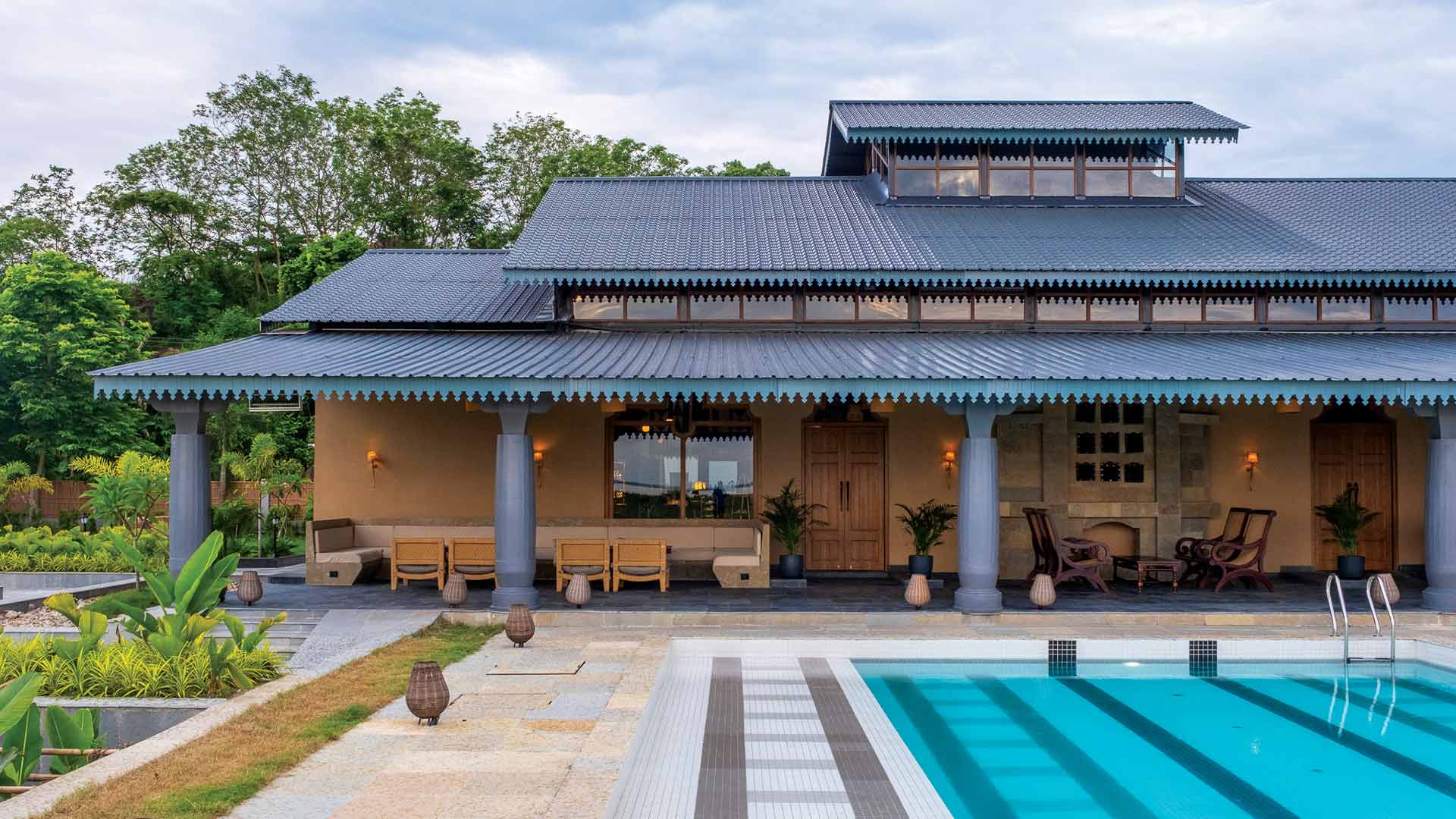
The buildings reflect vernacular Assamese forms.
A new address on the Brahmaputra
Resorts here are few and far between. Which is why the Rhino & River Wildlife Retreat & Spa, the first resort on the banks of the Brahmaputra, is such a crucial opening in a region that’s discovering what responsible and sustainable tourism can add to its travel landscape. It recently became a member of the Small Luxury Hotels of the World (SLH) network, a significant stamp of credibility for a property that only opened in late 2025. It has opened up the hotel to the possibility of international tourists, of whom they have had quite a few over the past year.
Rhino & River is where you head when you want some amount of rest and retreat within Assam’s bucolic villages, or want to spot rhinos up close and personal, and the abundant birdlife, especially cranes.
From the cottages of Rhino & River, the fertile Brahmaputra lies just a few metres away; yet it isn't directly accessible. You have to walk out of the resort, take a village road to a sandy embankment, and clamber down the sacks of sand that line it to stop erosion by a river that floods the villages during the monsoon, to get to the Brahmaputra. And there it lies, molten gold with inflexions of blue under a gentle mist, peaceful on the surface. But underneath, a strong current creates a shifting architecture of water and sediment, constantly reshaping the river, even when the surface appears still.
Tucked between the floodplains of the Brahmaputra and the world’s densest rhino habitat, the five-acre, 16-key Rhino & River Wildlife Retreat and Spa is redefining what luxury means in India’s northeast.
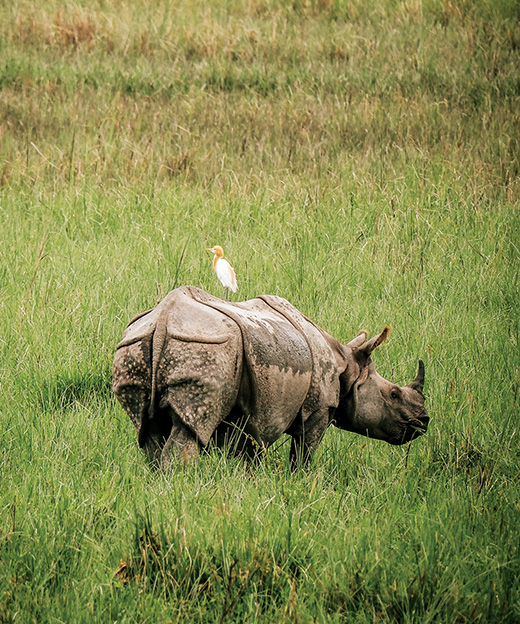
In Pobitora, rhino sightings are less a matter of luck and more a quiet certainty.
Design rooted in place
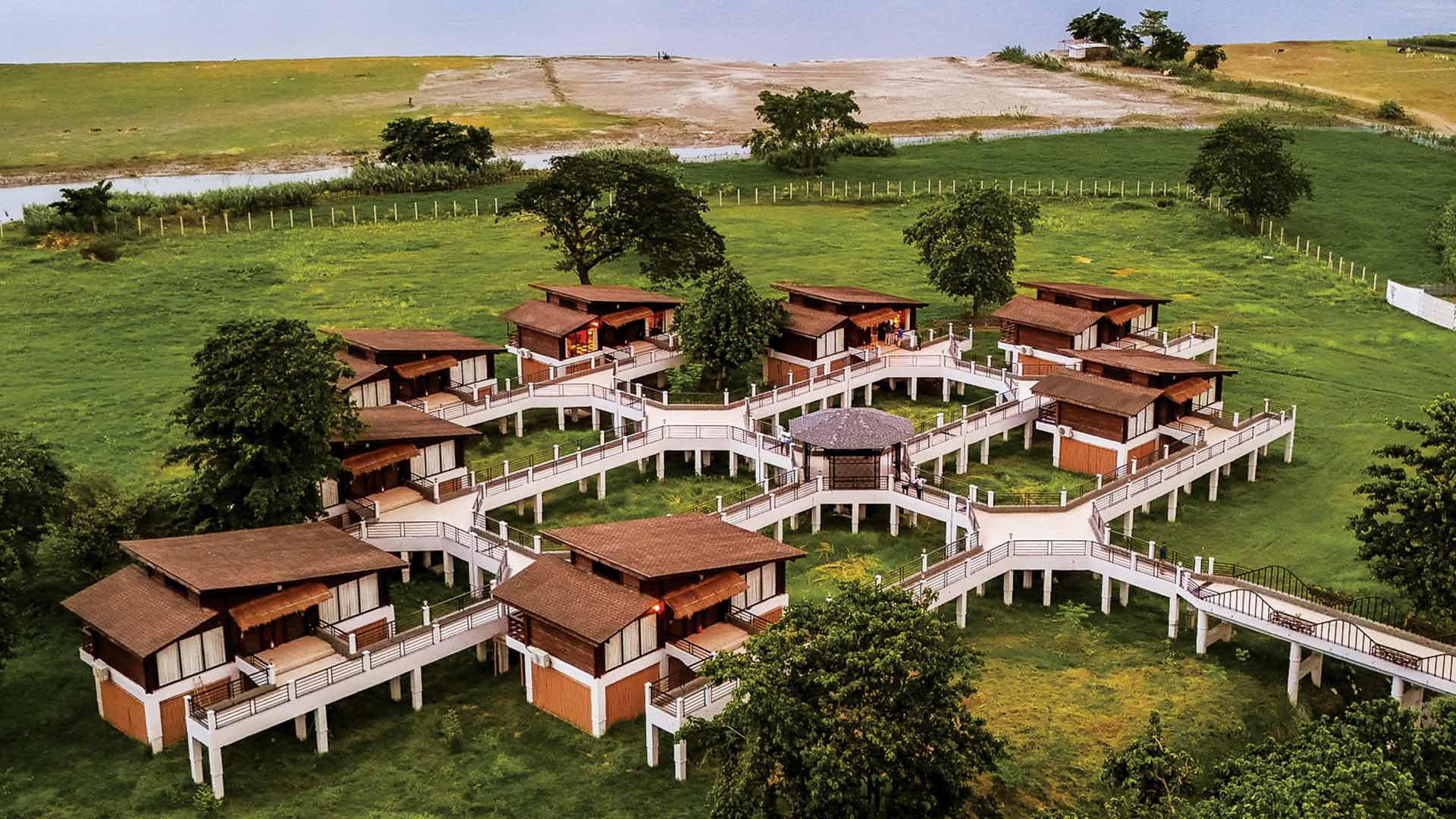
The cottages stand on stilts, a common design detail in a land where the river floods villages during particularly fierce monsoon months. So strong are the flood currents in some years that even rhinos get washed away. While the frame of the resort was built by Assam Tourism, the current management, SM JDB Estate Private Limited (a joint venture between two prominent Guwahati-based business groups SM Developers and the JDB Group that focuses on real estate and hospitality projects in northeast India), has refurbished the retreat to position it for premium travellers.
At the heart of Rhino & River is the dining area, Baan Kahi, sprawling and almost cavernous. The interiors, designed by EDIDA-winning Naga designer Aku Zeliang, are anchored in northeastern, particularly Naga, design traditions. A wall with black-and-white geometric motifs forms the core, while materials such as jute, water hyacinth and wood reference the region’s material palette.
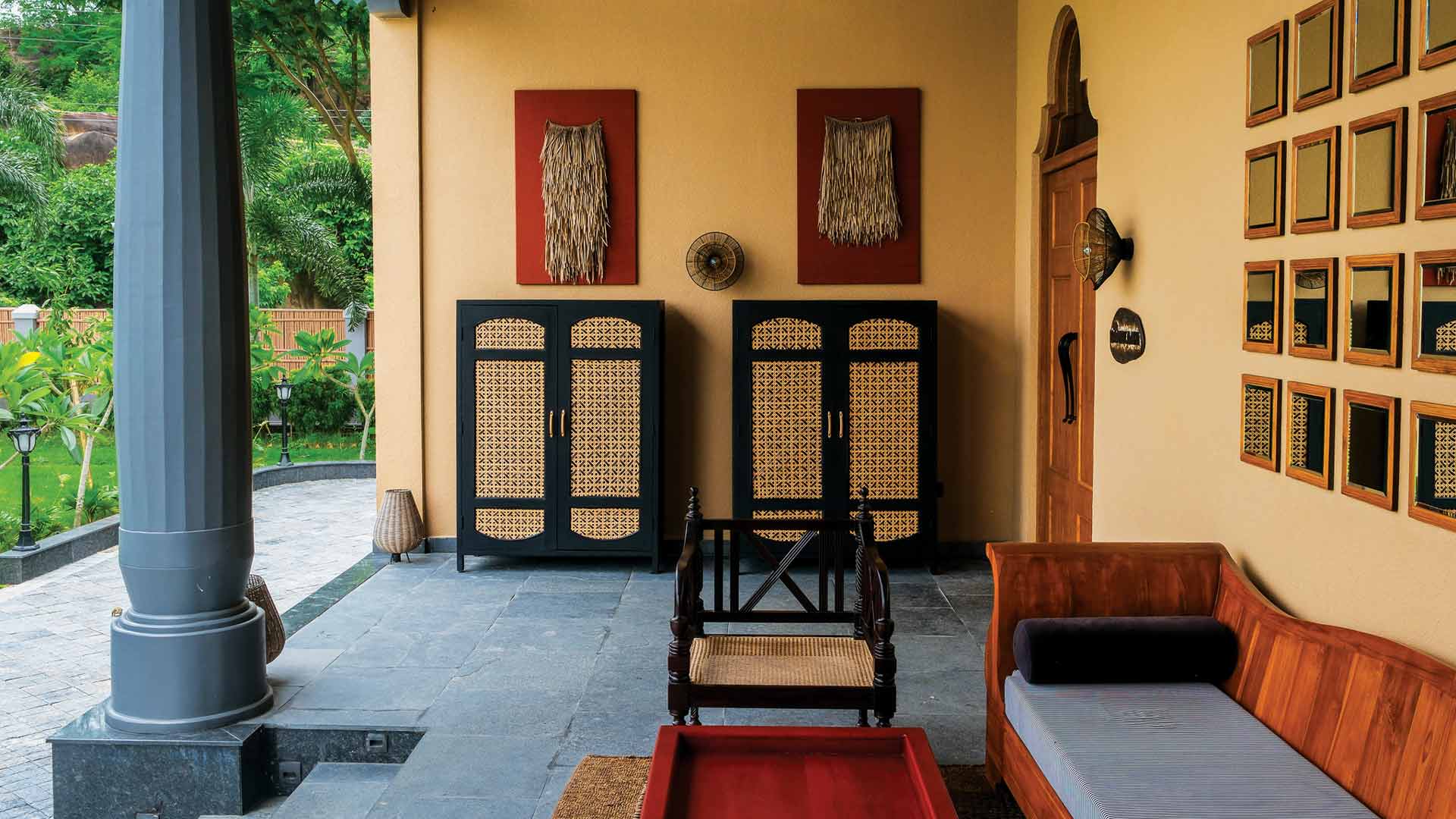
Within the rooms, the Brahmaputra’s muted browns and greens become the core palette. The wetland’s light and mist translate into layered interiors. The rhino itself becomes a tactile reference, seen in textured, almost armour-like finishes and metal rhinoceros figures across the retreat. As Resort Manager Mani Gurung says, “The idea was to be as local as possible, while allowing a certain contemporary layer to come in. Modernisation touches the design, but the respect for local remains intact.” Aku Zeliang reinterprets traditional Assamese homes through a contemporary lens, pairing asymmetrical sloping roofs with warm timber and layering in cane and bamboo elements handcrafted by local artisans.
You walk to your cottage through a long on-stilts bamboo pathway, which at one point has a delicate lattice or jaali gateway, somewhat like a pergola. The honeycomb-shaped gateway, painted black, frames the cottages, trees, and the Brahmaputra in the distance.
The room interiors are inspired either by safari lodges of yore, with leather and wood touches, or by the tea estates of Assam. The furniture in the dining area is all cane, much of it sculptural objets d’art, yet comfortable enough to sink into. In the tea estate cottage, the green rattan peacock chair is the highlight. “We don’t really have room numbers,” says Gurung. “Each room is named to reflect either the wildlife or the tea landscape, so the experience begins even before you step inside.
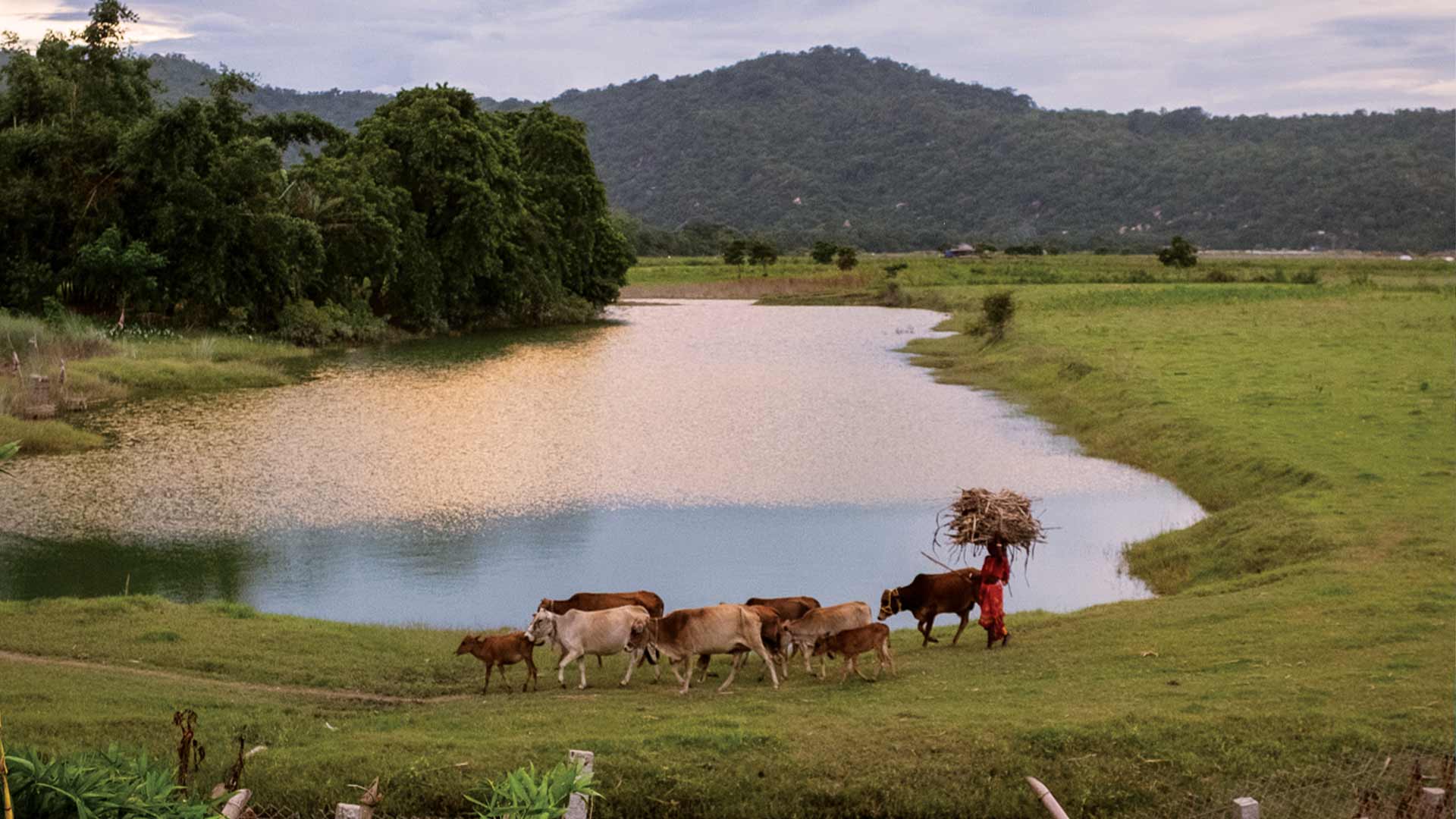
Village walks move beyond safari—to a life shaped entirely by the Brahmaputra’s rhythm.
At Baan Kahi, the dining experience draws from Assamese memory.
Where sightings feel inevitable
This is rhino country, so there is a safari through Pobitora Wildlife Sanctuary, where I am “guaranteed” a rhino sighting by Gurung. I have largely been lucky with sightings in the wild, but seeing over five rhinos in one morning was a first, even for me, one of them so close that I could reach out and touch her… if I wanted to. Here was a beast built like an army tank, highly territorial, capable of running at 45km/hr. And yet, she seemed nonchalant as she munched on fresh grass, her tough hide glistening in the morning sun.
If you’re expecting Pobitora to be a lesser cousin of Kaziranga National Park, it isn’t. The resort naturalist Amar Jyoti says sightings here aren’t a matter of luck; they’re almost assured. A drive across Pobitora reveals a magical landscape, a mosaic of marshes, floodplains, and tall elephant grass through which rhinos move stealthily. Safaris are often on elephant back, though we were in an open-air jeep.
The marshes and water bodies formed by the river are flush with migratory birds from Siberia and Central Asia—cranes, Oriental Pied Hornbills, storks, herons and thousands of Lesser Whistling ducks, who trill instead of quacking! “Over 200 species thrive in this ecosystem,” says Amar Jyoti. “The entire landscape shifts dramatically with seasons, sometimes resembling a floating world during monsoons.”
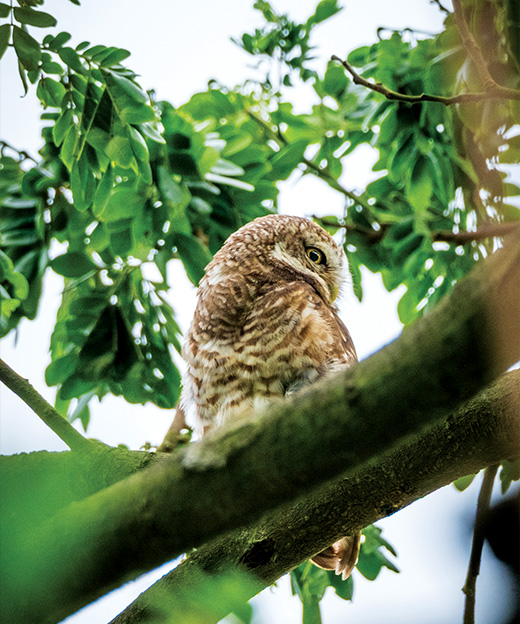
Birding reveals a wetland alive with migratory visitors.
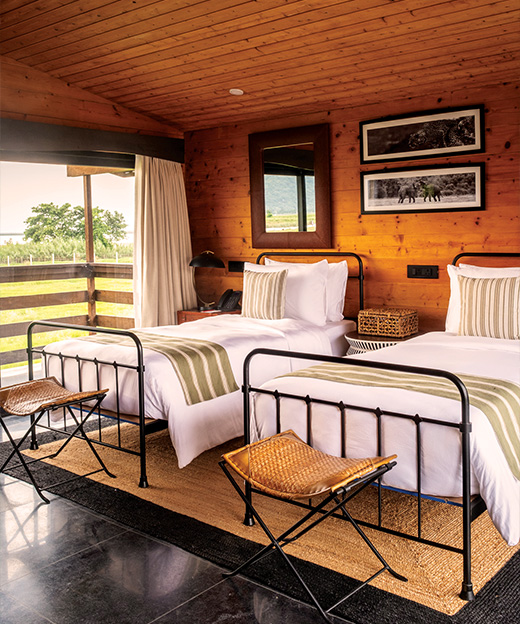
Rooms draw from the Brahmaputra—muted greens, softened light and colours that echo the rhino.
Black magic, handlooms and village walks
Rhino & River Wildlife Retreat & Spa positions itself as an experiential resort, and there is plenty to do in Pobitora despite its seclusion. The safari remains central. “Our focus is to bring Pobitora into the spotlight,” says Gurung. “Everyone knows Kaziranga, but very few people know Pobitora. Here, rhino sightings are almost guaranteed, and the culture is ancient.”
The region lies within the larger Mayang district, where black magic once flourished and where healers still treat years of pain and disease. The Mayang Museum, dedicated to practitioners and healers, chronicles the region’s tryst with black magic. People no longer practise black magic, Babumani Saikia, also a naturalist and storyteller, assures me, though there are healers—bejes—who practise ‘white magic’.
The Mayang Museum is not a large building, but it holds an unsettling amount of history. Old manuscripts line the walls, their edges worn soft with age, each page dense with spells, invocations, and rituals described with the precision of a medical textbook. There are skulls. There are talismans. Photographs of practitioners stare out from behind glass, men and women who could, according to the records, turn people into animals, find stolen goods, or treat malaria with methods that no pharmacy would recognise.
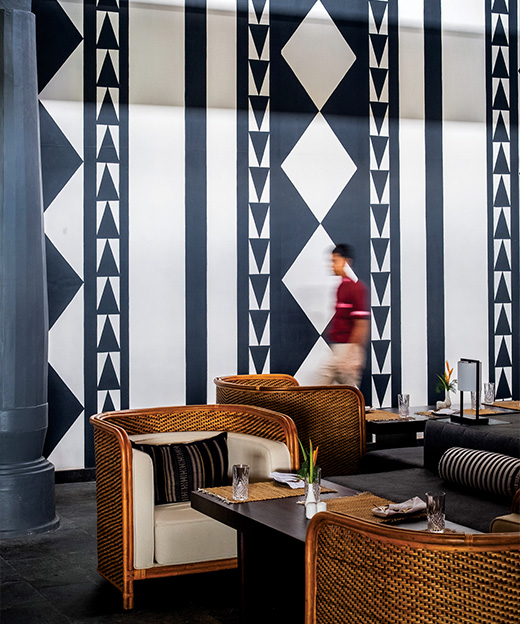
The spa is designed less for indulgence than recovery.
Babumani lets me take my time here, which I appreciate, because this is not a place you move through quickly. "People think magic ended," he says quietly. "It didn't. It just changed its shape." Outside, the village looks entirely ordinary—children, chickens, a woman hanging washing. I stood there for a moment, trying to reconcile the two. I couldn't quite.
The museum evoked a feeling that sits between fascination, curiosity and unease. For me, travelling through the region became as much about understanding an ancient culture steeped in magic and mystery as it was about the rhinos or the cuisine of the river people.
Beyond that, Rhino & River offers river experiences and village walks. On the first day, the boat I take—more like a dhow—moves down the Brahmaputra, with villages on both sides. We dock at river islands where people farm vegetables and spices on land made fertile by river sand, and where life is shaped by the ever-changing current.
The river, for now, moves with deceptive gentleness. But as Babumani tells me, come monsoon, it swells and quickens, the sediment-laden currents building and erasing sandbanks, restlessly redrawing the land as shifting channels give rise to temporary islands that are formed, eroded, and reshaped.
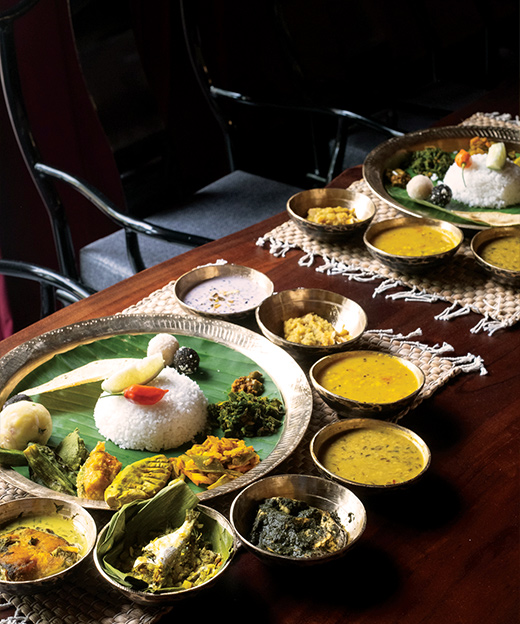
The Assamese thali at Baan Kahi features flavours built on balance.
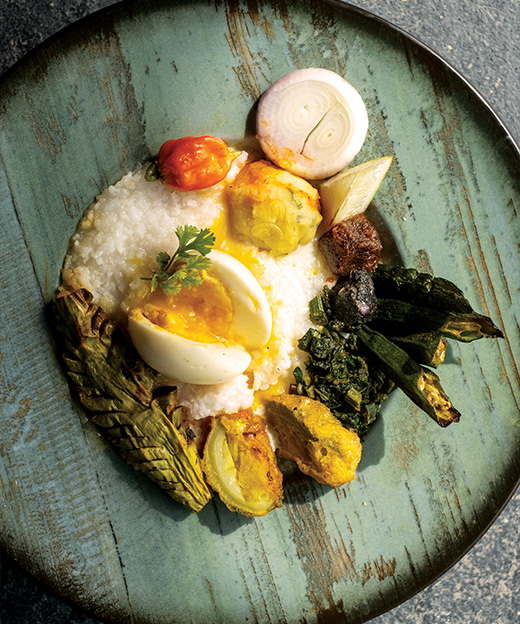
Breakfast arrives, with local staples that root the stay firmly in Assam.
Evenings that unfold slowly
Walking through the sandbanks and over sacks of sand is a workout, as is climbing a few hundred steps to the Shiva temple atop a hill, from where the view of Pobitora is exquisite, with the river in the distance, hills beyond, and villages in between. This simple temple, with the voice of the local priest chanting, the dog who followed me for the prasad, and the vista that loomed large, is exactly what you need to slow down and let go.
On a quieter evening, I walked through the village, meeting local weavers who create red-and-white Assamese gamosa (gamcha) and mekhela-chador (a two-piece garment) on traditional looms, ending at Babumani’s house for a cup of Assam black tea.
There were other moments of quiet and beauty over the three exploratory days: watching ducks trilling away or a rhino munching just a few metres away; a heron standing motionless in the shallows; the smell of river sand; the sound of the loom in the weaver’s house; the beauty and simplicity of naamghars, or the home temples; and the black Assam tea from just a few kilometres away, among the best I have had.
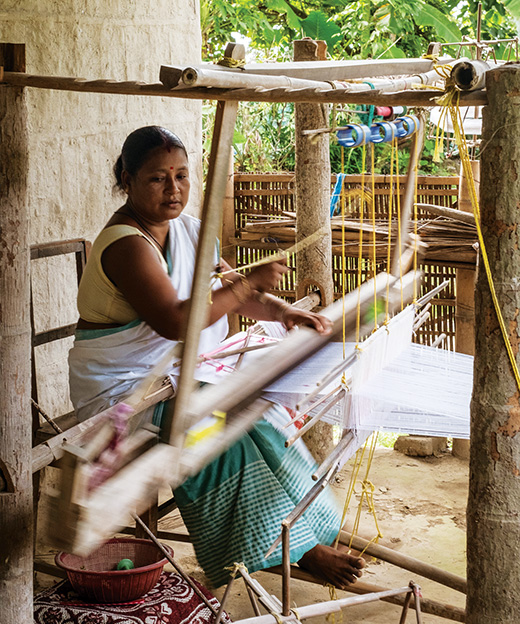
Village walks often end at the loom, where Assamese gamosa and mekhela-chador are still woven by hand.
Back at the resort, evenings unfold in the dining area, where local musicians perform boatmen’s songs and flute music, a popular Bihu troupe takes over with effortless energy, while you dine on Assamese and global dishes. The meals are fresh, local and sustainable. The black rice kheer, Assamese thali with river fish, puris, pani pitha and jolpaan are a testament to how a boutique hotel should be run. Then there is the large multi-room spa with steam, shirodhara and en-suite showers, where, they say, the foot spa is pure magic.
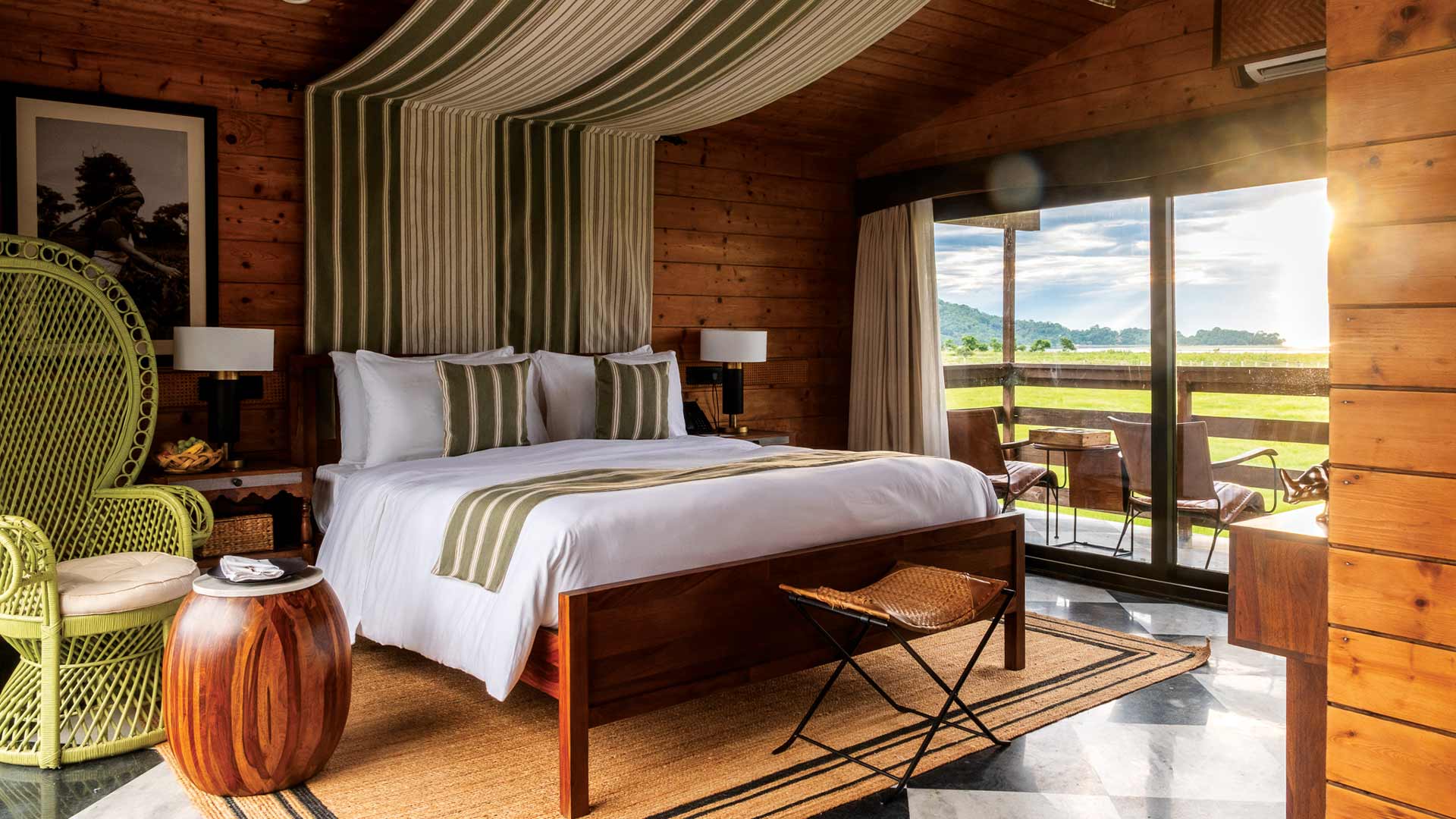
Each room is named for the wildlife or tea landscape around it.
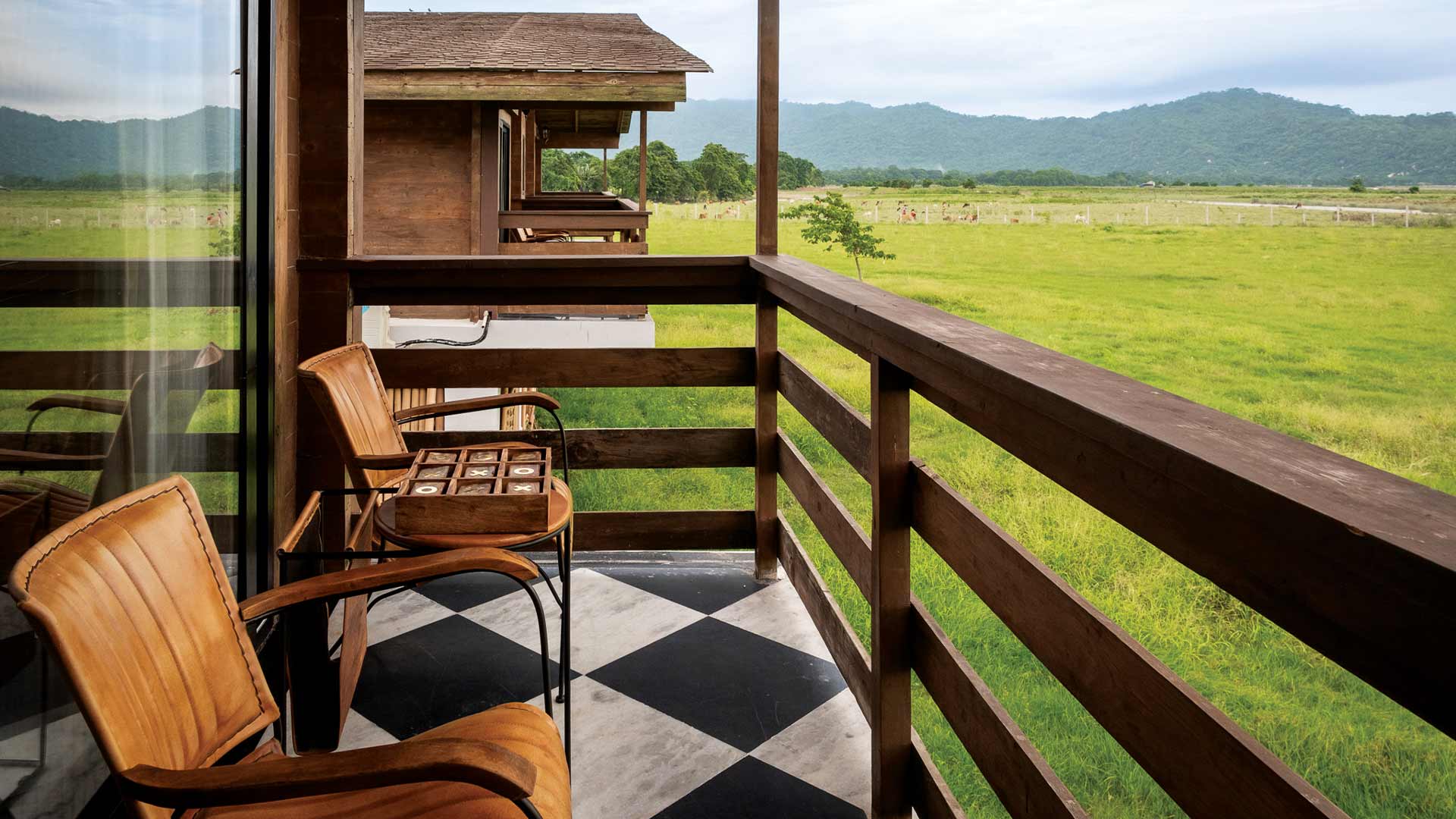
Local rice beer, still brewed the old way; from the balcony, the floodplains stretch toward the Brahmaputra.
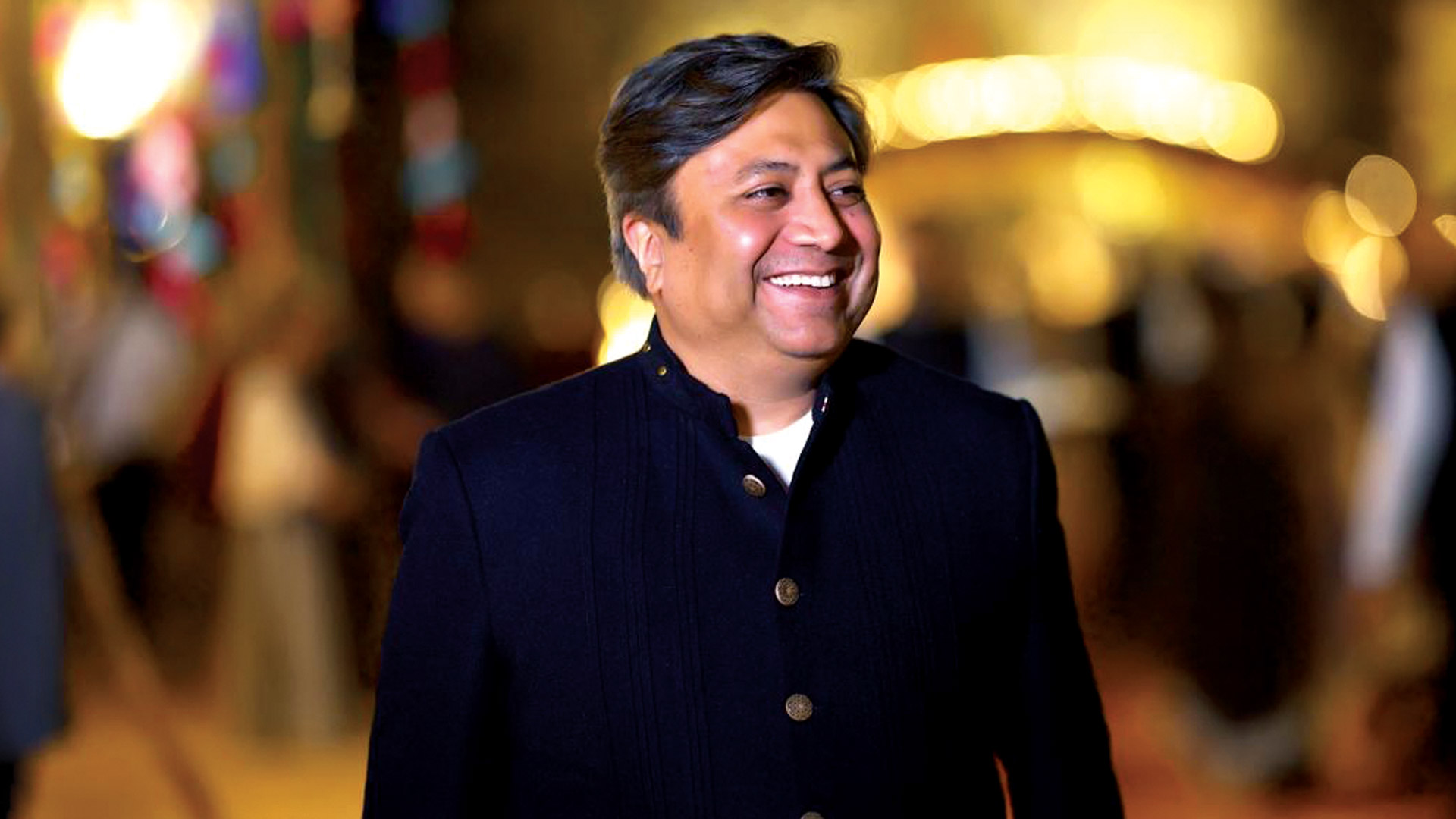
Vikas Agarwal, MD & CEO, SM Developers.
If you are planning an ultra-exclusive property like Rhino & River, the product and ecosystem must have a great sense of synergy. Once you achieve that, the service and narrative follow.
Vikas Agarwal
MD & CEO, SM Developers

Q&A with Vikas Agarwal, MD & CEO, SM Developers
On building a destination-led retreat where the river, the rhino and the region remain inseparable.
Rhino & River Wildlife Retreat & Spa is located in a destination that is still emerging on the tourism map. What made you believe this could become a viable hospitality destination?
Rhino & River is the first resort on the banks of the Brahmaputra, ever. Moreover, as a location just an hour from Guwahati—besides being a great weekend option—it is also easily accessible for anyone flying into the city. I felt it was time Pobitora, with the highest density of rhinos and its location in Mayang (the black magic capital), started getting its due, all of which could be woven into an interesting story.
What went into designing the resort?
Typically, northeastern design has always focused on timber and very in-your-face tribal artefacts. My vision was to house a contemporary northeast aesthetic within a traditional architectural shell. This way, while the structure evoked a bygone ‘Assam-type house’ era, the art and furniture remained comfortable, aesthetic and timeless. We have used materials from different parts of the region—Sohra Stone from Meghalaya, furniture from Nagaland, art from Arunachal—while keeping Assam as a focal point of the architecture, uniforms, and naming or signage. Our restaurant is called Baankahi, the traditional plating system of Ahom kings, while the bar is called Apong, or rice beer of Assam, and the spa is Nirban (nirvana).
How did you decide the experiences you would offer to your guests?
The entire ethos has been to offer truly local, immersive experiences. I was quite sure that we had to provide avenues for people to engage with nature in its rawest form and explore the area. We even got rabbits and ducks so that urban children, who don’t even get to see birds, feel the excitement of petting a rabbit. And you have to see how they go absolutely crazy doing that!
How do you create a sense of destination where existing tourism infrastructure is limited? What comes first—the product, the narrative, or the ecosystem around it?
I feel scale would define it. If you are planning a 200-room mega resort, you can literally plug it into any location where logistics are convenient, and seasonality is not too dominant. However, in the case of ultra-exclusive properties like Rhino & River, the product and ecosystem must have a great sense of synergy. Once you achieve that, the service and narrative follow. Rhino & River couldn't be what it has become without the rhino or the river, or the 500-year-old Shiva temple around it.
Assam’s tourism story is often dominated by Kaziranga. Do you see Pobitora as part of a broader shift in the axis of travel within the state? What makes this micro-destination compelling today?
I definitely cannot say that the axis will shift. However, Pobitora, and more specifically Rhino & River, provides a decent, quick fix for someone with limited time. You need at least three days to get anything out of Kaziranga. On the other hand, an 18-hr sojourn at R&R is a great way to experience the northeast. Also, this is our attempt to shift Guwahati from a transient location to a place where visitors can spend two nights and experience the entire region.
What were the biggest challenges in conceptualising and building Rhino & River Wildlife Retreat & Spa?
We partnered with Assam Tourism for the land. So that wasn’t very difficult. I feel conceptualising, and then bringing the right team to design the experiences, brand and art, have been the most interesting aspects. You have to get it right the first time, so all decisions have to be very carefully made. Therefore, although we have just 16 rooms, we have a reasonably large multi-room spa with steam, shirodhara and en-suite showers. We also have a heated pool so that even during peak winters, people can enjoy the property as a simple getaway with families or friends.
Boutique hotels often rely on strong storytelling. How did you define the identity of the retreat—as a wildlife retreat, a wellness escape, or a cultural immersion experience?
So, we are not located inside the Serengeti. And we realised it right when we started designing the property that Pobitora Sanctuary would be a six-month highlight. Thus, it was very important that we had multiple points of attraction for our patrons as an all-season destination. Being the melting pot of the northeast, Guwahati attracts travellers from all over the region, besides the rest of the country and the world.
Assam still faces constraints in connectivity, visibility, and perception. What structural challenges do hotel owners encounter when operating here?
Lack of connectivity is a myth. Guwahati airport is now the seventh busiest airport in the country. Any guest from any major city in the country can reach Guwahati within three hours. We need to work on visibility and perception, and our government—both the centre and the state—is doing a fantastic job. It is safe, it is connected, and now we need to up the ante.
Do guests come to Rhino & River specifically for Pobitora, or does the hotel itself act as the primary draw?
The right property is extremely important as an anchor. It is not that there weren’t other properties before Rhino & River. But the price point or the offering was for a different category, from a different time, and nothing to write home about. We felt that it was high time the region got a property for which people would travel from far and wide. So yes, we now have guests coming from Mumbai or even London, just to stay with us and travel onwards.
What will it take for Assam to emerge as a more mainstream luxury and boutique travel destination?
We are at a very, very nascent stage as far as luxury is concerned. We have to ensure that the time invested by the guest with us has a 101% return. The memories and the experiences that they carry have to last a lifetime. Moreover, Assam has not two, not three, but seven or eight national parks. Maybe even a few more. So we need about 15 to 20 more Rhino & Rivers. Only then, in the next couple of decades, will we see a real luxury circuit developing in the region. Until then, the river needs to keep flowing, and the birds need to continue chirping.
Image credits: Himanshu Lakhwani (for Rhino & River Wildlife Retreat & Spa, Pobitora)