













Ayodhya 2.0: An Ambitious Road Map
A combined public and private sector push is seeing Ayodhya emerge as the fastest-growing tourism destination in India. What opportunities does the destination offer to the hotel and travel industries?

By Suman Tarafdar
Just about anyone will attest to this—Ayodhya is arguably the fastest-growing spiritual and religious tourist destination. Unprecedented attention by the federal and Uttar Pradesh governments has been lavished on what was once the legendary capital of the Ikshvaku dynasty, with the deity Lord Ram at its cultural and spiritual core.
The transformation has been impressive. What was till recently a sleepy town twinned with neighbouring Faizabad, the first capital of the nawabs of Awadh, is now being posited as one that, in the not-so-distant future, would occupy a space similar to the Vatican, Mecca or Bodhgaya, which rank high on the religious tourism marquee.
The newly built temple, inaugurated by Prime Minister Narendra Modi, has ushered in an uptick in interest in the city, and both the public and private sectors are rushing to build infrastructure to meet a sharp increase in tourism. There are also plans to build a Tourism Facility Centre at Nayaghat as well as an international museum at an estimated cost of ₹200 crore.
Tata Sons is planning to construct a Museum of Temples at an estimated cost of ₹650 crores, dedicated to showcasing India's rich heritage and temple architecture. The UP Tourism Department will provide land for the museum on a 90-year lease. Additionally, Tata Sons will invest another ₹100 crores to improve Ayodhya's infrastructure and enhance its appeal to tourists.
The federal and state governments have launched several initiatives to make Ayodhya a major centre of religious tourism. This includes the Ayodhya Mahayojana 2031 plan, announced by the Uttar Pradesh government, covering an area of 133.67 sq.km. It is expected that by 2031, more than 40 million tourists will visit Ayodhya, double the number from today’s visitor count estimates. American financial services firm Jefferies Group LLC has estimated that Ayodhya will witness a $10 billion makeover with hotels increasing capacity five times, and attracting food, travel, and transport businesses.
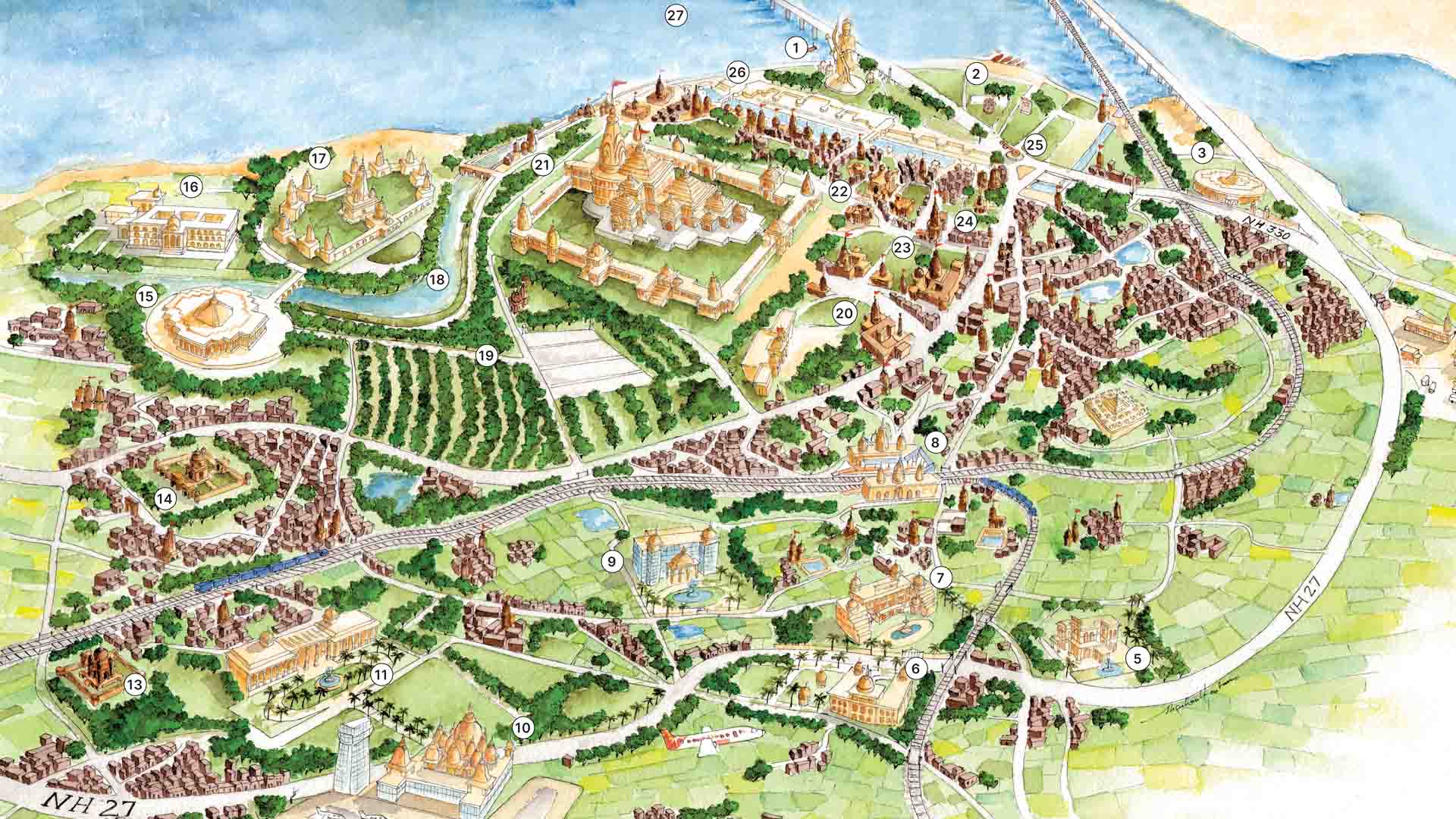
For the second stage of the town’s redevelopment, Vadodara-based urban planner Gopaldas Shah, part of the Masterplan team, has proposed the city’s layout on the ‘Dhanush’ plan, based on Vastushastra, according to reports. The document has a list of 27 projects which are all a part of the master plan. Part of these efforts includes the redevelopment of Ayodhya's outskirts under the Amrit Yojana-2 programme, with a budget of ₹351.40 crores.
While these initiatives have been announced, they are still in the preliminary stages, and it will take some time before we see progress and set deadlines for their completion.
Ancient Ayodhya
While the legendary city of Ayodhya is associated with Lord Ram, the historical city finds extensive references in ancient texts of the region. Here are some lesser-known aspects of the city, once one of the largest in the subcontinent:
- The word Ayodhya is derived from yudh or war and would more aptly translate to mean invincible.
- Ayodhya has an earlier name—Saketa, its name ascribed to the Sanskrit words saha (with) and aketen (houses or buildings). The city is referred to in ancient Sanskrit, Jain, Buddhist, Greek and Chinese sources as Saketa.
- The name Ayodhya is used from the Gupta era onwards, when Skandagupta moved his capital to Saketa and renamed it. Kalidasa’s Raghuvamsha mentions Ayodhya as an alternate name for Saketa.
- Both Gautama Buddha and Mahavira are said to have visited and lived in the city.
- Ancient scholars such as Panini and Patanjali mention the city in their works.
- Ayodhya was stated to be the capital of the Kosala kingdom in the period of the Mahajanpadas (ca. 6th century BC).
- The city’s importance grew as it lay on the intersecting trade routes of the Ganga valley in the ancient period—the Shravasti-Pratishthana north–south road, and the Rajagriha-Varanasi-Shravasti-Taxila east–west road.
- Even after the decline of the Guptas, the town continued to flourish, as evidenced by Chinese traveller Xuanzang, who mentioned it during his travels in the 7th century.
As a part of the Ayodhya Mahayojana 2031 plan, the city will see revamped infrastructure. UP governmentʼs Vision Document for Ayodhya envisages a grand new Ayodhya across river Saryu, straddling the adjoining districts of Gonda and Basti.

Infrastructure linkages
The travel and hospitality sectors are rushing in to fill the gap. A slew of projects have been announced. In the past few years, the government has boosted railway connectivity, even launching special ‘Ramayana Circuit’ trains to facilitate pilgrims visiting the city.
MakeMyTrip earlier announced an Ayodhya charter train package. Palace on Wheels, India’s first luxury train, is reported to be planning a religious circuit that includes Ayodhya, Varanasi, Prayagraj, Mathura and Vrindavan. Amongst the planned highlights of this religious trip, expected to run twice a month, are only vegetarian cuisine on board, no alcohol, and the playing of devotional songs along the entire route.
The National Highways Authority of India (NHAI) has undertaken a project to construct a 65-km ring road around town, from Sugriva Fort to Ram Mandir, at an estimated cost of `2,588 crore. Also on the anvil is a 1,200-acre Vedic Township with ashrams, hotels and other institutions.
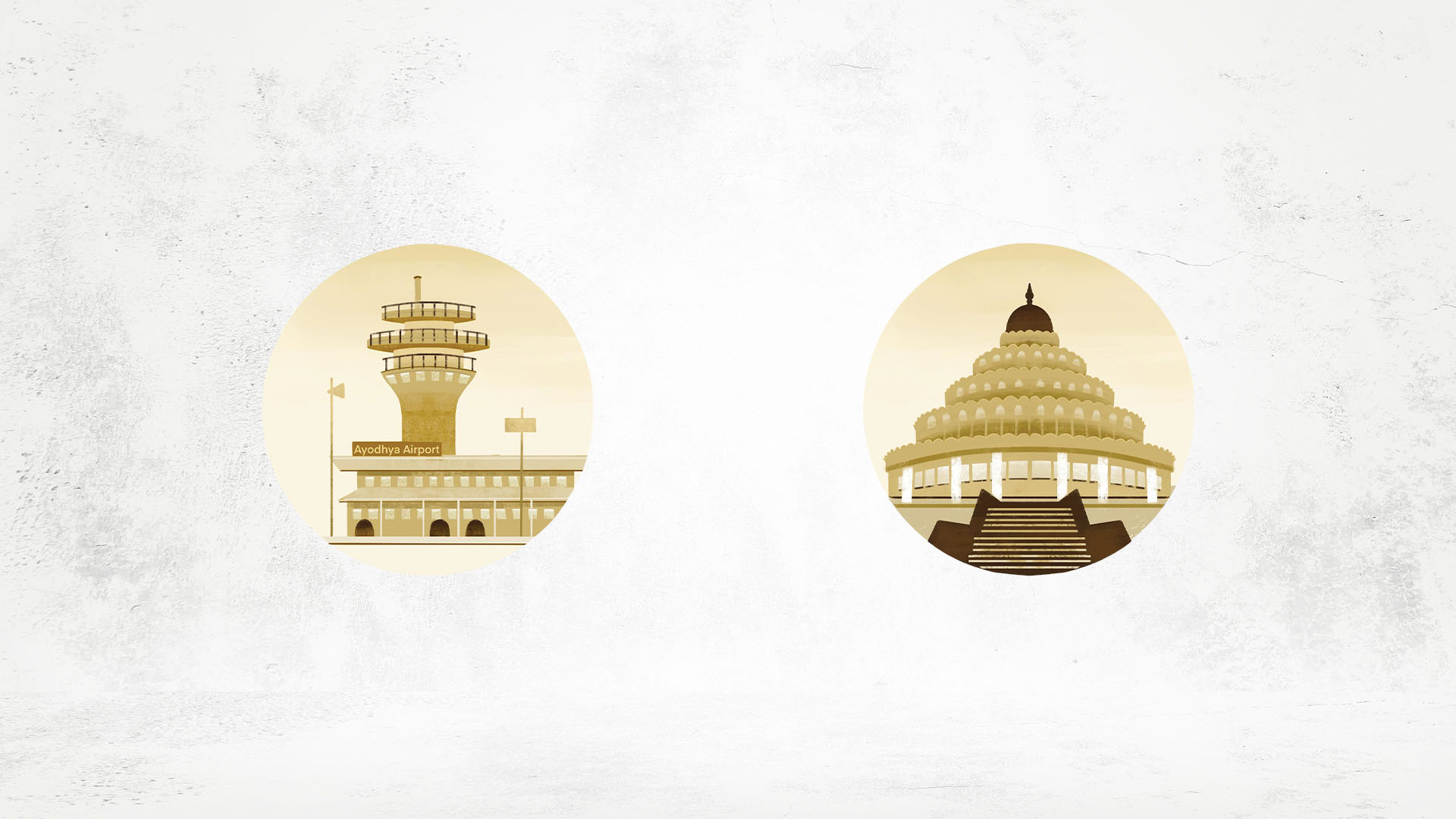
The speed of air connectivity has been even more impressive. Construction on the Maharishi Valmiki International Airport began in February 2022, with an allocated budget of `5 billion, and was inaugurated on 30 December 2023, while flight operations began on 10 January 2024—easily the fastest implementations of an airport project in the country. Several airlines are flying to Ayodhya already, including Air India Express (Bengaluru, Delhi, Gwalior, Kolkata), Akasa Air (Delhi, Pune), IndiGo (Ahmedabad, Delhi, Mumbai), SpiceJet (Ahmedabad, Bengaluru, Chennai, Darbhanga, Delhi, Jaipur, Mumbai, Patna) and Zoom Air (Delhi).
According to Aloke Singh, Managing Director, Air India Express, “We inaugurated our Ayodhya-Delhi flight on the very day of Ayodhya airport’s opening. Within a few weeks, we extended our connectivity to this sacred city, now linking Ayodhya with two additional metro cities: Kolkata and Bengaluru. This strategic expansion will provide pilgrims with convenient one-stop itineraries to Ayodhya and enhance connectivity to 16 other destinations on our network. The swift expansion of services in Ayodhya underscores our commitment to expanding both domestically and internationally, driven by a growing fleet.”
As a part of the Ayodhya Mahayojana 2031 plan, the city will see revamped infrastructure. UP government’s Vision Document for Ayodhya envisages a grand new Ayodhya across the river Saryu, straddling the adjoining districts of Gonda and Basti.
Hospitality Boom
IHCL has announced the signing of two new hotels in Ayodhya. Both Vivanta and Ginger branded hotels are greenfield projects. “These signings are in line with IHCL’s vision to strengthen its presence across spiritual centres in India,” Suma Venkatesh, Executive Vice President - Real Estate & Development, IHCL says. “Ayodhya is an important pilgrimage site and receives a very high footfall throughout the year. We are extremely delighted to partner with Bhardwaj Global Infraventures Private Limited for these two hotels.”
Ajay K Bakaya, Managing Director of Sarovar Hotels & Resorts, says that hotel chains are in discussions or have already committed to establishing hotels in Ayodhya. Interestingly, hotel infrastructure may develop even beyond the core temple area. Hotelivate’s report puts it in perspective when it states, “For hotel developers and brands exploring the Ayodhya opportunity, it is important to note that the Chaurasi Kosi perimeter, delineated around the temple, imposes specific restrictions on hospitality establishments, mandating vegetarian offerings and an alcohol-free environment. In contrast, surrounding areas, including the Ayodhya Cantonment area and the Gonda district, north of the river Saryu, do not have such restrictions and present alternate options for hotel developers or brands who view these restrictions as challenges.”
International groups such as British conglomerate Trafalgar Square Capital, Hong Kong-based Taushan International Group, RG Group, Austin Consulting Group, Cosis Group and Unicorn Energy from Germany have shown interest in investments in Ayodhya.
The spiritual destination is on the cusp of transformation and it will be interesting to track how India’s religious tourism sector will evolve, based on lessons learnt from the city famous as Lord Ram’s birthplace.
Hotel infrastructure’s expanding footprint
To cater to the increased number of tourists, the plan is to have about 25,000 hotel rooms across categories, up from 592 (in 2023) and 70 dharamshalas, according to the Masterplan report. The speed with which a slew of hotel projects have been announced is notable. Projects worth ₹4,233 crore, budgeted for the construction of at least 100 hotels, including luxury ones, are in the pipeline.
Hospitality consultancy firm Hotelivate, in its report Ayodhya’s Gold Rush: Hospitality Boom in the Offing, estimates, “Assuming that about 5% of the total footfall would opt to stay in branded hotels with an average guest density of 2.2 people per room and a length of stay of one night, we project that the market will require an inventory of 8,500-12,500 branded keys to cater to this demand. Owing to the inherent seasonality, an assumption of 65% marketwide occupancy has been taken.”
Real estate consultancy JLL estimates about ₹350 crore worth of investments in hotel development. The UP Housing and Development Board invited interested parties to participate in an e-auction of hotel plots in Ayodhya. According to a report in the Hindustan Times, two mega hotels with a capacity of 200 rooms each, 20 hotels with a capacity of 100-175 rooms, 47 hotels with 50-99 rooms each, and 65 hotels with less than 50 rooms each will come up in Ayodhya.
The projected data is based on the potential of the destination as a spiritual tourism getaway rather than actual arrivals, so how it shapes up ultimately needs to be tracked over the next few years. There is no taking away from the fact that the possible potential has enthused businesses, among them the hospitality industry.
Among the leading hotel groups that have signed projects are Indian Hotels Company Limited (IHCL), Marriott, Sarovar Hotels & Resorts, Fortune Hotels, and Wyndham Hotels & Resorts. The projects are expected to be realised in the next few years. Others such as ITC are said to be actively exploring opportunities.
Dikshu Kukreja, Managing Principal, CP Kukreja Architects, estimates that about 30,000 rooms across different categories will be needed to cater to the visitors. Vijay Naraayanan, Co-Founder & CEO, AweSpace Ventures Private Limited, has said that the leading real estate transaction advisory firm in diversified investments in ultra-luxurious properties has drawn ambitious plans to develop bespoke residential retreats.
IHCL has announced the signing of two new hotels in Ayodhya. Both Vivanta and Ginger branded hotels are greenfield projects. “These signings are in line with IHCL’s vision to strengthen its presence across spiritual centres in India,” Suma Venkatesh, Executive Vice President - Real Estate & Development, IHCL says. “Ayodhya is an important pilgrimage site and receives a very high footfall throughout the year. We are extremely delighted to partner with Bhardwaj Global Infraventures Private Limited for these two hotels.”
Ajay K Bakaya, Managing Director of Sarovar Hotels & Resorts, says that hotel chains are in discussions or have already committed to establishing hotels in Ayodhya. Interestingly, hotel infrastructure may develop even beyond the core temple area. Hotelivate’s report puts it in perspective when it states, “For hotel developers and brands exploring the Ayodhya opportunity, it is important to note that the Chaurasi Kosi perimeter, delineated around the temple, imposes specific restrictions on hospitality establishments, mandating vegetarian offerings and an alcohol-free environment. In contrast, surrounding areas, including the Ayodhya Cantonment area and the Gonda district, north of the river Saryu, do not have such restrictions and present alternate options for hotel developers or brands who view these restrictions as challenges.”
International groups such as British conglomerate Trafalgar Square Capital, Hong Kong-based Taushan International Group, RG Group, Austin Consulting Group, Cosis Group and Unicorn Energy from Germany have shown interest in investments in Ayodhya.
The spiritual destination is on the cusp of transformation and it will be interesting to track how India’s religious tourism sector will evolve, based on lessons learnt from the city famous as Lord Ram’s birthplace.
Ayodhya will require 8,500-12,500 branded keys to cater to this demand. Owing to the inherent seasonality, an assumption of 65% marketwide occupancy has been taken.
Ayodhya’s Gold Rush: Hospitality Boom in the Offing, by Hotelivate
- 1 Million Passengers
According to the Airport Authority of India data, the Maharishi Valmiki International Airport has a current capacity of welcoming 1 million travellers per annum, which will go up to six to seven million after Phase II is complete.
- 1 Lakh People Per Day
The refurbished Ayodhya Dham Railway Station can receive over one lakh people per day.
- 85,000 crore
The Uttar Pradesh government plans to invest over H85,000 crores (US$ 10 billion) over the next decade in the city. As outlined in Ayodhya Mahayojana 2031, this investment is aimed at a multifaceted development, including the upgradation of the infrastructure, the establishment of a spiritual university, greenfield townships (over 1,200 acres to be allotted for the development), urban forests, a convention centre, arts and craft centre and a hospitality management and training centre.
- 8.5k-12.5k Branded Keys
Hotelivate, in its report Ayodhya’s Gold Rush: Hospitality Boom in the Offing, projects that the market will require an inventory of 8,500-12,500 branded keys in the medium to long term to cater to this demand.