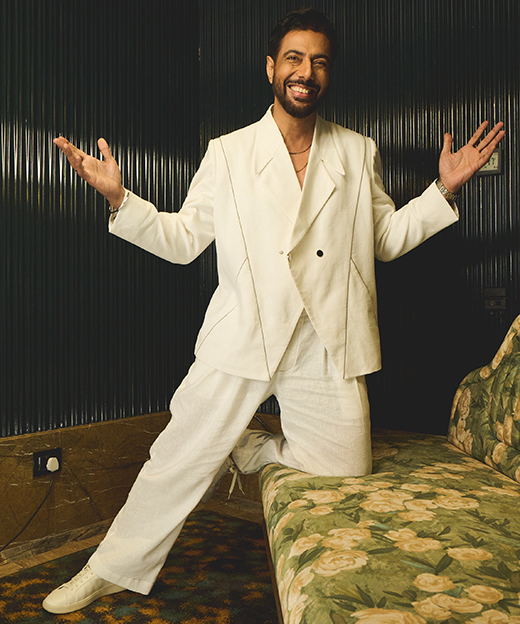


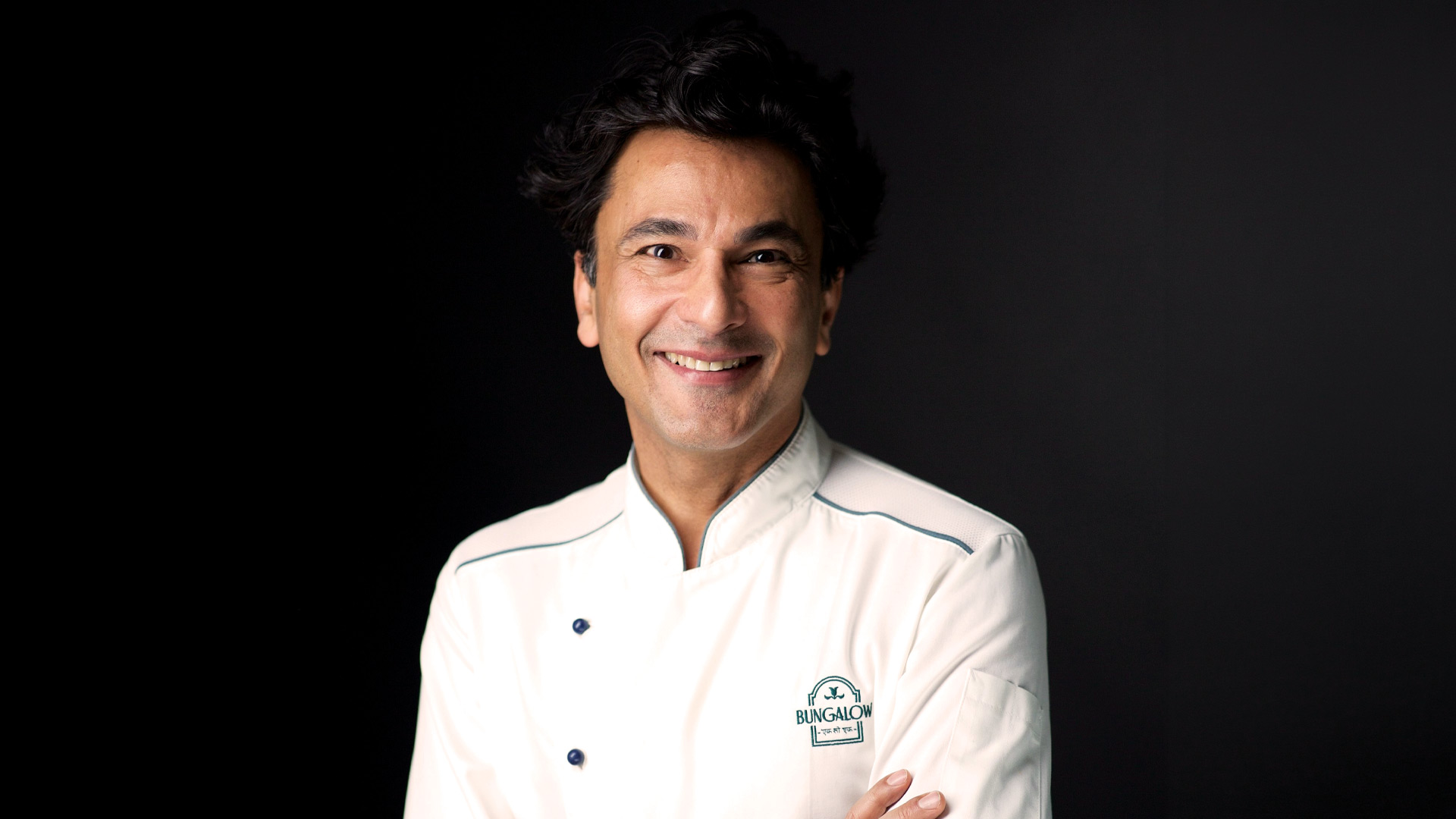









Unscripted, Unapologetically Ranveer Brar
For SOH’s year-end issue, we interviewed the multi-hyphenate chef on living a life without hyphens. In a wide-ranging conversation, Chef Brar talks Lucknow and langars, Dubai and dal, gamified television and the faith that seasons every dish.

By Deepali Nandwani
He may be one of India’s most recognisable chefs, but few profiles look past the screen persona to the craft at his core: storytelling. He often narrates the history or little nuances of a dish before he cooks it, an instinct that has made him a favourite online and shaped everything he does, from television and his YouTube kitchen to his Dubai restaurant Kashkan by Ranveer Brar, and his growing body of work as an actor. Chef Brar also brings immense knowledge of, and deep insight into, India’s culinary culture, from its best-known dishes to the cuisines closest to his heart.
We trace his journey from Lucknow’s langar kitchens and kebab lanes to five-star hotel kitchens, Boston, MasterChef India and film sets, and his YouTube celebrity with 9.07 million followers when we did this interview. We also ask where the kitchen sits in a multi-hyphenate career, what celebrity chef culture has done for Indian food, and why reviving forgotten recipes matters to him.
Indian Food, Unhyphenated
Let’s begin with the larger question: what is driving Indian dining today, and the constant spotlight on dining and chefs?
We’ve evolved to a point where the generation now making dining decisions is a secure one. Look at India generationally. The first generation after Independence was figuring things out. The next was busy consolidating. The one after that travelled extensively, enjoyed the world, and looked to the West for inspiration. Today’s generation is proud of its roots. It is no longer enamoured of the West; it doesn’t look up to it, and it won’t be looked down upon for the colour of its skin. That pride, that sense of belonging, now drives most purchasing decisions.
It’s not just dining. Look at clothing, accessories and lifestyle at large: brands that are unabashedly Indian, that celebrate Indian art and craft, are doing well, because the people spending the money today value that Indianness. Now cut to the dining scene. You have diners who are more aware, whose pride in and curiosity about everything Indian is a big driving factor. We are what we project, and today India is projecting India, not an aspiration to ape the West. That is what the dining scene reflects. And this is not a fad or a trend; it is a generational shift, and it is here to stay.
You spoke about how we no longer need Western approval for our food. Yet tasting menus are everywhere, we’re on Asia’s 50 Best, and the Michelin Guide is coming to India. Are we still cooking for a global palate, or are we now confident enough about who we are?
Absolutely. We don’t need Michelin; Michelin needs us. We don’t need the West to tell us how good we are. They need us, and if they need us, we’re happy to welcome them. But the days of looking for Western approval are gone, and that is something I fundamentally stand by. Chefs of my generation, and the generation before me, spent their lives fighting the colour of their skin, toiling to prove themselves in kitchens full of fair-skinned chefs, to prove they were better. We don’t need that ratification from Michelin anymore.
Dining was once among a family’s few entertainment options: you went to the movies, or you ate out when the budget allowed. Today, with a more secure generation and regional food coming into its own, has dining become mainstream culture, as big as cricket or cinema?
Dining might have been optional; eating never was. How often we eat out, and why, is something you can study for better business and better consumer understanding. But here’s my take: yes, people now look at food as a lens to a much bigger understanding of culture. Food is no longer just about the recipe or about being delicious. It is a window into a bigger story, whether that’s the story of its origin, the culture, the tribe, the people who made it, or just the grandmother whose recipe it is. We have fundamentally shifted to looking through food, making it a peephole rather than just a functional necessity.
And it’s not just today. Go back into history, and whenever there are long periods of peace, food travels up Maslow’s hierarchy, from physiological need to self-expression to self-actualisation. Long periods of peace, self-awareness and collective self-awareness are reflected in this quest to eat out more, because you’re looking to take away more from a meal out than just something tasty.
Over the last decade or so, regional cuisines have gone mainstream and modern expressions of Indian food have emerged. Has this changed the way urban India eats out? Is there a modern narrative for Indian food?
The modern narrative of Indian food is its unmodernisation. For the longest time, we kept attaching hyphens to Indian food: progressive-Indian, modern-Indian. The hyphen is no longer in vogue. Modern Indian food is real Indian food. That is where it can express itself fully, and where chefs can go out and say, it is what it is. I’ve not done anything to the recipe. Here is a big bowl of soup, because this is how you eat it. For me, that is freeing, both for the person who cooks and for the culture he represents.
You were appointed brand ambassador for Odia cuisine, and you’ve often called it one of your favourites. Yet it remains one of India’s least-known cuisines. Why should Indians know more about it, and what sets it apart for you?
There are two parts to this answer. One, people deserve to know more than the clichés they get in restaurants, the quintessential Punjabi clichés. Two, my personal fascination with Odia food, because it comes either from the temples or from humble homes. With age, all of us learn to remove the fluff. Towards the end, Picasso was painting lines, because the real beauty of art lies in less being more. Odia food encompasses that simplicity of less is more. At this age, having learned to remove the fluff myself, it speaks to me, and that’s why I represent it as its brand ambassador.
You were appointed brand ambassador for Odia cuisine, and you’ve often called it one of your favourites. Yet it remains one of India’s least-known cuisines. Why should Indians know more about it, and what sets it apart for you?
There are two parts to this answer. One, people deserve to know more than the clichés they get in restaurants, the quintessential Punjabi clichés. Two, my personal fascination with Odia food, because it comes either from the temples or from humble homes. With age, all of us learn to remove the fluff. Towards the end, Picasso was painting lines, because the real beauty of art lies in less being more. Odia food encompasses that simplicity of less is more. At this age, having learned to remove the fluff myself, it speaks to me, and that’s why I represent it as its brand ambassador.
Punjabi food and South Indian breakfast staples like idli resonate with Indians and global audiences far more than any other Indian food. What is it about them that appeals so widely?
Two things explain why Punjabi food and South Indian breakfast have travelled so well. One, the food is simple to recreate away from home. Then, the people, and the pride they take in showcasing their food. The Shettys, the community from Udupi, are single-handedly responsible for taking idli, dosa and vada to the world. They take that kind of pride, unabashedly putting their food forward and insisting to the world, ‘you have to try it’. We are the best spokespeople for our own food and culture. Punjabis and the people of Udupi are culturally outgoing enough to talk about theirs, and the first step to making your food famous is to talk about it.
Let’s talk about your restaurant, Kashkan, in Dubai. Why did you choose the emirate as a destination? Was it the opportunity, or is there something special about running a restaurant there?
For the longest time, I believed restaurants were high-investment, low-return businesses. You put in a lot of time and money, and the return is lower than for most other things we do. But then the Dubai opportunity came. As I travelled around the city, I realised there was this large Indian population just two-and-a-half hours from home, and yet so far. The angst there is very different. Kai baar kya hota hai na, ‘closest to church, farthest from God’ wali baat ho jaati hai. (Sometimes, you are closest to a church and yet far from the Divine). I felt that in Dubai. Every Indian knows how close they are to home, and yet how far, because they travel back only once a year. That’s what makes Dubai different. In the US, you know you’re really far from home. In Dubai, you know the distance isn’t much, and yet you can’t fly back home. So you miss your food very differently. The longing for home is far stronger when you’re closer. Every time someone comes to Kashkan, it’s like they’ve flown home, dined, and returned to Dubai.
Indian food cooked abroad, even by Indian chefs, rarely tastes like home. Why do most restaurants overseas lose that taste, and what have you done differently?
It's not that chefs can’t keep it authentic. You cater to different markets, so you start with what people know and lead them towards what you want them to eat. In Dubai, I’m cooking for Indians, so I can serve Indian food the way they eat it back home. In a market with no connection to Indian food, I can’t start with hard-hitting Indian food; I have to ease people in. They’re training the audience to a point where authenticity can come in. That’s one.
Two, whether we like it or not, our food changes with the water. Every place’s water imparts its taste to the food. Amritsar ka khaana Bombay mein same nahin rehta. Bombay ka paani alag hai, Amritsar ka alag hai, Dubai ka alag hai, America ka alag hai. Paani badalta hai, swaad badal jaata hai, and we have to accept that. (Amritsar’s food doesn’t stay the same in Bombay. Bombay’s water is different, Amritsar’s is different, Dubai’s is different, America’s is different. The water changes, the taste changes.) A dal is five parts water to one part dal, hai na? Ek litre dal mein sirf 200ml dal hai, 800ml paani hai. (In a litre of dal, only 200ml is dal; 800ml is water.) That water will change how the
dal tastes.
Food as Story
Your new YouTube show Yess Chef crossed 700,000 views on its first day and has gone far beyond. You’ve said you want food knowledge to have the swagger of cricket knowledge. With a show full of celebrities, what was the starting point?
Yess Chef was born out of a need to tokenise food knowledge. As Indians, we find great flex in knowing when Sachin (Tendulkar) scored his first century or when Shah Rukh’s first film released, but we know very little about the food on our table. And a message is not a message if it’s given as a sermon. It becomes a message when it touches people’s lives lightly, and that’s how we wanted to do it. We wanted to casually drop the idea that knowing what’s on your table is as important as Rohit (Sharma)’s 100-ball century and how many sixes he hit, because what’s on your table is what goes inside you. So we put our heads together to create a format that gave the message without giving the message.
I’m not saying the audience is naive, but I learn this from Ishaan (his son) all the time. He’s very intelligent, but the more you teach him, the more he refuses to learn. You can’t preach content anymore. You entertain people and find places for the message to come through, which, fortunately, it has. People are flexing their food knowledge on Instagram now; food 'did you know' on Meta has gone up in the last two weeks. I’m not here holding a baton that says I’m going to change the world. I’m just saying, hey, this is good to know too. I don’t take myself seriously, so I don’t want to make content that’s serious.
MasterChef India is known for its emotional stories and family moments, which is very different from MasterChef anywhere else in the world. Is that how Indians connect with food?
I think MasterChef is a show that put food media on centre stage. Just as Wimbledon has its centre court, MasterChef is the centre court of food media. This is where food media plays out, and everybody else comes to watch. And I say with great pride that I’ve been associated with this centre stage for a while now. It magically brings together the country and its passion for food, and it makes every homemaker dream that they’ll be recognised for their passion for food, for something that they’ve spent their entire life expressing. It makes their family believe that the achaar (pickle) business that they always wanted their mom to do, or that papad business, is possible. It gives a voice to the dreams of a country where every house believes that they cook the best food.
You’ve described recent seasons of MasterChef as more gamified. What do you mean by that?
People often ask me whether the best cook really won. My answer is that there’s gamification of the show that one must keep in mind: time-bound challenges, a challenge inside a challenge, sometimes a challenge inside a challenge inside a challenge. So you have to cook well, but you also have to play the game well. That’s where your presence of mind, your competitive streak and your game awareness become very, very important on MasterChef.
Is there a dish or contestant that has stayed with you?
Every season. Gaurav Khanna’s honeycomb dish was a very strong one. So was a pomegranate khandvi lasagna in Season 4, and the Odia thali Abinas Nayak made in the finale. Every season has had a dish that left you awestruck.
With 9.07 million YouTube subscribers, do you see yourself as much a creator as a chef? What does a chef bring to YouTube that gives them an edge?
Even at 50, I don’t know how to define who I am. Maybe I don’t want to: creator, chef, actor, poet, photographer, whatever comes. I don’t want to be defined. Now, what does a chef like me bring to YouTube? As chefs, we spend most of our lives understanding complicated food. I spent 30 years understanding how complex food is, and at the end of it I said, ‘Now, let me simplify it for people.’ All my expertise goes into simplifying rather than complicating. My competence is in understanding the complexities of food and then laying them out simply for everyone. I don’t complicate people’s lives anymore. I tell them, hey, anybody can cook. You can cook too. It’s actually very simple.
Can you really show complex dishes on YouTube?
You can, but they don’t really work. YouTube is very search-led; people find you when they’re searching for something. But do complex recipes work? They do. Nihari is a very complex recipe; its masala has 18 or 19 spices. I made it with all of them. I put in khus ki jad (vetiver root), paan ki jad (betel root), pipli (long pepper), even the most complicated samudra ki jhaag (powdered cuttlefish bone). People went looking for those at their nearest pansari (traditional spice and herb seller). That recipe has clocked over five million views as we speak. So it’s not that you cooked a complicated recipe; it’s that you simplified it enough for everybody to feel they could cook it too.
You’ve said food fiction is cinema’s next big thing. What do you mean by that? And I hear you’re playing a chef who makes biryani in a film…
Food content is going to move into food fiction, whether short films or short stories developed into films. We recently produced a film called Rampher ki Kulfi. I haven’t acted in it; I’ve presented and produced it. It’s about a kulfiwala in Lucknow. You see it everywhere: there are 10 shops, one does all the business, and the others wonder why. Rampher kulfiwale hain, aur baaki sab kulfiwalon ka dhandha nahin chalta, Rampher ki line lagi rehti hai. (Rampher is a kulfi seller. None of the other kulfi sellers gets any business, but there’s always a queue outside Rampher’s.) The film is about finding out what Rampher puts in his kulfi. That’s what I mean by food fiction. It isn’t about recipes. It’s about the small nuances of food that affect us emotionally, told as fiction. I strongly believe the time for food fiction has come in India.
As for playing a chef, I played one in Modern Love Mumbai, and I’ll be playing one in a UK production very soon. I don’t mind playing a chef if the role is challenging, and both were. I look forward to acting at least once a year, because it lets me step out of myself and be somebody else. Being Ranveer in my head all the time can drive me crazy.
Social media is full of scaremongering about Indian food: too many carbs, too little protein, carnivore diets are better. I’ve seen people abandon their traditional food because of it. As one of the biggest food voices on these platforms, how do you see this?
We live in an opinionated world. Everybody comes with an opinion. We also live in a world where knowledge is no longer currency. Knowledge is everywhere; pick up your phone, and you can find out anything about anything. Today’s currency is wisdom: the wisdom of those consuming both the content and the food to understand what works for them and what doesn’t. That’s what really matters. This overcrowding of information and opinion isn’t going to get any less; it’s only going to get worse. So it’s up to us to be more self-aware and understand what works for us. If we don’t double-check every piece of information, we’re taking what we eat very lightly.
And yet, can chefs counter the demonising of Indian food online?
You can’t. The algorithm feeds you more of what you already watch. So even if 20 chefs put out 20 videos, if your algo is set to feed you demonising videos, that’s what you’ll keep getting. Only when you become more self-aware and start questioning beliefs as a consumer will it change. That’s the practical reality. Everybody has a voice, and that’s the beauty of it. It’s a democratic world; why take away anybody’s chance to put their opinion forward? Our food is bigger, better and older than all of this. Indian food has survived worse attacks than these, and how? So I’m not worried about Indian food. We need to worry about ourselves and what we consume. The answer lies there.
Storytelling is central to your YouTube presence and your personality, yet chefs aren’t usually known for it, despite all the talk of “experience”. Where does that passion come from?
For me, it’s Lucknow. Lucknow is where much of my articulation and storytelling comes from. Storytelling there isn’t just an art form; it’s how you learn, how things are taught to you, how you gain perspective. And I have always been curious. Throughout my career, I’ve asked a lot of questions about origins, details, geographies, and over time the answers have interconnected. Woh Hindi mein kehte hain na, ek aur ek gyaarah ho jaata hai (As they say in Hindi, one and one make eleven). That’s where most of these stories come from.
I also strongly believe food is much more than a recipe. A recipe is the most basic, dal-roti expression of food. The romance of food, the space where it touches, moves and inspires, starts with stories, with telling people a little more. That is foundational to who I am. And I take great pride in the fact that we’ve started this culture of storytelling, which has now become so common. People are both asking and telling stories about food.
Where do you get these stories from? Books, people, older chefs?
It’s 32 years of everything. Of asking the right questions, reading the right books, having the right conversations, meeting the right people.
Talking about stories, your Dora Kebab is often mentioned but rarely explained. What is it, really?
Let me tell you the story of the Dora Kebab. Today it’s become popular. It was my signature back in 2003, when we launched it at a restaurant called Made in India. Personally, I don’t believe in signatures, because then they start defining you, and I don’t want things to define me. I want to be fluid. If this was my signature yesterday, today it’s something else, and I want people to accept that. So, I never really boast about signatures. But yes, the Dora Kebab has become a classic. It was cooked on a silken thread. The thread was smoked, the mince was wrapped on it and cooked, and when you opened the thread, the kebab fell onto your plate. That’s the whole story of the Dora Kebab.
What is the thin line between food history and food folklore? Do you sometimes find yourself crossing the line slightly for a better story?
All of it is folklore. The beauty of a story is that it’s a jacket you’re handed to wear. Wear it if you like it. If somebody tells me a recipe comes from a book from 800BC, do you think its translation holds in today’s context? Everything changes. A story is as true as you want it to be. Its purpose is not authenticity; it is to touch you, move you and inspire you to act. Nobody owns a story, and a story owns nobody and nothing.
You’ve championed millets and black soybeans. Is protecting ingredients and food traditions a chef’s responsibility, or is it passion for you?
I stay away from words like responsibility and changing the world. I do what feels right at the time. With water tables falling, millets are the inevitable future of eating. Anything that grows with less water is the future we’re living into, and we might as well accept that now and align with the environment. That’s fundamentally what millets are about. Do I care about eating consciously? Do I believe you become what you eat? Very strongly. Do I believe in ancient wisdom? I do. Do I preach it? No. I speak about it because I feel it. I’ve lived my life that way, and that’s where I want to keep it.
Books are a very different medium. How do you approach them?
For the longest time, we struggled with why we should publish books at all. But I’m a very DIY person. If I have to learn photography or lighting, I’ll do it myself. So I said, let’s set up a publishing house. Inkstain Publishing publishes not just my books but those of many young, upcoming chefs, and we’re editing a few autobiographies too. A lot of my books are experiments to understand what works in publishing. My latest, A Journey Through India, is one. We’ve sold 5,000 copies, and another 1,000 have gone to print. We’re not on Amazon; we’re nowhere. We sell only through our website and social media handles, because I want to learn how to distribute on our own. So I do books because some recipes need to be communicated, but also because I want to learn the business of publishing and distribution.
The Hotel Years
Let’s go back to your years in hotels. You studied hotel management, so hotels were the obvious next step?
Maybe there was no other choice. When we graduated in ’98, hotels were the only option. There were no freestanding restaurants; that culture didn’t exist. Basically, Taj, Oberoi and ITC came for campus interviews.
Does a hotel management course hold value for a young chef today?
Education brings structure to understanding. Are our curricula the most relevant in the world today? Maybe not. Were they when we passed out? No. We did all right because education wasn’t just about what was in the books; it was about fundamentals, and fundamentals never change. In cooking, as in any skill, whether cycling or swimming, you can’t build without the right fundamentals. Agar aapko achhe se swimming nahin karni aati, foundation sahi nahin hai, toh aap Olympics tak toh nahin pahunch paoge na? (If you can’t swim well, if your foundation isn’t right, you’ll never make it to the Olympics, will you?) If you want to ride the Tour de France, you have to build your fundamentals first. So I still believe in education, especially in a skill-based job like the kitchen. Woh kehte hain na, aap riyaaz karte karte riyaaz ho jaate hain. (As they say, you practise until you become the practice.) Only then can you express yourself freely.
Was Morisco at Taj Fort Aguada, Goa, the first restaurant you opened for a hotel?
Yes. Morisco was the first restaurant I opened on my own, and I’m so glad it’s still running. I was there recently for the hotel’s 50-year celebration, and we celebrated it at Morisco. I had also opened the renovated Machan and Rick’s at Taj Mansingh, and Cafe Fontana at Taj Palace, but those were as part of a team. Morisco was my baby.
In Goa, seafood isn’t just food; it’s life, and Goans are fiercely passionate about anything they consider their own. What went through the mind of a chef from Lucknow, by way of Delhi, while opening a seafood restaurant in this coastal state?
My first reaction when asked to open Morisco in Taj Fort Aguada: what the hell am I going to do? Here’s a Punjabi boy from Lucknow, trained in Delhi, who knows nothing beyond shrimp and bhekti. Back then, hotels served Calcutta and Bombay bhekti and shrimp, the occasional pomfret, the occasional trout. And now I am being told to open a seafood restaurant. Thankfully, I had chefs who believed in me. I asked for ten days’ chhutti (holiday). For those 10 days, all I did was go to fish markets. I stayed in Calangute, picked up a little Konkani and learnt all the fish names in the local language. I spent four days fishing on a trawler, and three days in the shack kitchen of Derek, brother of one of my commis, watching how he cooked. In those 10 days I built up a little confidence.
But you’ve got to have people who believe in you: who’ll say, okay, you’re opening this restaurant, and you’re opening it alone, and who’ll give you 10 days’ leave because that’s your prep. We were expected to do ₹20,000 to ₹30,000 a day in sales. We averaged ₹2.5 lakh a day, and the rest is history. Ab band mat karna, Taj walon, sun ke! (Taj folks, don’t go shutting it down after hearing this!)
What was your favourite local fish to work with?
Let me tell you a story. Ranveer has taken his 10 days’ leave, cooked in the shack kitchen, done his food trials. Now everybody says, okay, ‘Ranveer, show us the menu’. There’s a table of 10: the corporate chef, Chef Nita, Chef Bernhard Koenig, the executive chef, the general managers of two hotels. I put a red snapper on the grill, and it curls up like a dhanush, a bow. For the life of me, I can’t figure it out, because red snapper is like butter, and this one became worse than rubber. It was the first fish I’d ever put on that grill. I couldn’t even cut it with a knife. I thought, I’m gone. Fortunately, I had a pomfret in the tandoor, and that saved me. I never served that snapper. But since then, I swear by the snapper, the tamso, as it’s called in Konkani. Any rockfish, any day. Give me snapper, give me perch: rockfish is my favourite category.
You became an executive chef at 25, one of the youngest ever. What kind of pressure does that put on a young chef?
It was sheer luck. I turned 25 in February 2003, and was promoted in April. In 2003, that was unthinkable; even today it’s rare. Three things happened. One, I lost my sleep for about a year. For the first six months, I literally slept in the office, because I didn’t want to get anything wrong. A lot of people had put their faith in me, and I didn’t want to disappoint them. I’d use the executive lockers, shower and get back to work.
Two, it was a pre-opening hotel. We were launching three restaurants, including Red, and a pastry shop. You’re not just an executive chef; you’re an executive chef at a hotel that’s launching, which is a very critical stage. It gave me confidence for life, to the point of overconfidence. And three, I learnt to respect age. I got the job at 25, but for decisions I’d still go back to the 40- or 45-year-old commis and ask, "What used to happen here before? Have you dealt with this?" Nothing beats experience. Fortunately, I had a staff that walked with me.
Hotels are often called homogenising spaces. Do chefs lose their individuality in hotel kitchens, and what should hotels do to retain talent?
Let’s call a spade a spade. At the Taj general managers’ and owners’ conference in Goa, that’s exactly what I spoke about: why are freestanding restaurants taking over? Why are chefs leaving to open their own places? One, there is some homogenisation. Hotel ke chef ke upar ek kalai lag jaati hai. Har koi ek doosre jaisa dikhne lagta hai. (A hotel chef begins stagnating after a few years; they all start to look alike.) Two, hotel restaurant chefs don’t see a future. Above the restaurant chef there’s an executive sous chef, sometimes a chef de cuisine, then an executive chef. Before he makes any decision, he needs three approvals. A restaurant is a nimble space; it needs to dance to the chef’s tune. You can’t have disempowered chefs running restaurants. The restaurant chef can’t be the junior-most guy in the kitchen. It’s a very powerful position, and we need to empower it.
And the future of a chef is not to become a general manager. Hotels have built a standard ladder: chef, then director of operations, then general manager. Now a chef’s aspiration is to become a GM, and for me, that’s exactly why good talent leaves. If you want to serve food for life, literally and figuratively, you don’t want to become a GM. So the question is, you’re such a big organisation; what do you have to offer me as a chef? Big hotels need to answer that, or the threat of freestanding restaurants taking over is real, present and undeniable. Can hotels solve for it? Of course, with their resources, their acumen and their customer base. But they’ll need to rethink the hierarchy and decision-making of restaurant chefs, and the careers they promise them. They will have to.
If you were running F&B at a hotel today, what’s the one thing you would change?
First, I’d make the chef responsible for his P&L and give him the leeway to make decisions. I’d give him at least ₹20,000 a day to buy what he wants and express himself. I wouldn’t club his plate orders with the hotel’s and make him wait a year. Ki jab baaki hotel ki pletein order hongi, toh teri pletein bhi order ho jaayengi. Tab tak restaurant mar jaate hain. (He is made to wait until the rest of the hotel’s plates are ordered. By then, restaurants die.) Restaurants die in a year. They don’t work on hotel purchasing cycles. I’d empower restaurant chefs to stay nimble. More importantly, I’d separate the restaurant’s social media from the hotel’s and have agencies handle my restaurants as if they were freestanding. I’d present each restaurant as a concept, not one nested in a hotel. Both communication and operations need to be independent and projected that way. The hotel is an elephant. Restaurants are mountain goats; they need to climb and move fast. For them to coexist, the elephant needs to recognise the mountain goat.
Executive chefs once reported to F&B directors. Is that still the case?
Yes, it is, and that’s why the executive chef now wants to become the F&B director. The future we show him is a jacket and a GM’s title one day, and that’s where we lose good chefs. If I want to cook for the rest of my life, where do I go? Worse, we hire expat chefs purely to run our restaurants and pay them well, Italians or chefs from China, because they’re restaurant chefs and we respect them. But to our own boys we say, "You’re a sous chef now; next, you’ll be an executive sous chef." Where is the respect for the Indian restaurant chef? If we expect them to run restaurants the way they would in London after quitting their hotel jobs, we need to give them the same respect, the same salaries and the same growth.
Is there any hotel restaurant in India today that earns that kind of respect?
A bunch of them. Hotels can awe you with their presence, much like Avartana in Chennai awes you with its presence and then delivers that awe with the food. Bukhara will always be my example of how hotels can build restaurant brands. Whichever hotel chain you work for, go back and study what Major Rehman did. There’s a lot all of us hoteliers can learn about building restaurants as brands.
Failure and Freedom
What was the first thing you did that felt like freedom?
I do everything freely. But the first thing that felt truly freeing was quitting a very well-paid job as cluster chef for the Claridges Group, where I handled multiple hotels. I said, I’m going to open a restaurant in the US. It bombed. And that freed me. Iss se zyaada kya hi ho jaayega? (Things wouldn’t get worse than this.)
Everything about those years has been written, so I won’t go into details. But after Boston, when you came back to India, what did that time teach you about success and failure?
It taught me to be indifferent to both. It taught me not to give a flying f**k about either. We take our successes and our failures too seriously, and then we let them define us. One good day can’t define us. One bad day can’t define us. Even if that good day is winning the Nobel Prize, it still can’t define us.
With the spotlight on food and the money riding on it, do today’s chefs fear failure more than ever?
Natural hai na, yaar. Kisi bhi cheez pe aap paisa lagaoge toh darr toh ban jaayega na. Aap ghode pe bhi paisa lagaoge toh jockey bhi darega na, bhai. (It’s natural, yaar. Put money on anything, and you are always fearful you will lose it all. Put money on a horse and even the jockey gets nervous.) So, it’s not just chefs. When there’s money riding on something, it can hold you back and change how you approach things. That’s only natural. But this fight between love and fear, between freedom of expression and fear, is a choice people have to make. Most chefs facing it today will free themselves of it tomorrow.
Why did you agree to be on the cover of SOH?
When I was asked to do this interview, I asked myself: what purpose will I serve on the cover of SOH? What difference can I make to the lives of the people who read this magazine? The answer I gave myself, and the message I want to leave here, is for every chef: fly free. Don’t be limited by what people tell you to be. Your hotel may tell you this is your world, that you’ll never cross this line, that the paycheck you get on the first of the month will define you for the rest of your life. It’s not true. If there’s anyone who can do it all, it’s a chef.
Chefs rarely talk about what a restaurant’s failure does to them. You’ve spoken openly about it, and still do. Was that a conscious decision?
I speak about my Boston restaurant shutting down for two reasons. One, to remind myself that I’m no God, and that I have to be grateful for everything I have today, every breath I take. It keeps me grounded. Two, to tell everybody who hears me that it’s okay. At some point you’ll ask yourself, what’s the worst that can happen? And it’s all right.
Today, whether I act or write or do any of the 10 things I do, I can do it because I’ve been a chef, because I’ve learnt to do 20 things at once. No other department in a hotel handles 20 things at once. So to every chef who reads this: be the freest you can be. If the world is waiting for anyone, it’s you. Don’t be limited by that paycheck at the end of the month.
Lucknow, Langar & Ustadji
Did a young Ranveer growing up in Lucknow know that he wanted to cook?
No, young Ranveer growing up in Lucknow didn’t know what he wanted to do. He was just sure that he didn’t want to do what others were telling him to do. This wasn’t my calling. I wanted to be a carpenter, a doctor, everything that a child wants to be. And then, when the city gave you options of being a doctor or an engineer or the usual stuff, you chose not to be any of that. I decided to become a chef to annoy everyone around me, and because it was an unusual choice.
So you were a Punjabi boy from a Sikh family growing up in a Bengali neighbourhood in a Nawabi city. That’s a lot of influences. What did each of these cultures teach you about food?
So I think—ye kai baar ye jo hota hai na (this happens a lot of the time)—we don’t realise that there is always a method to the madness. What we think is chaos is usually harmony. I felt a lot of confusion when I was growing up. On one side, there was a very strong Punjabi cultural identity and the yearning of my parents to hold on to it. And when I stepped out of home, there were these 55 Bengali families who were influencing my decisions. And when I stepped further away from this, there was Lucknow, the city of Nawabs. So the first emotion that you encounter is confusion. But then, Hindi mein ek shabd hai…sahajta. Jab aap sahaj ho jaate hain… (There’s a word in Hindi, sahajta, a state of natural ease. When you become sahaj, at ease with things), when you let it be, then all of it starts finding a place inside of you.
So the Punjabi has found a place within me. On one end there is this refined Lakhnaviyat, and on the other, there is the loud Punjabi. And the Bong finds a place in me, too—I feel it in my love for music, the love for literature, the absolute love for fish, which showed up in Morisco. So I feel very harmonious inside. My learning is to let the confusion be. There is a place for many of us within one of us. Most of it is about letting it be.
You also cooked at a gurdwara. What did the langar teach you about food that a restaurant never could?
In retrospect, these all make for great conversations. When I cooked in the langar, it was basically to escape sitting still, because for a six- or seven-year-old to haath jod ke baithna (sit with folded hands) next to his dadaji (grandfather) in a gurdwara for three hours was impossible. So you went where the action was, and the action was in the langar, with people running around, kisi ko kuch chahiye (someone needs something). I went to the langar to escape sitting in one place, and I still escape sitting in one place.
But what I do observe now is that there’s a strong, powerful emotion in cooking called faith, the real salt, the real seasoning of food. Bhakti jo hai, woh khaane ka asli swabhaav hai (Devotion is the true nature of food). Even now, when I enter the kitchen, I try to transport myself to a place of calm, and a large part of that calm is faith. It lets you cook without fear, without trying to control everything.
Much has been said about your time with Ustad ji. Looking back at what you picked up—the patience, the skill—is that learning disappearing in the age of social media and quick meals?
Some fundamentals will always stay. Cooking is a skill, and whether it’s swimming, cycling or cooking, you can read a thousand books and watch millions of videos. But the real test is jab aag jalti hai aur pan aap gas pe rakhte ho, toh khaana toh asli wahi banta hai na? (When the fire is lit and you put the pan on the gas, that’s when real food gets made). In this age of being exposed to so much cooking, I’d say exposure means zilch. Cooking, and cooking a lot, is the only way to learn. That, I think, is a universal law. Pothi padh padh jag mua, pandit bhaya na koye, (no one becomes a wise man by reading books), as Kabir said. Bhagwan ko aap hazaar kitaab parh ke nahin pa sakte, aapko ibaadat se hi paana padega (you can’t find God by reading a thousand books; you find Him only through prayer).
My last question would be: If I were to ask you, what is the greatest vegetarian dish of all time?
Wow. The greatest vegetarian dish? It has to be khichdi. If one dish unites the country, it’s khichdi of some sort.